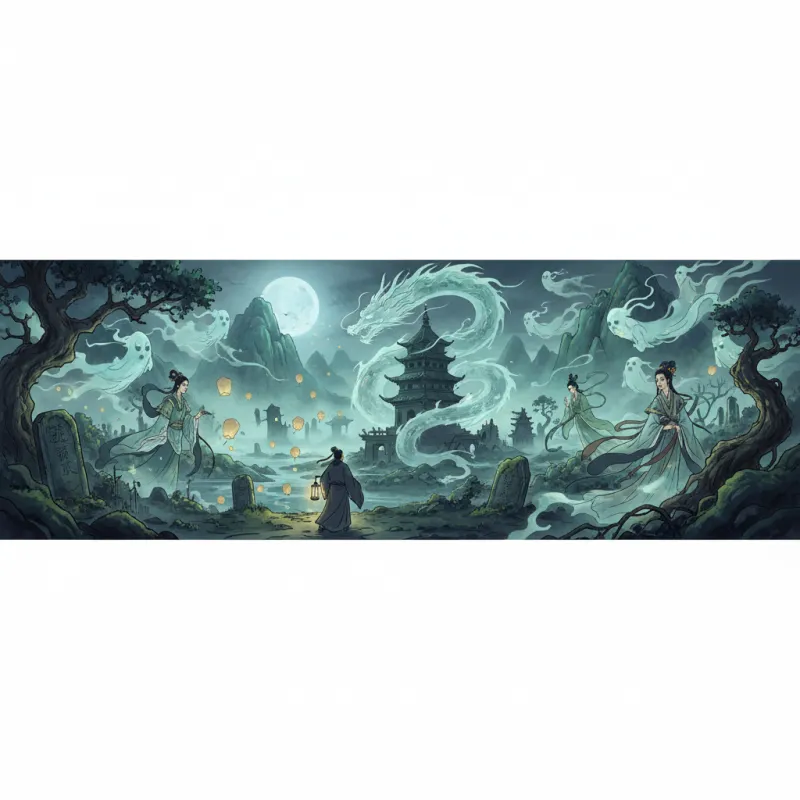
The paper money crackles in the bronze basin, its smoke curling toward ancestors who may or may not be watching. This scene plays out in countless Chinese households during Ghost Month, when the boundary between worlds grows thin and the hungry dead press close to the living. But unlike Western ghosts—those transparent sheet-wearers who rattle chains and say "boo"—Chinese supernatural beings operate under an entirely different cosmology, one where bureaucracy extends beyond death and a ghost's power depends less on how they died than on whether anyone remembers to feed them.
The Bureaucracy of the Dead
Chinese supernatural folklore doesn't traffic in simple hauntings. Instead, it presents the afterlife as a mirror of imperial administration, complete with judges, clerks, and an extensive filing system. The Ten Courts of Hell, popularized during the Tang Dynasty (618-907 CE), process souls with the efficiency of a celestial DMV. King Yanluo (阎罗王, Yánluó Wáng)—borrowed from the Buddhist Yama but thoroughly sinicized—presides over this underworld bureaucracy, where every deed gets tallied and every soul receives its appropriate punishment or reward.
This administrative approach to death reflects Confucian values of order and hierarchy extending into eternity. A ghost isn't simply a scary entity; it's a soul that has fallen through the cracks of this system. The most dangerous spirits are those who died without proper burial rites, whose names aren't recorded in family genealogies, or who have no descendants to perform the necessary rituals. They become hungry ghosts (饿鬼, èguǐ), eternally starving because no one feeds them offerings during festivals.
Categories of Chinese Ghosts
Chinese folklore distinguishes between numerous types of supernatural entities, each with specific characteristics and dangers. The gui (鬼, guǐ) represents the standard ghost—a deceased person's spirit that hasn't moved on. But within this category exist countless variations. The yuanhun (冤魂, yuānhún) are wronged souls seeking justice, often victims of murder or judicial corruption. These spirits won't rest until their grievances are addressed, making them particularly persistent haunters.
Then there are the jiangshi (僵尸, jiāngshī), often mistranslated as "Chinese vampires" but more accurately described as hopping corpses. These reanimated bodies, stiffened by rigor mortis, bounce toward victims with arms outstretched, draining life force rather than blood. The Qing Dynasty saw an explosion of jiangshi tales, possibly reflecting anxieties about death far from home—a corpse had to be transported back to ancestral lands for proper burial, and the jiangshi represented the nightmare of that journey going wrong.
Water ghosts (水鬼, shuǐguǐ) haunt rivers and lakes, drowning victims to take their place in the reincarnation queue. Fox spirits (狐狸精, húlijīng), while not technically ghosts, occupy similar narrative space—shapeshifters who seduce scholars and drain their yang energy. The distinction between ghost, demon, and spirit often blurs in Chinese folklore, creating a rich taxonomy of supernatural beings that would make any paranormal taxonomist weep with joy.
The Power of Unfinished Business
What makes Chinese ghosts particularly compelling is their motivation. They're not haunting for sport—they have agendas. The classic tale of Nie Xiaoqian from Pu Songling's "Strange Tales from a Chinese Studio" (聊斋志异, Liáozhāi Zhìyì, 1740) illustrates this perfectly. Xiaoqian, a beautiful ghost, lures men to their deaths not from malice but because a demon controls her. She's trapped between worlds, unable to reincarnate, forced to serve an evil master. When the scholar Ning Caichen shows her genuine compassion, she risks everything to save him.
This pattern repeats throughout Chinese ghost literature: spirits are bound by obligations, debts, or injustices. The ghost of Dou E in Guan Hanqing's Yuan Dynasty play "The Injustice to Dou E" (窦娥冤, Dòu É Yuān) causes snow in summer and drought for three years—not random haunting, but a cosmic protest against judicial corruption. Her supernatural power derives directly from the magnitude of injustice done to her.
Even malevolent spirits often have comprehensible motivations. The female ghosts who died in childbirth or from romantic betrayal aren't evil—they're angry, and Chinese folklore validates that anger. The supernatural becomes a vehicle for social commentary, a way to discuss injustices that couldn't be addressed through official channels.
Ancestor Worship and Ghost Prevention
The flip side of ghost fear is ancestor veneration, and understanding one requires understanding the other. Proper ancestor worship isn't just about respect—it's ghost prevention. A well-fed, properly honored ancestor becomes a protective force for the family. Neglected ancestors become problems.
The Qingming Festival (清明节, Qīngmíng Jié) and Ghost Month (鬼月, Guǐ Yuè, the seventh lunar month) structure the relationship between living and dead. During Qingming, families sweep graves, burn incense, and offer food—maintaining the contract with their ancestors. Ghost Month flips the script: now all ghosts roam free, and the living must be cautious. Don't swim (water ghosts are active), don't stay out late, don't whistle at night (it attracts spirits), and definitely don't get married (inauspicious to have hungry ghosts as wedding guests).
This ritualized approach to the supernatural reveals something profound about Chinese cosmology: the dead aren't gone, they're relocated. They maintain relationships with the living, require maintenance, and can intervene in worldly affairs. The boundary between life and death is permeable, negotiable, and above all, manageable through proper ritual observance.
Literary Ghosts and Social Commentary
Chinese ghost stories reached their apex during the Qing Dynasty with Pu Songling's "Strange Tales from a Chinese Studio," a collection of 491 stories that used supernatural encounters to critique society. Pu, a failed examination candidate, channeled his frustrations into tales where fox spirits were more honorable than corrupt officials and ghosts showed more integrity than living scholars.
These weren't just entertainment—they were social commentary wrapped in supernatural packaging. When censorship prevented direct criticism of the government, ghost stories provided cover. A tale about a wronged ghost seeking justice could comment on judicial corruption without naming names. A story about a scholar seduced by a fox spirit could critique the examination system that drove men to obsession and madness.
The tradition continues in modern Chinese horror cinema and literature, where supernatural entities often represent social anxieties. Ghosts of the Cultural Revolution haunt contemporary fiction, and urban legends about ghost buildings reflect anxieties about rapid development and displacement.
Regional Variations and Local Spirits
While certain ghost beliefs span Chinese culture, regional variations add fascinating complexity. Southern China, with its proximity to water, features more water ghost stories. Northern regions, influenced by Manchu traditions, developed the jiangshi mythology. Yunnan and Guizhou, home to numerous ethnic minorities, blend Han Chinese ghost beliefs with local shamanic traditions.
Local spirits tied to specific places—the city god (城隍, chénghuáng), earth god (土地公, tǔdì gōng), and various mountain and river spirits—create a supernatural geography. Every location has its own spiritual bureaucracy, its own dangerous spots, its own protective deities. This localization of the supernatural means that ghost lore varies dramatically even between neighboring villages.
The Miao people's practice of exorcism rituals differs significantly from Han Chinese Daoist methods, yet both coexist in the broader framework of Chinese supernatural belief. This syncretism—the blending of Buddhist, Daoist, Confucian, and folk beliefs—creates a supernatural ecosystem far more complex than any single tradition could produce.
Modern Ghosts in a Technological Age
Chinese ghost beliefs haven't disappeared in the modern era—they've adapted. Urban legends about haunted subway stations, ghost calls from disconnected phone numbers, and spirits appearing in elevator security footage show how traditional beliefs evolve with technology. The fundamental logic remains: improper death creates ghosts, and ghosts seek resolution.
Contemporary Chinese horror films like "The Eye" and "Rigor Mortis" update traditional ghost stories for modern audiences while maintaining core folkloric elements. The hungry ghost still hungers, the wronged spirit still seeks justice, and the boundary between worlds still thins during Ghost Month. What changes is the setting, not the underlying cosmology.
Even among educated, urban Chinese populations, many maintain some level of supernatural caution. They might not believe in ghosts intellectually, but they still avoid whistling at night, still feel uneasy during Ghost Month, still participate in ancestor worship. These practices persist not necessarily from belief but from cultural habit—and from the nagging thought that maybe, just maybe, the old stories contain some truth.
The enduring power of Chinese ghost folklore lies in its flexibility and depth. These aren't simple scary stories—they're a complete cosmology that addresses death, justice, family obligation, and the relationship between past and present. The ghosts aren't just haunting; they're reminding the living of their responsibilities, their history, and the thin membrane separating this world from the next.
Related Reading
- The Drowning Ghost (水鬼): China's Most Feared Water Spirit
- Chinese Ghosts: A Field Guide to the Dead Who Will Not Leave
- Female Ghosts in Chinese Literature: Beauty and Tragedy
- Exploring Chinese Supernatural Folklore: Ghosts, Spirits, and Afterlife Beliefs
- Ghost Marriage: When the Dead Need a Spouse
- Ox-Head and Horse-Face: The Messengers of Hell
- Fox Spirits: China's Most Famous Shapeshifters
- Unveiling Chinese Supernatural Folklore: Ghosts, Spirits, and Afterlife Beliefs
Explore Chinese Culture
- Explore ancient mythical creatures
- Explore Daoist exorcism traditions
- Explore Chinese folk beliefs and superstitions