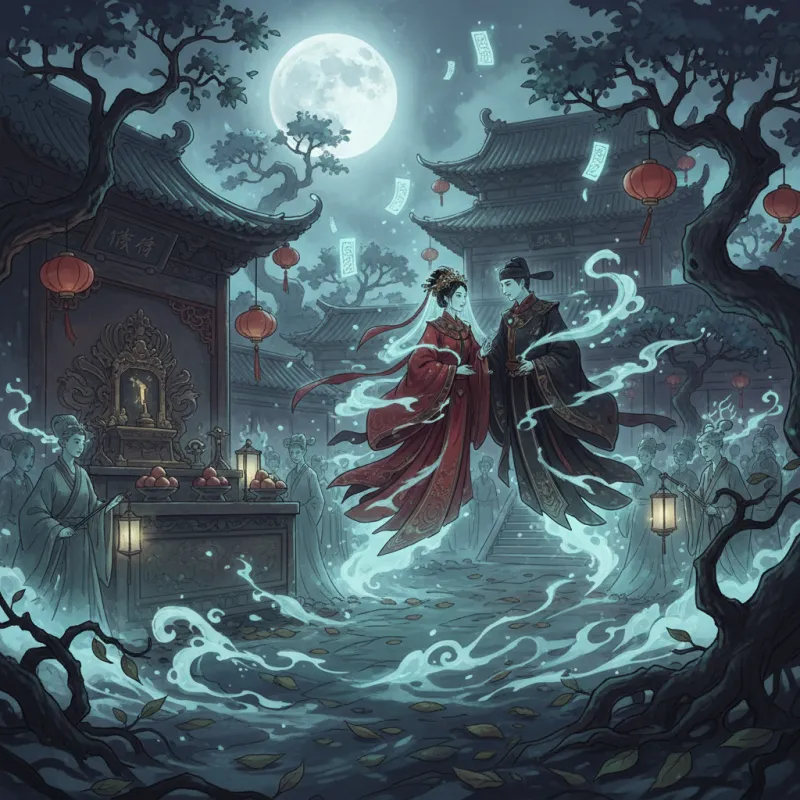
The bride wore red, but she couldn't walk. Her family carried her to the ceremony in a sedan chair draped with funeral white, while firecrackers exploded to ward off evil spirits who might interfere with a wedding where one party had been dead for three years. This wasn't a scene from a horror film — it was a ghost marriage (冥婚, mínghūn), and in some parts of China, it still happens today.
When Death Doesn't End Marriage Obligations
Chinese cosmology doesn't grant you freedom just because you die. The afterlife mirrors the living world in its social structures, hierarchies, and yes, its expectations about marriage. An unmarried person who dies becomes a 孤魂野鬼 (gūhún yěguǐ) — a lonely wandering ghost with no descendants to worship them, no spouse to accompany them, and a dangerous tendency to cause trouble for the living.
Ghost marriage solves this problem by giving the dead what they were denied in life. The practice operates on a simple premise: if marriage brings social completion and spiritual peace to the living, it must do the same for the dead. Families arrange these posthumous unions for multiple reasons — to fulfill a betrothal promise made before death, to appease a restless spirit causing illness or misfortune, or simply because leaving a child unmarried feels like abandoning them to eternal loneliness.
The Shang Dynasty (1600-1046 BCE) left us archaeological proof that this isn't some modern superstition. Excavations at Yinxu revealed paired burials where bodies were interred together despite dying years apart — the later burial carefully positioned to join the earlier one. The Zhou Li (周礼), that exhaustive catalog of Zhou Dynasty ritual, describes ceremonies for marrying the deceased, complete with protocols for matching families and conducting the rites.
The Matchmakers Who Work with Corpses
Finding a suitable match for a dead person requires specialized skills. Ghost matchmakers (阴媒, yīnméi) operate in the shadows of the funeral industry, connecting families who need to marry off deceased children. Their work mirrors traditional matchmaking but with macabre complications — they must negotiate not just compatibility and family status, but also the logistics of obtaining remains, timing ceremonies, and navigating legal gray areas.
The ideal ghost marriage pairs two deceased individuals, creating a union entirely in the spirit world. Families exchange the usual betrothal gifts, though funeral white replaces wedding red in the decorations. They combine the burial goods, merge the ancestral tablets, and sometimes even exhume and rebury the bodies together. The ceremony itself compresses a traditional wedding into its essential elements — bows to heaven and earth, the exchange of symbolic items, and the formal recognition by both families.
But what happens when only one party is dead? These asymmetrical ghost marriages create the most unsettling scenarios. A living woman might marry a deceased man, moving into his family home to care for his parents and maintain his ancestral worship. She's expected to remain faithful to a husband she never met, producing no children (or adopting a nephew to continue the line), and eventually being buried beside him. Some families arrange these marriages for financial reasons — the bride's family receives substantial payment, while the groom's family secures someone to perform the necessary rituals.
The reverse situation — a living man marrying a deceased woman — occurs less frequently but follows similar logic. He gains a wife in name, her family gains peace of mind, and everyone pretends this arrangement makes sense.
The Dark Side: Corpse Theft and Murder
Ghost marriage's darker manifestations reveal how far families will go to satisfy the dead. When demand for deceased brides exceeds supply, some turn to grave robbery. Corpse theft for ghost marriages became enough of a problem that Chinese law specifically addresses it — stealing remains for this purpose carries serious criminal penalties.
The most horrifying cases involve murder. In 2016, police in Shaanxi Province uncovered a ring that killed women to sell their bodies for ghost marriages, fetching up to 50,000 yuan per corpse. The victims were mentally disabled women, chosen because their disappearances would draw less attention. This wasn't an isolated incident — similar cases have emerged from Shanxi, Henan, and other provinces where ghost marriage traditions remain strong.
These crimes expose the practice's fundamental problem: it treats women's bodies as commodities, even in death. The ghost bride has no agency, no choice, and no escape. She's purchased, positioned, and buried according to someone else's needs. The practice that claims to bring peace to restless spirits creates new victims in the process.
Regional Variations and Modern Adaptations
Ghost marriage never spread uniformly across China. It concentrated in northern provinces — Shanxi, Shaanxi, Hebei — where ancestor worship traditions run deepest and family obligations extend most forcefully beyond death. Southern regions practiced it less frequently, and some ethnic minorities never adopted it at all.
Modern practitioners have developed workarounds for the legal and ethical problems. Some families use photographs or dolls instead of actual remains, conducting the ceremony with symbolic representations. Others create elaborate paper effigies of the bride or groom, burning them to send the spouse to the afterlife rather than physically combining burials. These adaptations preserve the ritual's spiritual purpose while avoiding corpse theft and the commodification of bodies.
Taiwan maintains a particularly visible ghost marriage tradition. Families place red envelopes containing money and the deceased's information along roadsides, hoping someone will pick them up and agree to the marriage. The person who takes the envelope becomes symbolically engaged to the dead person — though modern Taiwanese mostly know to leave these 冥婚紅包 (mínghūn hóngbāo) alone unless they're actually interested in the arrangement.
The Psychology of Marrying the Dead
What drives families to arrange these marriages? Guilt plays a significant role — parents who couldn't fulfill their duty to see their child married feel they've failed at a fundamental obligation. In a culture where filial piety flows both directions, leaving a child unmarried feels like abandonment. The ghost marriage lets them complete what death interrupted.
Fear motivates others. An unmarried ghost might appear in dreams, cause illness, or bring misfortune to the family. These spirits are thought to be jealous of the living, resentful of their incomplete status, and capable of causing real harm. Marrying them off transforms them from dangerous 孤魂野鬼 into settled ancestors who can be properly worshipped. The practice shares psychological territory with other Chinese ghost traditions — the same logic that drives families to burn paper money and paper houses for the dead, or to conduct elaborate hungry ghost festival rituals to appease wandering spirits.
Some families simply can't accept that death ended their child's story. The ghost marriage writes a new chapter, giving narrative closure to a life cut short. It's less about the dead person's actual needs and more about the living family's need to feel they've done everything possible.
Legal Status and Social Controversy
The People's Republic of China doesn't recognize ghost marriages as legal unions, but it doesn't explicitly ban the practice either — unless it involves corpse theft, fraud, or other crimes. This legal ambiguity lets the tradition persist in rural areas while remaining invisible in cities. Police intervene when bodies are stolen or when families report coercion, but consensual ghost marriages between willing families largely escape official attention.
Social attitudes split along generational and urban-rural lines. Older rural residents see ghost marriage as a natural extension of filial duty, no stranger than burning paper money or maintaining ancestral graves. Urban educated Chinese often view it as feudal superstition, an embarrassing remnant of backward thinking that should have died with the imperial era. The practice survives in the gap between these worldviews, practiced quietly by families who care more about ancestral peace than modern opinions.
The feminist critique is harder to dismiss. Ghost marriage overwhelmingly affects women — as commodified brides, as living women trapped in marriages to dead men, as murder victims killed to supply the corpse market. The practice reveals how deeply Chinese patriarchal traditions can reach, extending male family authority even beyond death. A woman who escapes arranged marriage in life might still be married off after death, her body and spirit claimed by a family she never knew.
The Future of an Ancient Practice
Ghost marriage is dying, but slowly. Each generation practices it less than the last, and urbanization pulls families away from the rural communities where these traditions maintain their grip. Young Chinese increasingly reject the cosmology that makes ghost marriage logical — they don't believe in restless spirits, don't feel bound by ancestral obligations, and don't accept that the dead need spouses.
But the practice won't disappear entirely. As long as some Chinese believe in an afterlife that mirrors this world's social structures, as long as filial piety demands that parents care for children even after death, ghost marriage will find practitioners. It may become rarer, more hidden, more symbolic — but the impulse behind it runs deep in Chinese culture's understanding of death, family, and obligation.
The tradition connects to broader questions about how cultures handle death and memory. Ghost marriage is an extreme example, but it's not fundamentally different from other ways the living maintain relationships with the dead — talking to graves, setting places at dinner tables, keeping rooms unchanged for decades. We all struggle with the finality of death, and we all create rituals to soften that boundary. Ghost marriage just makes the relationship more explicit, more formal, and considerably more unsettling to outsiders.
For families who practice it, ghost marriage isn't horror or superstition — it's love. Misguided love, perhaps, love that creates victims and perpetuates harmful traditions, but love nonetheless. They're trying to care for their dead children the only way their culture taught them. That the practice horrifies modern sensibilities doesn't make their grief less real or their intentions less sincere. It just makes ghost marriage one more example of how cultural logic can lead to practices that seem incomprehensible from outside, yet feel necessary from within.
Related Reading
- Chinese Ghost Stories for Beginners: Where to Start
- Female Ghosts in Chinese Literature: Beauty and Tragedy
- Lake Monsters and Sea Creatures in Chinese Folklore
- Exploring Chinese Supernatural Folklore: The Haunting World of Ghosts and Spirits
- Chinese Ghosts: A Field Guide to the Dead Who Will Not Leave
- Chinese Internet Ghost Stories: The Creepypasta of the East — Cnspirit Perspective
- The Enigmatic Spirit-Animals of Chinese Supernatural Folklore and Afterlife Beliefs
- Zhong Kui: The Demon Queller Who Failed His Exams
Explore Chinese Culture
- Explore ancient mythical creatures
- Explore Daoist exorcism traditions
- Explore Chinese folk beliefs and superstitions