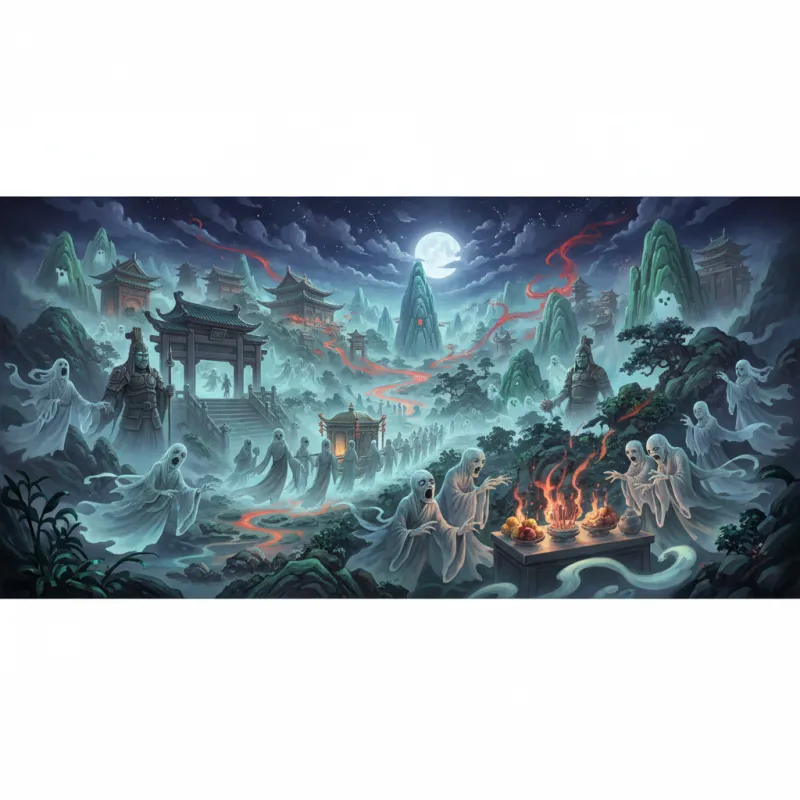
Your grandmother burns paper money at the altar every full moon. Your mother won't whistle at night. Your uncle refuses to stick chopsticks upright in rice. Ask them why, and they'll give you the same answer: "It disturbs the ghosts." In Chinese culture, the dead aren't gone — they're neighbors, and you'd better learn the etiquette.
The Architecture of the Afterlife
Chinese ghost beliefs don't operate on a simple heaven-and-hell binary. The spirit world (阴间, yīnjiān) is a bureaucracy as complex as any earthly government, complete with judges, clerks, and endless paperwork. When someone dies, their soul doesn't float to some abstract paradise — it reports to the underworld courts for judgment.
The Ten Courts of Hell, popularized during the Tang Dynasty and elaborated in texts like the Jade Record (玉历宝钞, Yùlì Bǎochāo), process souls like a cosmic DMV. Each court handles specific sins: the First Court judges overall virtue, the Fifth Court deals with misers and loan sharks, the Tenth Court determines your next reincarnation. King Yanluo (阎罗王, Yánluó Wáng) — borrowed from the Sanskrit Yama — presides over this system with the efficiency of a seasoned magistrate.
But here's what makes Chinese ghost beliefs distinct: this isn't permanent. The afterlife is a waiting room. Most souls cycle through judgment, punishment if necessary, and eventual rebirth. The goal isn't eternal rest — it's transformation and return.
The Hierarchy of Hungry Ghosts
Not all ghosts are created equal. The term "hungry ghost" (饿鬼, èguǐ) gets thrown around loosely, but traditional classifications are far more specific. The Petavatthu, a Buddhist text that heavily influenced Chinese ghost taxonomy, describes beings with throats as thin as needles and bellies as large as mountains — perpetually starving, unable to satisfy their cravings.
In Chinese folk religion, hungry ghosts fall into several categories. There are the yuānhún (冤魂) — wronged spirits who died unjustly and seek vengeance. These are the ghosts that haunt Chinese ghost stories with the most dramatic flair: the murdered concubine, the falsely accused official, the abandoned lover. Their hunger isn't for food but for justice, and they won't rest until they get it.
Then there are the gūhún yěguǐ (孤魂野鬼) — literally "solitary souls and wild ghosts." These spirits have no descendants to worship them, no one to burn offerings, no place in the ancestral hierarchy. They're the homeless of the spirit world, wandering and desperate. During the Ghost Month (鬼月, guǐyuè), the seventh lunar month when the gates of hell open, these are the spirits that flood into the mortal realm looking for any scrap of attention or sustenance they can find.
The most dangerous category? The lìguǐ (厉鬼) — fierce ghosts who died violent, premature deaths. Drowning victims, murder victims, women who died in childbirth, soldiers killed in battle — anyone whose life was cut short before their natural time. These ghosts retain the trauma and rage of their deaths, and they're not interested in your offerings. They want company in death, which is why traditional wisdom warns against swimming in places where people have drowned or walking alone near execution grounds.
Ancestral Worship: The Social Contract
Here's the deal Chinese families have struck with death: you take care of us in life, we'll take care of you in death. Ancestral worship (祭祖, jìzǔ) isn't optional sentimentality — it's a binding contract that keeps the cosmic order functioning.
During Qingming Festival (清明节, Qīngmíng Jié) and the Double Ninth Festival (重阳节, Chóngyáng Jié), families visit graves, sweep tombs, and burn offerings. But the real work happens at home altars, where ancestral tablets (神主牌, shénzhǔpái) serve as permanent addresses for deceased family members. These aren't symbolic gestures — they're maintenance payments on a spiritual insurance policy.
Well-fed ancestors become shén (神) — deified spirits with real power to influence the living world. They can steer business deals in your favor, help you pass exams, even influence marriage prospects. Neglected ancestors, on the other hand, become problems. They might send illness, bad luck, or financial troubles as a not-so-subtle reminder that you've forgotten your obligations.
The offerings matter. Incense creates a pathway between worlds. Spirit money (纸钱, zhǐqián) provides currency in the afterlife — and modern versions include paper credit cards, iPhones, and luxury cars, because apparently inflation affects the spirit world too. Food offerings should be the deceased's favorites, served with the same care you'd show a living guest. My grandmother always set out an extra bowl at dinner for my grandfather, and she'd get genuinely annoyed if someone sat in "his" chair.
Ghost Month: When the Veil Thins
The seventh lunar month isn't just spooky season — it's a massive supernatural event that reshapes daily life for millions of people. On the first day, the gates of the underworld swing open, and spirits flood into the mortal realm for their annual vacation. For thirty days, the living and dead share space, and everyone adjusts their behavior accordingly.
The rules during Ghost Month are specific and non-negotiable. Don't swim — water ghosts (水鬼, shuǐguǐ) are actively recruiting. Don't whistle or call out names at night — you might attract unwanted attention or, worse, something might answer. Don't get married — starting a new life while death is ascendant is asking for trouble. Don't move house, don't start a business, don't make major decisions.
On the fifteenth day, the Ghost Festival (中元节, Zhōngyuán Jié) reaches its peak. Families set out elaborate feasts on the street for wandering spirits. Temples hold massive ceremonies with chanting monks and burning incense. In some regions, people float lanterns on rivers to guide lost souls. The message is clear: we haven't forgotten you, even if you're not our ancestors.
This isn't superstition for its own sake — it's harm reduction. The logic goes: if you feed the hungry ghosts, they won't need to steal from you. If you show respect, they'll leave you alone. It's the same principle behind leaving offerings at Chinese shrines year-round, just amplified to industrial scale.
The Technology of Ghost Detection
How do you know if you're dealing with a ghost? Chinese folk tradition has developed an entire diagnostic toolkit. Cold spots, sudden illness, recurring nightmares, unexplained financial losses — these are symptoms, not coincidences. Animals, especially dogs and cats, can see spirits that humans can't. If your dog barks at empty corners or your cat stares at nothing, pay attention.
Children under seven are particularly sensitive because their hun and po souls (魂魄, húnpò) — the ethereal and corporeal soul components — aren't fully integrated yet. This is why traditional families are so protective of young children during Ghost Month and why you'll see babies wearing protective amulets.
The hun soul is yang, associated with consciousness and personality. It rises upward after death, ideally joining the ancestors. The po soul is yin, tied to the physical body. It sinks downward, returning to earth. Problems arise when these souls don't separate properly — when the po lingers too long or the hun can't ascend. That's when you get hauntings.
Professional ghost hunters — Taoist priests, Buddhist monks, spirit mediums — use specific tools. Mirrors reflect a ghost's true form. Roosters crow at spiritual disturbances. Glutinous rice absorbs negative energy. Peach wood swords cut through spiritual barriers. These aren't props from movies; they're technologies refined over centuries of practical application.
Living Alongside the Dead
The Western approach to ghosts is often binary: believe or don't believe, haunted or not haunted. Chinese ghost beliefs operate on a different frequency. It's not about whether ghosts exist — of course they exist. The question is how to maintain proper relationships with them.
This worldview produces some counterintuitive results. A "haunted" house in Western terms might be a perfectly acceptable residence in Chinese terms, as long as the ghosts are properly managed. Some families deliberately maintain relationships with non-ancestral spirits who've taken up residence, treating them as supernatural roommates with specific needs and boundaries.
The flip side is that neglecting ghost relationships has real consequences. When businesses fail, when families fracture, when illness strikes — these aren't random events. They're symptoms of broken spiritual contracts, unpaid debts to the dead, or territorial disputes with entities you didn't know you were offending.
This is why Chinese exorcism practices aren't about banishing all spirits — they're about restoring proper order. A good exorcist doesn't just clear a space; they negotiate, mediate, and sometimes relocate spirits to more appropriate locations. It's spiritual urban planning.
The Modern Ghost
Chinese ghost beliefs haven't disappeared in the face of modernization — they've adapted. Urban apartments have compact ancestral altars. Digital incense apps let you make offerings from your phone. Online stores sell designer spirit money featuring luxury brands.
Young Chinese people might roll their eyes at their parents' superstitions, but they still avoid the number four (死, sǐ, sounds like "death"), still feel uneasy during Ghost Month, still maintain some version of ancestral worship even if it's just a photo and some fruit. The beliefs persist because they're not really about ghosts — they're about family, obligation, and the refusal to let death sever relationships that matter.
The dead aren't gone. They're just in another room, and you'd better remember to set a place for them at dinner.
Related Reading
- River Gods and Water Deities in Chinese Mythology
- Chinese Ghost Stories for Beginners: Where to Start
- Ghost Marriage: When the Dead Need a Spouse
- Lake Monsters and Sea Creatures in Chinese Folklore
- Ghost Marriage: Wedding the Dead
- Mengpo Soup: The Drink That Erases Memory
- The Most Famous Chinese Ghost Stories: Tales That Have Haunted a Civilization
- Door Gods and Protective Spirits: China's Supernatural Security System
Explore Chinese Culture
- Explore ancient mythical creatures
- Explore Daoist exorcism traditions
- Explore Chinese folk beliefs and superstitions