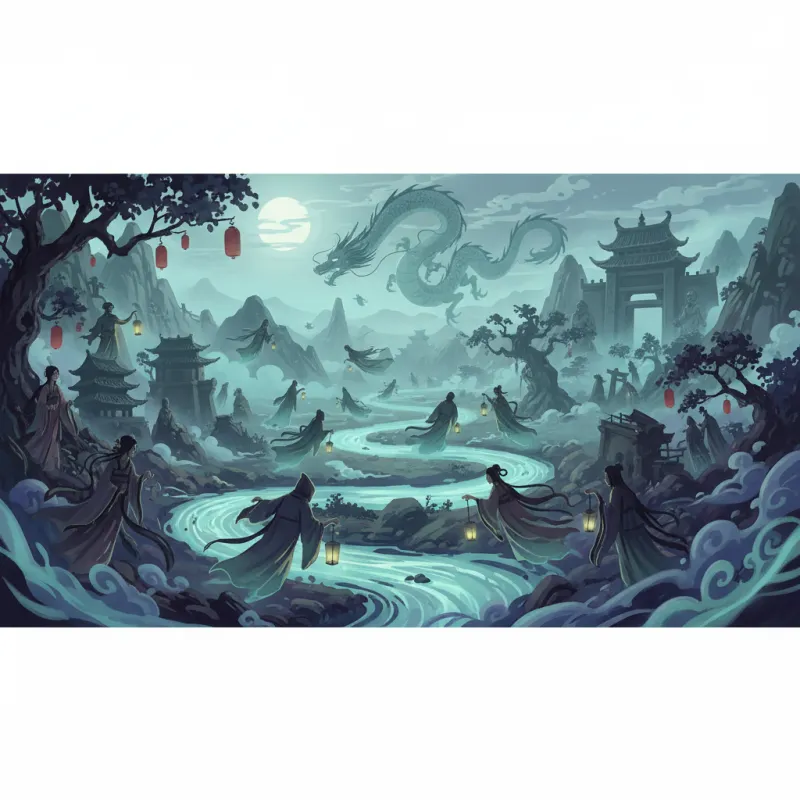
The old woman's funeral procession had barely left the village when her grandson saw her standing in the doorway of her own house, wearing the same blue cotton jacket she'd been buried in that morning. He wasn't hallucinating—in traditional Chinese belief, he was witnessing something perfectly logical: her 魂 (hún) hadn't yet realized it needed to leave.
This scene, repeated in countless variations across Chinese history, reveals something fundamental about Chinese supernatural folklore. Unlike Western traditions that often treat ghosts as aberrations or evil entities, Chinese culture developed an elaborate, bureaucratic understanding of the spirit world that mirrors earthly society. The dead aren't simply gone—they've relocated to a different administrative district.
The Three Souls and Seven Spirits
Chinese metaphysics doesn't mess around with simple dualism. Forget body-and-soul—traditional belief holds that each person contains 三魂七魄 (sān hún qī pò), three hun souls and seven po spirits. The hun are ethereal, intellectual, associated with yang energy. They're what makes you you—your personality, memories, consciousness. The po are physical, instinctual, tied to yin and the body itself.
When someone dies, this system gets complicated fast. The hun souls are supposed to ascend or move on to the afterlife, while the po spirits remain with the corpse and gradually dissipate. But—and this is where ghost stories begin—things don't always go according to plan. A violent death, improper burial, unfinished business, or lack of descendants to perform ancestral rites can trap hun souls in the mortal realm. These become 鬼 (guǐ), ghosts, and they're usually not happy about their situation.
The po spirits present their own problems. If they don't dissipate properly, they can animate the corpse, creating a 僵尸 (jiāngshī), the famous hopping vampire. These creatures, stiff from rigor mortis and hopping because their joints don't bend, became staples of Hong Kong horror cinema—but their roots stretch back to Qing Dynasty folklore and earlier.
The Bureaucracy of the Dead
Here's where Chinese supernatural folklore gets distinctly Chinese: the afterlife operates like an imperial government agency. The dead must report to 地府 (dìfǔ), the underworld, which functions as a vast bureaucratic system complete with judges, clerks, and endless paperwork.
The journey starts with 黑白无常 (Hēi Bái Wúcháng), Black and White Impermanence, two psychopomp figures who escort souls to the underworld. White Impermanence, tall and dressed in white, represents death by natural causes—he's the "good cop." Black Impermanence, shorter and darker, handles violent deaths—definitely the "bad cop." They're not evil; they're civil servants doing their jobs.
Once in the underworld, souls face the 十殿阎罗 (Shí Diàn Yánluó), the Ten Courts of Hell, each presided over by a different judge. This isn't the Christian hell of eternal damnation—it's more like a cosmic rehabilitation system. Souls are judged based on their earthly deeds, sentenced to specific punishments that fit their crimes, and eventually reincarnated. The 18th-century novel Journey to the West features a memorable sequence where the monk Xuanzang tours these courts, witnessing punishments that would make Dante take notes.
The bureaucratic nature extends to paperwork. During funeral rites, families burn 纸钱 (zhǐqián), spirit money, along with paper houses, cars, and even paper smartphones in modern practice. These aren't symbolic—they're actual currency and goods in the spirit economy. Without proper provisions, the deceased might suffer poverty in the afterlife, or worse, return as a hungry ghost demanding sustenance from the living.
Categories of Supernatural Entities
Chinese folklore distinguishes between numerous types of supernatural beings, each with specific characteristics and origins. Understanding these categories matters because encountering a 狐狸精 (húlijīng), fox spirit, requires different protocols than dealing with a 厉鬼 (lìguǐ), vengeful ghost.
Fox spirits occupy an ambiguous space—they're not ghosts but shape-shifting animals who've cultivated supernatural powers through centuries of practice. They often appear as beautiful women and feature prominently in Strange Tales from a Chinese Studio (聊斋志异, Liáozhāi Zhìyì), Pu Songling's 17th-century collection. Some fox spirits are benevolent, even romantic partners to humans; others are predatory, draining life force from their victims. The ambiguity reflects Daoist ideas about cultivation and transformation—these beings aren't inherently good or evil, just powerful and pursuing their own agendas.
Hungry ghosts, 饿鬼 (èguǐ), represent a particularly pitiable category. These are souls of people who died without descendants to make offerings, or who were so greedy in life they're cursed with insatiable hunger in death. They're depicted with enormous bellies and needle-thin throats, forever starving. The Ghost Festival (中元节, Zhōngyuán Jié) in the seventh lunar month specifically addresses their plight, with communities making offerings to feed wandering spirits who have no family to care for them.
Then there are 冤魂 (yuānhún), wronged souls who died unjustly and refuse to move on until their grievances are addressed. These form the backbone of Chinese ghost story tradition. The classic tale of 窦娥冤 (Dòu É Yuān, "The Injustice to Dou E") from the Yuan Dynasty tells of a young widow falsely executed for murder. Her ghost causes three years of drought until her case is reopened and justice served. This narrative pattern—ghost returns, reveals truth, achieves vindication—appears repeatedly in Chinese literature and reflects Confucian concerns about justice and proper social order.
Afterlife Geography and Reincarnation
The Chinese afterlife has a specific geography, mapped out in religious texts and folklore. After passing through the Ten Courts, souls reach 奈何桥 (Nàihé Qiáo), the Bridge of Helplessness, spanning a river that separates the dead from rebirth. Before crossing, they encounter 孟婆 (Mèng Pó), an old woman who serves 孟婆汤 (Mèng Pó tāng), a soup that erases all memories of past lives.
This memory-wiping detail is crucial. It explains why we don't remember previous incarnations and provides narrative tension in stories where characters somehow retain past-life memories. The Tang Dynasty tale of 牡丹亭 (Mǔdān Tíng, "The Peony Pavilion") plays with this concept, featuring a young woman who dies of lovesickness, refuses to drink the soup, and returns to life to find her beloved.
The concept of 轮回 (lúnhuí), reincarnation, borrowed from Buddhism but thoroughly sinicized, offers both hope and warning. Good karma leads to rebirth in better circumstances—perhaps as a wealthy human, or even ascending to become a 仙 (xiān), an immortal. Bad karma results in rebirth as an animal, or in the worst cases, as a hungry ghost or demon. This system provides moral framework: your actions have consequences that extend beyond a single lifetime.
Interestingly, Chinese folklore also includes escape routes from this cycle. Daoist cultivation practices aim to achieve immortality, bypassing death entirely. Buddhist enlightenment offers liberation from the wheel of rebirth. These alternatives mean that death isn't necessarily inevitable—with sufficient dedication, knowledge, or virtue, one might transcend the entire system. This possibility adds another layer to supernatural tales: that ghost you encounter might be a failed immortality seeker, or a bodhisattva testing your compassion.
Living with the Dead
What makes Chinese supernatural folklore particularly fascinating is how it integrates with daily life. The dead aren't separate from the living—they're family members who've changed addresses. Ancestral veneration, 祭祖 (jìzǔ), isn't worship in the Western religious sense; it's maintaining family relationships across the boundary of death.
During 清明节 (Qīngmíng Jié), Tomb Sweeping Day, families visit graves, clean tombstones, make offerings, and update deceased relatives on family news. This isn't morbid—it's social obligation. Neglecting ancestors can result in them becoming hungry ghosts or causing misfortune for living descendants. The relationship is reciprocal: properly maintained ancestors provide blessings and protection; neglected ones become problems.
This practical approach to the supernatural extends to exorcism and spirit mediation. When hauntings occur, families don't necessarily panic—they consult specialists. Daoist priests perform rituals to guide trapped souls to the afterlife. Buddhist monks chant sutras to generate merit for the deceased. Spirit mediums, 乩童 (jītóng), allow ghosts to possess them temporarily to communicate grievances. These aren't fringe practices—they're established social services for managing supernatural problems.
The physical environment also reflects this integration. Traditional Chinese architecture includes specific features to manage spiritual traffic: spirit walls (影壁, yǐngbì) behind entrance gates to block malevolent entities (ghosts can only travel in straight lines), door gods (门神, ménshén) painted on gates, and careful feng shui orientation to ensure positive energy flow and prevent ghostly accumulation in corners.
Modern Persistence and Evolution
You might think modernization would erode these beliefs, but Chinese supernatural folklore proves remarkably resilient. Contemporary Chinese horror films like The Eye (2002) and Rigor Mortis (2013) draw directly from traditional ghost lore while updating settings to modern apartment buildings and urban environments. The rules remain consistent—improper burial causes hauntings, vengeful ghosts seek justice, exorcism requires proper ritual knowledge—but the aesthetics adapt.
Even in mainland China, where official atheism prevails, folk practices persist. During Ghost Month, businesses in southern China still avoid major transactions. Families still burn spirit money. Young people who claim not to believe in ghosts still avoid whistling at night (it attracts spirits) or leaving chopsticks standing upright in rice (resembles incense offerings to the dead).
The internet age has spawned new variations. Online communities share "true" ghost encounters, debate the effectiveness of various protective talismans, and discuss which temples have the most powerful exorcists. Video games and web novels incorporate traditional supernatural elements, introducing younger generations to folklore through digital media. The 2017 mobile game Onmyoji, based on Japanese adaptations of Chinese supernatural concepts, became a massive hit, demonstrating continued appetite for these narratives.
What persists across all these adaptations is the fundamental worldview: death is a transition, not an ending. The supernatural realm operates by comprehensible rules. Proper ritual and moral behavior matter. These aren't primitive superstitions—they're sophisticated systems for understanding mortality, maintaining social bonds across generations, and finding meaning in the face of death.
The Philosophical Underpinnings
Beneath the colorful stories of hopping vampires and fox spirits lies serious philosophy. Chinese supernatural folklore synthesizes Confucian ethics, Daoist cosmology, and Buddhist metaphysics into a coherent system that addresses fundamental human concerns.
The Confucian emphasis on 孝 (xiào), filial piety, extends beyond death through ancestral veneration. This creates continuity across generations and reinforces family bonds as the fundamental social unit. When ghosts return to punish unfilial children or reward devoted descendants, they're enforcing Confucian values through supernatural means.
Daoist concepts of 阴阳 (yīnyáng) and 气 (qì) provide the metaphysical framework. Ghosts are yin entities, which is why they appear at night, in dark places, and cause coldness. Living humans are yang. Imbalance between these forces creates supernatural problems; restoration of balance resolves them. This isn't mystical nonsense—it's a systematic way of understanding energy, transformation, and the relationship between different states of existence.
Buddhism contributes karma and reincarnation, adding moral dimension and cosmic justice. The Ten Courts of Hell directly reflect Buddhist concepts of karmic retribution, while the possibility of liberation from rebirth offers ultimate hope. The synthesis isn't always seamless—Buddhist and Daoist afterlife concepts sometimes contradict—but Chinese folk religion cheerfully incorporates both, letting individuals choose which framework suits their needs.
This philosophical depth means Chinese supernatural folklore isn't just entertainment. It's a way of processing grief, enforcing social norms, explaining misfortune, and finding meaning in death. When someone says they saw a ghost, they're not just reporting a spooky experience—they're participating in a millennia-old conversation about what it means to be human, what happens when we die, and how the living and dead maintain relationships across the ultimate boundary.
The richness of Chinese supernatural folklore lies in this combination: vivid, specific stories grounded in elaborate metaphysical systems that address universal human concerns. Whether you believe in ghosts or not, these traditions offer profound insights into how one of the world's oldest continuous civilizations has understood death, morality, and the invisible world that exists alongside our own.
Related Reading
- Chinese Ghost Beliefs: A Complete Guide to the Spirit World
- Chinese Ghost Stories for Beginners: Where to Start
- Lake Monsters and Sea Creatures in Chinese Folklore
- Ghost Marriage: Wedding the Dead
- Water Ghosts: The Spirits That Pull You Under
- Zhong Kui: The Demon Queller
- Exploring Chinese Supernatural Folklore: Ghosts, Spirits, and Afterlife Beliefs
- Temple Legends: The Ghost Stories That Live in China's Sacred Spaces
Explore Chinese Culture
- Explore ancient mythical creatures
- Explore Daoist exorcism traditions
- Explore Chinese folk beliefs and superstitions