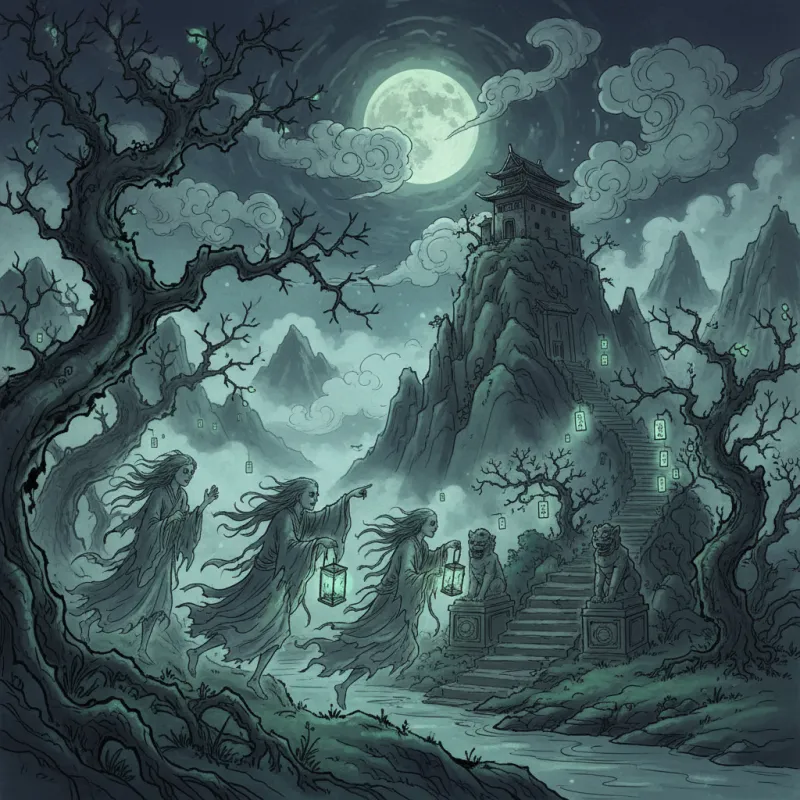
The scholar's lamp flickers. Outside, footsteps approach through the garden—light, deliberate, impossible. It's the third night this week. He doesn't run. Instead, he pours a second cup of wine, arranges his brushes, and waits. When the beautiful woman in Tang dynasty robes materializes through his wall, he'll ask what unfinished business chains her to this world, because in Chinese ghost stories, that's not the terrifying question—it's the opening line of negotiation.
This is your first lesson: Chinese ghosts aren't jump-scares. They're people who died wrong, and they have paperwork to settle.
Why Western Readers Get Chinese Ghost Stories Wrong
You've probably encountered Chinese ghost stories filtered through modern horror cinema—The Ring derivatives, J-horror influenced films, or wuxia fantasies where ghosts are just another monster type. These adaptations strip away what makes the tradition distinctive: its bureaucratic precision, its Confucian ethics, its assumption that the supernatural world operates on comprehensible rules.
Western ghost fiction, from The Turn of the Screw to The Haunting of Hill House, traffics in ambiguity. Is the ghost real? Is the narrator reliable? The uncertainty is the point. Chinese ghost stories, particularly the classical tradition, have no patience for this. The ghost is real. The underworld exists. There are forms to file. The question isn't "what's happening?" but "how do we resolve this according to proper procedure?"
This philosophical difference produces stories that feel more like legal dramas or romance novels than horror. The scholar and the ghost-woman negotiate. The magistrate investigates supernatural crimes using the same logic he'd apply to tax fraud. The exorcist isn't a mystic—he's a bureaucrat with the right stamps and seals.
Start Here: Strange Tales from a Chinese Studio
蒲松龄 (Pú Sōnglíng, 1640-1715) wrote 聊斋志异 (Liáozhāi Zhìyì, Strange Tales from a Chinese Studio) across decades of failure. He never passed the imperial examinations. He spent his life as a poorly-paid tutor in provincial Shandong, collecting supernatural accounts from travelers, servants, and local gossips. The result: 491 stories that became the foundation text for understanding Chinese ghost fiction.
Strange Tales isn't a novel—it's a collection, which means you can start anywhere. But I recommend three entry points:
"Nie Xiaoqian" (聂小倩) — The template for every Chinese ghost-romance that followed. A scholar encounters a beautiful ghost-woman forced by a demon to lure men to their deaths. Instead of fleeing, he helps her escape her supernatural bondage. The story has been adapted dozens of times (most famously as A Chinese Ghost Story, 1987), but the original is startlingly tender. Nie Xiaoqian isn't a monster—she's a victim of circumstance, and the story treats her supernatural condition as a solvable problem, not a horror.
"The Painted Skin" (画皮) — This one is horror. A demon wears a human skin like a costume, seducing a scholar while peeling it off at night to reveal the rotting corpse beneath. When the scholar's wife discovers the truth, she must negotiate with a Taoist priest who demands humiliating payment for his exorcism services. The story's genius is its economic realism—supernatural aid costs money, and the price is never fair.
"Ying Ning" (婴宁) — A young man falls for a girl who laughs constantly, inappropriately, at everything. She turns out to be half-fox-spirit, raised by a ghost-mother in a supernatural household. The story is a comedy about integrating the supernatural into domestic life. Ying Ning's laughter isn't madness—it's her refusal to perform the emotional restraint expected of Qing dynasty women.
The best English translation is John Minford's three-volume Strange Tales from a Chinese Studio (Penguin Classics, 2006). It preserves Pu Songling's literary style while providing the cultural context Western readers need.
The Other Essential: What the Master Would Not Discuss
If Strange Tales is the foundation, 子不语 (Zǐ Bù Yǔ, What the Master Would Not Discuss) by 袁枚 (Yuán Méi, 1716-1797) is its more skeptical, more philosophical cousin. Yuan Mei was everything Pu Songling wasn't—a successful official, a celebrated poet, a wealthy man who retired early to run a literary salon. His ghost story collection, written decades after Strange Tales, reads like a response.
Where Pu Songling treats supernatural events with earnest credulity, Yuan Mei maintains ironic distance. His narrators question, investigate, and sometimes expose fraud. His ghosts are more psychologically complex, his exorcists more ambiguous. The title itself is a Confucian joke—it references Confucius's refusal to discuss "strange phenomena, physical exploits, disorder, and spirits." Yuan Mei discusses them anyway, but with the Master's skeptical eye.
The collection is harder to find in English. The best option is Kam Louie and Louise Edwards's partial translation, What the Master Would Not Discuss (M.E. Sharpe, 1996), though it only includes about a third of the original stories.
Beyond the Classics: Modern Recommendations
Once you've absorbed the classical tradition, these modern works show how contemporary writers adapt and subvert the conventions:
Lilian Lee's Farewell My Concubine — Not marketed as a ghost story, but the novel (more than the film) is saturated with supernatural logic. The Peking Opera performers live in a world where theatrical roles bleed into reality, where playing the ghost of Consort Yu for decades makes you half-ghost yourself. Lee uses classical ghost story conventions to explore performance, identity, and political trauma.
Qiu Miaojin's Last Words from Montmartre — A Taiwanese lesbian writer's experimental novel that treats psychological haunting as literal haunting. The narrator is pursued by the ghost of her former lover, but the ghost might be her own dissociated self. Qiu rewrites the scholar-ghost-woman romance as queer tragedy, maintaining the classical tradition's assumption that ghosts are people with unfinished emotional business.
Can Xue's short fiction — The most challenging recommendation. Can Xue writes surrealist fiction that feels like ghost stories without ghosts—or rather, where everyone is already a ghost, and the living world is the haunted space. Her work is what happens when you take the classical tradition's bureaucratic supernatural logic and push it into Kafkaesque absurdity.
What to Skip (For Now)
Journey to the West and Investiture of the Gods are foundational Chinese fantasy texts, but they're not ghost stories—they're god stories, demon stories, epic quest narratives. The supernatural beings operate on different rules. Start with the intimate, human-scale ghost fiction before tackling the cosmic mythology.
Similarly, skip the modern C-horror film boom until you've read the source material. Films like The Eye or Rigor Mortis are visually striking but culturally deracinated—they borrow Chinese ghost imagery while abandoning the philosophical framework that makes the tradition coherent.
The Reading Order That Actually Works
- Read five stories from Strange Tales: "Nie Xiaoqian," "The Painted Skin," "Ying Ning," "The Cricket," and "Lotus Fragrance"
- Read the introduction to your translation—seriously, read it, the cultural context matters
- Pick ten more stories at random, see what hooks you
- Read three stories from What the Master Would Not Discuss to see how Yuan Mei responds to Pu Songling
- Watch A Chinese Ghost Story (1987) to see how the tradition translates to cinema
- Return to Strange Tales and read twenty more stories—you'll notice patterns you missed the first time
- Branch into modern adaptations once you can recognize what they're adapting
Why This Matters Beyond "Cultural Literacy"
Chinese ghost stories offer a model for supernatural fiction that Western traditions have largely abandoned: the assumption that the uncanny can be understood, negotiated with, and integrated into ordinary life. The scholar doesn't destroy the ghost—he helps her file the correct paperwork with the underworld bureaucracy. The wife doesn't flee the fox-spirit—she teaches her proper human behavior. The magistrate doesn't dismiss supernatural crimes—he investigates them using the same evidentiary standards he'd apply to theft.
This isn't naïve optimism. These stories emerge from a culture that experienced catastrophic violence, political instability, and social upheaval across centuries. The insistence that even ghosts follow comprehensible rules is a philosophical stance: the world is terrifying, but it's not arbitrary. There are patterns. There are procedures. There are ways to negotiate.
That's the real lesson for beginners. Chinese ghost stories aren't about fear—they're about the possibility of resolution, even after death. The scholar pours that second cup of wine because he believes the ghost-woman can be reasoned with. Sometimes he's wrong. But the attempt is always worth making.
Start with Strange Tales. Pour yourself a cup of wine. When the footsteps approach through your garden, you'll know what questions to ask.
Related Reading
- Ghost Marriage: When the Dead Need a Spouse
- River Gods and Water Deities in Chinese Mythology
- The Drowning Ghost (水鬼): China's Most Feared Water Spirit
- Lake Monsters and Sea Creatures in Chinese Folklore
- Chinese Ghosts: A Field Guide to the Dead Who Will Not Leave
- Dream Spirits and Sleep Demons: The Supernatural World of Chinese Dreams
- Temple Legends: The Ghost Stories That Live in China's Sacred Spaces
- Chinese Death Customs That Surprise Westerners
Explore Chinese Culture
- Explore ancient mythical creatures
- Explore Daoist exorcism traditions
- Explore Chinese folk beliefs and superstitions