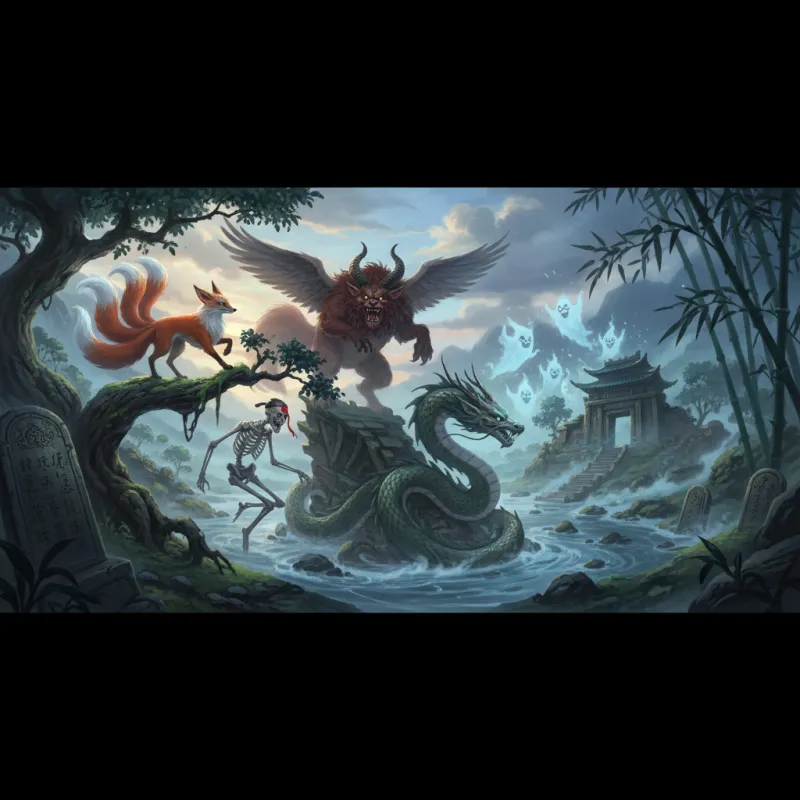
A fox spirit transforms into a beautiful woman and seduces a scholar. Is she a demon? A ghost? Something else entirely? If you answered "demon," you've just made the mistake that trips up every Western reader encountering Chinese supernatural fiction for the first time. The Chinese classification system for supernatural beings doesn't map onto our tidy categories of angels and demons, good and evil. It's more like a periodic table of the paranormal — each type of being has distinct properties, origins, and behaviors, but moral alignment isn't one of the defining characteristics.
The Core Categories: More Than Just Translation Problems
The Chinese supernatural taxonomy recognizes at least five major categories, each with its own etymology, cultural baggage, and narrative function. The problem starts when translators reach for the word "demon" to cover all of them.
妖 (yāo) are beings that have cultivated supernatural power through practice and time. The character itself combines "woman" and "strange," though yāo can be any gender. These are your fox spirits, snake spirits, tree spirits — entities that began as ordinary creatures or objects and achieved consciousness and power through absorbing essence (usually from the moon, sun, or living beings). A yāo isn't inherently evil; it's just operating on non-human logic. The white snake from The Legend of the White Snake is a yāo, and she's arguably more moral than the monk who tries to destroy her marriage.
魔 (mó) is the closest thing to the Western concept of "demon" — beings of pure malevolence, often Buddhist in origin (the character is the Chinese rendering of "Mara," the demon who tempted Buddha). These are the antagonists in Journey to the West, the forces that actively work against enlightenment and cosmic order. But even here, the category gets fuzzy: some mó are former celestials who fell from grace, making them more like fallen angels than inherent evil.
鬼 (guǐ) are ghosts — the spirits of dead humans who haven't moved on. They're not demons at all, though they're often lumped in with supernatural threats. A guǐ might be vengeful, protective, confused, or just lonely. The hungry ghosts are a specific subcategory of guǐ, but most ghosts in Chinese fiction are just people who died badly and have unfinished business. They haunt because they're stuck, not because they're evil.
精 (jīng) translates roughly to "essence" or "spirit," and refers to beings that have achieved consciousness through accumulating vital energy. This overlaps significantly with yāo, but jīng tends to emphasize the transformation process itself. A thousand-year-old ginseng root that gains sentience is a jīng. So is a stone that absorbs enough moonlight to walk around. The Monkey King from Journey to the West is technically a stone jīng who cultivated himself into something far more powerful.
仙 (xiān) are immortals or transcendent beings — the ones who've successfully cultivated themselves beyond the mortal realm. They're not gods (that's 神, shén), but they're not exactly demons either. Some started as yāo or jīng and achieved transcendence through Daoist cultivation practices. Others were humans who found the right combination of alchemy, meditation, and luck.
The Cultivation Spectrum: From Beast to Immortal
What makes Chinese supernatural taxonomy fascinating is that it's not static. A being can move between categories through cultivation (修炼, xiūliàn) — the practice of refining one's essence and accumulating power. This is why the same creature might be called different things at different points in its existence.
Take the typical fox spirit narrative: A fox lives in the wild for a hundred years, absorbing moonlight and practicing breathing exercises. At this point, it's a 狐妖 (húyāo) — a fox yāo. It learns to take human form and moves to the city, where it might seduce scholars to steal their yang essence (making it a threat) or fall genuinely in love (making it sympathetic). If it continues cultivating and achieves transcendence, it becomes a 狐仙 (húxiān) — a fox immortal, a being of genuine spiritual power that might be worshipped at local shrines.
The same progression applies to other beings. A snake that cultivates for a thousand years becomes a dragon. A turtle that absorbs enough essence becomes a 玄武 (xuánwǔ), one of the four celestial guardians. Even objects can make this journey: the Journey to the West features demons who started as musical instruments, weapons, and household items that their celestial owners carelessly left lying around for a few centuries.
This cultivation framework means that "demon" is often a temporary state, not a permanent identity. The antagonist in one story might be the enlightened sage in another, given enough time and proper practice. It's a fundamentally different worldview from Western demonology, where a demon is a demon forever, and redemption is either impossible or requires divine intervention.
Regional Variations: Not All Demons Are Created Equal
Chinese supernatural taxonomy isn't uniform across the vast geography and long history of Chinese civilization. What counts as a yāo in Tang Dynasty literature might be classified differently in Qing Dynasty fiction. Regional folklore adds its own categories that don't fit neatly into the standard five.
Southern Chinese folklore, particularly in regions like Guangdong and Fujian, features 蛊 (gǔ) — beings or curses created through poisonous magic, often involving insects or snakes. These aren't quite yāo, aren't quite mó, but occupy their own category of human-created supernatural threats. The Gu poison traditions represent a whole subcategory of supernatural danger that doesn't map onto the standard taxonomy.
Northern folklore emphasizes 僵尸 (jiāngshī) — hopping corpses that are technically guǐ but behave more like animated bodies than conscious spirits. They're created through improper burial, violent death, or possession by malevolent forces, and they occupy a weird middle ground between ghost and monster.
Minority ethnic groups within China have their own classification systems that sometimes overlap with, sometimes contradict, the Han Chinese taxonomy. Miao folklore features 苗疆 (miáojiāng) supernatural beings that don't fit standard categories. Tibetan Buddhist demonology introduces 罗刹 (luóchà, from Sanskrit "rakshasa") and other beings that blend Indian and Chinese supernatural concepts.
The Moral Complexity: Why "Demon" Is a Terrible Translation
Here's where Western translations consistently fail: they translate yāo, mó, and sometimes even jīng as "demon," flattening the moral complexity into a simple good-versus-evil binary. But Chinese supernatural fiction doesn't work that way.
A yāo who eats humans isn't necessarily evil in the cosmic sense — it's following its nature, the way a tiger follows its nature by hunting deer. The question isn't whether the yāo is morally wrong, but whether it can be reasoned with, redirected, or needs to be stopped for practical reasons. Many stories feature yāo who are sympathetic characters despite being dangerous. They're not fallen angels choosing evil; they're beings with their own logic and needs that happen to conflict with human welfare.
This is why Strange Tales from a Chinese Studio (聊斋志异, Liáozhāi Zhìyì) by Pu Songling features so many fox spirits who are portrayed as romantic heroines rather than demonic threats. They're yāo, yes, but they're also individuals with their own desires, fears, and moral codes. Some are predatory, some are loving, most are complicated. The scholar who falls in love with a fox spirit isn't being tempted by a demon — he's entering a relationship with a non-human being who operates on different rules.
Even mó, the closest thing to pure evil in the taxonomy, often have backstories that complicate their villainy. The demons in Journey to the West frequently turn out to be escaped celestial pets, former disciples who went astray, or beings who were wronged and turned to darkness. They're antagonists, but they're not metaphysical evil incarnate.
Practical Implications: How to Deal With Each Type
Chinese folklore doesn't just classify supernatural beings — it provides practical guidance for dealing with them. The approach varies dramatically depending on what you're facing.
For yāo: Negotiation is possible. Many stories feature scholars or monks who talk yāo into leaving humans alone, either through moral persuasion or by offering alternative sources of essence. Daoist talismans and Buddhist sutras can repel them, but the most effective approach is often to address their needs. A fox spirit stealing yang essence might stop if given access to proper cultivation techniques. A tree spirit haunting a forest might be appeased by offerings and respect.
For mó: Direct confrontation is usually necessary. These beings actively oppose cosmic order, so negotiation rarely works. Buddhist monks and Daoist exorcists use different techniques — monks rely on sutras and the power of enlightenment, while Daoists use talismans, swords, and ritual magic. The key is that mó must be either destroyed or bound; they can't be reasoned with because their nature is fundamentally opposed to harmony.
For guǐ: Address the unfinished business. Most ghosts aren't malevolent; they're stuck. Proper burial rites, resolving injustices, or simply acknowledging their existence can help them move on. The Chinese exorcism traditions include extensive protocols for dealing with different types of ghosts, from the merely confused to the actively vengeful.
For jīng: Similar to yāo, but often more alien in their thinking. A stone jīng that's been conscious for only a few decades might not understand human concepts at all. Approach with caution and be prepared for completely non-human logic.
For xiān: Show respect and don't bother them unless absolutely necessary. Immortals are beyond mortal concerns, and attracting their attention can be dangerous even when they're benevolent. If you must interact with one, proper ritual courtesy is essential.
The Modern Evolution: How Contemporary Fiction Handles the Categories
Contemporary Chinese fantasy fiction (玄幻, xuánhuàn, and 修真, xiūzhēn genres) has taken the traditional taxonomy and run with it, creating elaborate cultivation systems where beings progress through clearly defined ranks. Web novels like Coiling Dragon and I Shall Seal the Heavens feature protagonists who start as humans and cultivate their way through increasingly powerful states, sometimes becoming yāo-like in their power, sometimes achieving xiān status.
This modern fiction makes explicit what was implicit in classical texts: the categories are permeable, and power level matters more than origin. A sufficiently powerful human cultivator might be more dangerous than a minor yāo. A xiān who's lost their cultivation might be weaker than a dedicated jīng.
The taxonomy has also been exported and adapted by non-Chinese authors writing in the "cultivation" genre, though these adaptations often simplify the moral complexity back into Western good-versus-evil frameworks. The nuance gets lost in translation, again.
Why This Matters: Reading Chinese Supernatural Fiction Correctly
Understanding the taxonomy changes how you read Chinese supernatural fiction. When Journey to the West calls a character a yāo, it's not saying they're evil — it's saying they're a cultivated being who's probably going to be an obstacle but might also be redeemable. When Strange Tales introduces a fox spirit, you should be thinking "complicated non-human person" not "demonic seductress."
The taxonomy also reveals deeper philosophical assumptions. Chinese supernatural fiction assumes that consciousness and power can emerge from anything given enough time and proper conditions. It assumes that moral behavior is a choice, not an inherent property of your species or origin. It assumes that the universe is full of beings operating on different logics, and that "good" and "evil" are human categories that don't necessarily apply to non-human consciousness.
Next time you encounter a "demon" in Chinese fiction, ask yourself: Is this a yāo following its nature? A mó actively choosing evil? A guǐ stuck in a bad situation? A jīng that doesn't understand human rules? Or a xiān operating on logic so far beyond mortal understanding that it seems arbitrary? The answer changes everything about how you should interpret the story.
The Western demon is a fallen angel, a being that chose evil and is defined by that choice. The Chinese yāo is a fox that lived long enough to become something more, and what it chooses to do with that power is an open question. That's not a translation problem — it's a fundamentally different way of thinking about consciousness, morality, and the supernatural. And it makes for much more interesting stories.
Related Reading
- Jiangshi: The Chinese Hopping Vampire
- Unveiling the Shadows: A Journey Through Chinese Supernatural Folklore of Ghosts and Spirits
- Jiangshi: The Hopping Vampires of Chinese Horror
- Yaoguai: A Classification of Chinese Monsters
- Daoist Exorcism: The Art of Banishing Spirits in Chinese Culture
- Chinese Dream Interpretation: What Your Dreams Mean in Traditional Culture
- The Chinese Afterlife Is a Bureaucracy (And That Tells You Everything)
- Modern Ghost Sightings in China: When Ancient Beliefs Meet the Digital Age
Explore Chinese Culture
- Explore ancient mythical creatures
- Explore Daoist exorcism traditions
- Explore Chinese folk beliefs and superstitions