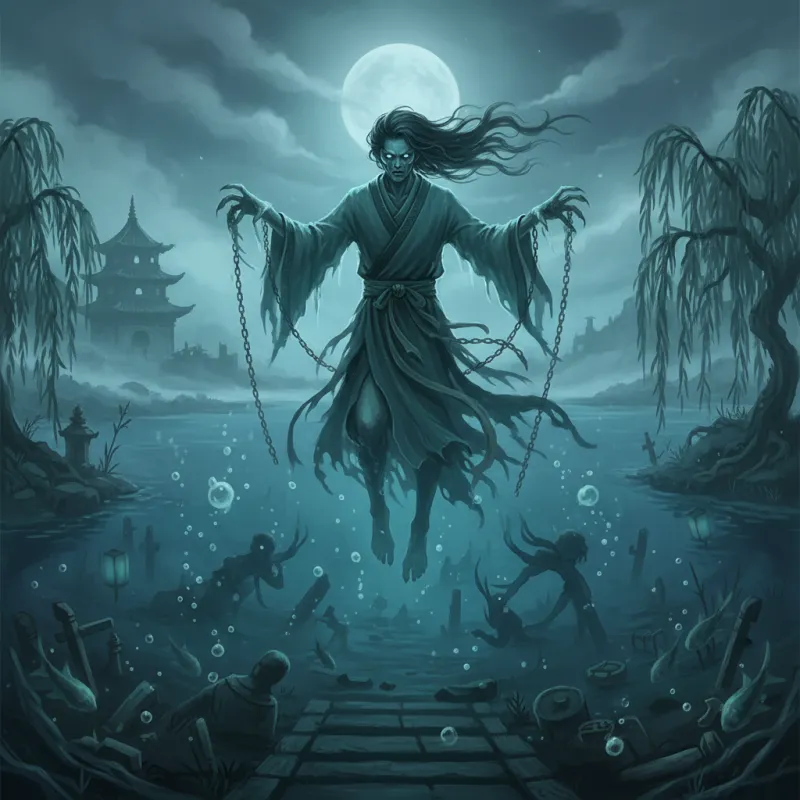
Every summer, the same warning echoes across China's rivers and lakes: "Don't swim after dark. The water ghosts are hungry." It sounds like superstition meant to scare children away from dangerous waters. But the 水鬼 (shuǐguǐ) — the drowning ghost — represents something far more unsettling than a simple cautionary tale. This spirit doesn't haunt because it's angry or seeking revenge. It haunts because Chinese cosmology has trapped it in a bureaucratic nightmare: it cannot move on to the afterlife until it drowns someone else to take its place.
The Substitute Death System
The water ghost operates under the principle of 替死鬼 (tìsǐguǐ) — literally "substitute death ghost." According to traditional Chinese belief, a person who drowns becomes bound to that specific body of water, unable to proceed to 阴间 (yīnjiān), the underworld, for judgment and eventual reincarnation. The ghost remains trapped in a liminal state, neither fully dead nor able to move forward in the cosmic cycle. The only escape? Find a replacement.
This creates a horrifying perpetual motion machine of death. Each drowning victim becomes a new water ghost, which must then claim its own victim, who becomes the next ghost, and so on. Certain rivers, lakes, and ponds throughout China gained reputations as particularly dangerous precisely because they had claimed so many lives — each death adding another desperate spirit to the waters, each spirit increasing the likelihood of the next drowning.
The system reveals something fundamental about Chinese supernatural beliefs: even death operates according to rules and hierarchies. The underworld bureaucracy doesn't make exceptions for tragic accidents. A drowned person cannot simply show up at the gates of the afterlife without proper clearance. They need a replacement to fill their position in the mortal world before they can proceed.
What the Water Ghost Actually Does
Unlike Western water spirits that might seduce or enchant their victims, the shuǐguǐ employs more direct tactics. The most common method involves grabbing swimmers by the ankles and pulling them under. Witnesses to drownings often report that victims seemed to be struggling against something pulling them down, fighting an invisible force beneath the surface.
But the water ghost has subtler techniques as well. It can create illusions — making deep water appear shallow, or causing swimmers to become disoriented and swim away from shore instead of toward it. Some accounts describe the ghost appearing as a drowning person calling for help, luring would-be rescuers to their own deaths. Others tell of the ghost manifesting as a beautiful woman or handsome man at the water's edge, enticing victims to enter the water.
The ghost supposedly becomes more desperate and aggressive the longer it remains trapped. A newly drowned spirit might wait months or even years for the right opportunity, but an ancient water ghost that has been bound to its location for decades will actively hunt for victims, creating dangerous currents or causing boats to capsize.
The Appearance and Nature of Shuǐguǐ
Descriptions of water ghosts vary significantly across different regions of China, but certain characteristics appear consistently. Most accounts describe them as bloated and pale, with waterlogged skin that appears almost translucent. Their hair hangs in wet, tangled masses, and water constantly drips from their bodies. The eyes are often described as particularly disturbing — either completely white or reflecting light like an animal's eyes in darkness.
Some traditions hold that the water ghost retains the appearance it had at the moment of drowning, complete with whatever injuries caused the death. A person who drowned after hitting their head on rocks would appear with a crushed skull; someone who drowned while drunk would still smell of alcohol. This detail serves a practical purpose in folklore: it reminds people of the specific dangers associated with each body of water.
The ghost's physical form is said to be cold and slippery, making it difficult to fight off once it grabs hold. Its strength is supernatural — even a child who drowned can overpower a strong adult swimmer once it has become a shuǐguǐ. The ghost doesn't need to breathe, doesn't tire, and knows every current and depth of its watery domain.
Interestingly, water ghosts are generally confined to the specific location where they drowned. A ghost from a river cannot travel to a nearby lake, and a ghost from one section of a river cannot move to another section. This geographic binding means that locals often know exactly which spots are most dangerous — the places where drownings have occurred before.
Historical Accounts and Literary References
The concept of the water ghost appears throughout Chinese literature, but one of the most detailed accounts comes from the Qing Dynasty collection 《阅微草堂笔记》(Yuèwēi Cǎotáng Bǐjì) — "Notes from the Yuewei Hermitage" — by 纪昀 (Jì Yún), better known as 纪晓岚 (Jì Xiǎolán). In one story, a scholar encounters a water ghost that has been waiting for a replacement for over thirty years. The ghost explains its predicament with bureaucratic precision: it cannot leave until someone drowns in the exact spot where it died, and it cannot force someone to drown who isn't "fated" to die at that time.
This introduces another layer to the water ghost mythology: the concept of 命中注定 (mìngzhōng zhùdìng) — predetermined fate. Some versions of the belief hold that the water ghost can only successfully drown people whose time has come according to the cosmic ledger maintained by the underworld judges. This creates a strange moral ambiguity — is the ghost evil for drowning people, or is it simply an instrument of fate, helping to fulfill deaths that were already written?
The Ming Dynasty novel 《西游记》(Xīyóu Jì) — "Journey to the West" — features a water ghost in the story of the 通天河 (Tōngtiān Hé), the "River That Leads to Heaven." The spirit there demands annual sacrifices of children, though this represents a more powerful and malevolent version of the typical water ghost. The novel's depiction influenced how water ghosts were portrayed in later folklore, adding elements of deliberate malice that weren't always present in earlier accounts.
Protection and Prevention
Given the water ghost's terrifying nature, Chinese folk tradition developed numerous methods for protection. The most straightforward approach: avoid swimming in places where drownings have occurred, especially during the seventh lunar month when the gates of the underworld open and ghosts roam more freely during 鬼月 (guǐyuè) — Ghost Month.
For those who must enter dangerous waters, several protective measures exist. Wearing jade is believed to offer some protection, as jade is considered pure and can repel negative spiritual energy. Some people carry 符 (fú) — Taoist talismans — specifically designed to ward off water ghosts. These paper charms, inscribed with protective characters and symbols, are either worn on the body or burned and their ashes mixed with water to drink before swimming.
Certain times are considered more dangerous than others. The hour of the Rat (11 PM to 1 AM) and the hour of the Ox (1 AM to 3 AM) are particularly risky, as these are when yin energy is strongest. Swimming during these hours is essentially inviting an encounter with a water ghost.
An interesting folk belief holds that water ghosts cannot harm people who are completely naked, as the ghost needs to grab onto clothing to pull victims under. This belief likely originated from practical observation — clothing does create drag in water and can become entangled — but it became incorporated into supernatural lore.
Some communities placed stone tablets or small shrines near dangerous waters, dedicated to 河神 (héshén) — river gods — or 龙王 (lóngwáng) — dragon kings. The theory was that these more powerful water deities could keep the water ghosts in check, preventing them from claiming victims. Regular offerings at these shrines were meant to maintain the protection.
The Compassionate Water Ghost
Not all water ghost stories end in tragedy. A recurring motif in Chinese folklore is the 善良的水鬼 (shànliáng de shuǐguǐ) — the compassionate water ghost — who refuses to claim a substitute despite its own suffering. These stories typically follow a pattern: the ghost has an opportunity to drown someone, but discovers the potential victim is a good person, or has young children, or is the sole support for elderly parents. The ghost chooses to let them live, remaining trapped in the water.
In some versions of these tales, the ghost's compassion is eventually rewarded. The Jade Emperor or another celestial authority takes notice of the ghost's virtue and grants it permission to move on to the afterlife without a replacement, or even elevates it to the position of a minor water deity. These stories serve a moral function, teaching that virtue can transcend even death and the rigid rules of the cosmic bureaucracy.
One famous story from Jiangsu Province tells of a water ghost who saved a child from drowning, actively pushing the child toward shore instead of pulling them under. When asked why, the ghost explained that it had been a mother in life and could not bear to create another orphan. According to the tale, the local magistrate heard of this and commissioned a small temple to be built in the ghost's honor, where she was worshipped as a protective spirit rather than feared as a malevolent one.
Modern Persistence and Psychological Reality
The belief in water ghosts remains surprisingly persistent in modern China, particularly in rural areas. Even in cities, parents still warn children about shuǐguǐ when teaching water safety. The ghost serves as a personification of very real dangers — strong currents, sudden drop-offs, underwater obstacles, and the panic that can overtake even experienced swimmers.
From a psychological perspective, the water ghost represents the terror of drowning itself — the helpless feeling of being pulled down, the inability to breathe, the disorientation of not knowing which way is up. The ghost's cold, slippery grip mirrors the sensation of water closing over one's head. Its pale, bloated appearance reflects what actually happens to bodies that remain submerged for extended periods.
The substitute death concept also reflects a deeper anxiety about the randomness of death, particularly accidental death. By creating a system where drownings follow a pattern — each ghost creating the next — the folklore imposes order on what is actually chaotic and unpredictable. It's psychologically easier to believe that drownings happen because a ghost needs a replacement than to accept that they happen randomly, that anyone could slip beneath the surface at any moment for no reason at all.
The water ghost endures in Chinese culture not because people literally believe in spirits lurking beneath every pond, but because it captures something true about water itself — its beauty and danger, its life-giving and life-taking nature, the way it can shift from welcoming to hostile in an instant. The shuǐguǐ is less a supernatural entity than a cultural acknowledgment that water demands respect, and that every body of water in China has claimed lives and will claim more. The ghost is the memory of those deaths, and a warning about the deaths to come.
Related Reading
- Chinese Ghost Beliefs: A Complete Guide to the Spirit World
- Ghost Marriage: Wedding the Dead
- Chinese Ghost Stories for Beginners: Where to Start
- Water Ghosts: The Spirits That Pull You Under
- River Gods and Water Deities in Chinese Mythology
- Unveiling the Mysteries of Chinese Supernatural Folklore: Ghosts, Spirits, and Afterlife Beliefs
- Lady White Snake: China's Greatest Love Story
- Chinese Demons: A Taxonomy of Evil in Chinese Mythology
Explore Chinese Culture
- Explore ancient mythical creatures
- Explore Daoist exorcism traditions
- Explore Chinese folk beliefs and superstitions