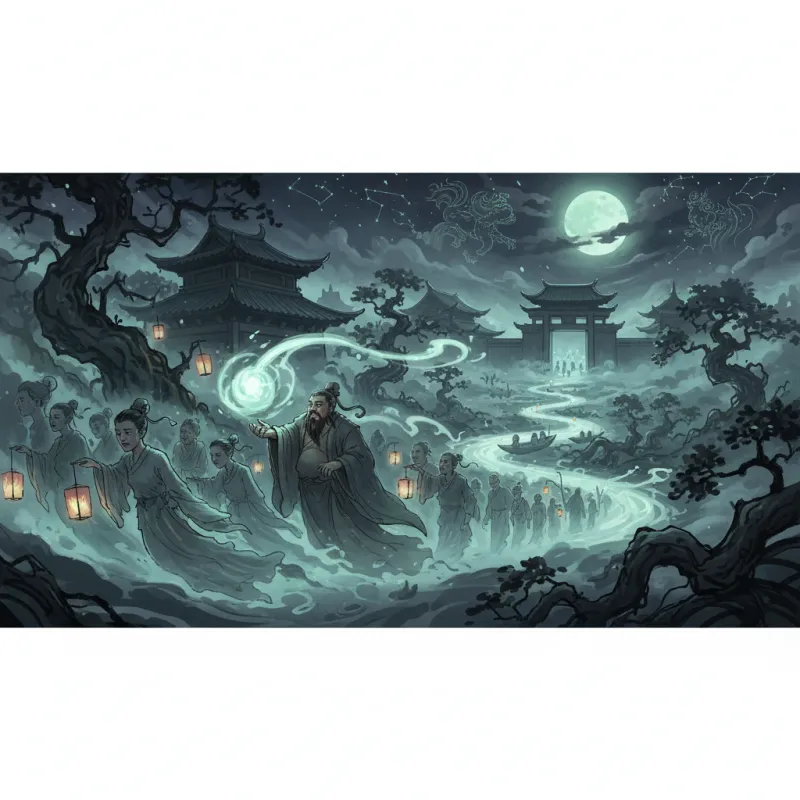
The old woman's hands trembled as she placed three sticks of incense before the ancestral tablet. "Don't let them follow you home," she whispered to her grandson, her eyes darting toward the darkening doorway. In that moment, she wasn't speaking metaphorically—she genuinely believed that hungry ghosts (饿鬼, è guǐ) prowled the streets during the seventh lunar month, desperate for offerings from the living. This wasn't superstition to her. It was survival knowledge, passed down through generations like a family recipe. Chinese supernatural folklore isn't just a collection of spooky stories—it's a complex system of beliefs that has shaped how millions of people understand death, morality, and their obligations to those who came before them.
The Three Teachings and the Architecture of the Afterlife
Chinese beliefs about ghosts and the afterlife didn't emerge from a single source—they're the product of what scholars call the "Three Teachings" (三教, sān jiào): Confucianism, Taoism, and Buddhism. Each contributed distinct elements that eventually fused into something uniquely Chinese. Confucianism provided the ethical framework, insisting that filial piety (孝, xiào) extends beyond death. Your ancestors aren't gone—they're watching, judging, and depending on your offerings for their comfort in the afterlife. Taoism contributed the bureaucratic structure of the underworld, complete with judges, clerks, and administrative procedures that mirror earthly government. Buddhism, arriving from India around the first century CE, brought the concept of karma and reincarnation, adding moral weight to the system.
The result? An afterlife that operates like a cosmic civil service. When you die, you don't simply cease to exist or float off to some abstract heaven. Instead, you report to the Ten Courts of Hell (十殿阎罗, shí diàn yán luó), where King Yama and his fellow judges review your life's deeds with bureaucratic precision. The Jade Record (玉历宝钞, Yù Lì Bǎo Chāo), a popular religious text from the Qing Dynasty, describes these courts in excruciating detail—complete with specific punishments for specific sins. Lied to your parents? Tongue-pulling. Wasted food? You'll be force-fed molten iron. The specificity is the point: this isn't vague spiritual philosophy, it's a detailed map of consequences.
Hungry Ghosts and the Economics of the Dead
Not all spirits successfully navigate the afterlife bureaucracy. Some become hungry ghosts—beings trapped between worlds, unable to move on due to improper burial, lack of descendants, or violent death. The concept of the hungry ghost reveals something crucial about Chinese supernatural beliefs: the dead have needs, and the living have obligations. This isn't charity—it's a transaction. During the Ghost Festival (中元节, Zhōng Yuán Jié), celebrated on the fifteenth day of the seventh lunar month, families burn paper money, paper houses, even paper smartphones to ensure their ancestors live comfortably in the afterlife.
The logic is economic. Ancestors who receive proper offerings become protective spirits, blessing their descendants with good fortune. Neglected ancestors become resentful, potentially causing illness, bad luck, or business failures. This creates a supernatural economy where the living and dead remain in constant exchange. The anthropologist Emily Ahern documented this in her 1973 fieldwork in Taiwan, noting that families kept meticulous records of which ancestors received which offerings—essentially maintaining spiritual bank accounts.
But hungry ghosts without descendants are the truly dangerous ones. With no one to feed them, they wander, desperate and malevolent. They're the supernatural equivalent of the homeless—pitied but feared, requiring community intervention. That's why many temples hold mass feeding ceremonies, offering food to "orphan ghosts" (孤魂野鬼, gū hún yě guǐ) who have no families to care for them. It's social welfare for the dead, and it reveals how Chinese supernatural beliefs extend moral obligations beyond blood relations.
Fox Spirits, Scholar-Ghosts, and the Pu Songling Effect
While hungry ghosts represent the dangerous side of the supernatural, Chinese folklore also features spirits who blur the line between threat and companion. Fox spirits (狐狸精, hú li jīng) are the most famous example—shapeshifters who typically appear as beautiful women, seducing scholars and draining their life force. But the stories are more complex than simple cautionary tales. In Pu Songling's Strange Tales from a Chinese Studio (聊斋志异, Liáo Zhāi Zhì Yì), completed around 1679, fox spirits are often sympathetic characters—lonely beings seeking connection, love, or justice.
Pu Songling's collection fundamentally shaped how educated Chinese people understood the supernatural. His stories feature ghosts who fall in love with living scholars, demons who seek enlightenment, and spirits who expose corrupt officials. The message isn't "avoid the supernatural"—it's "the supernatural world operates by the same moral principles as the human world." A ghost who was wronged in life seeks justice in death. A fox spirit who genuinely loves a scholar might sacrifice herself to save him. The supernatural becomes a mirror for examining human ethics.
This literary tradition created what I call the "sympathetic ghost" phenomenon in Chinese culture. Unlike Western horror traditions where ghosts are primarily threatening, Chinese ghosts often have legitimate grievances. The ghost of a murdered woman doesn't haunt randomly—she targets her killer or seeks someone who can expose the crime. This connects directly to beliefs about death rituals and proper burial practices, where improper treatment of the dead creates supernatural consequences.
The Exorcist's Toolkit: Daoist Magic and Buddhist Sutras
When ghosts become problematic, Chinese tradition offers multiple intervention strategies. Daoist priests (道士, dào shì) specialize in exorcism, using talismans (符, fú), ritual swords, and complex ceremonies to banish malevolent spirits. The classic image—a priest in yellow robes, wielding a wooden sword and chanting incantations—isn't just movie fiction. These practices have documented histories stretching back to the Tang Dynasty (618-907 CE).
The Daoist approach treats ghosts as entities that can be commanded, tricked, or forcibly removed. Talismans written in specialized script act as supernatural contracts, binding spirits to specific behaviors. The priest essentially out-bureaucrats the ghost, using the same cosmic administrative system that governs the afterlife. It's spiritual litigation—you're not destroying the ghost, you're serving it with a celestial restraining order.
Buddhist monks take a different approach, focusing on compassion and release. Rather than commanding ghosts to leave, they perform rituals to help spirits resolve their attachments and move toward reincarnation. The Ullambana Sutra provides the scriptural basis for the Ghost Festival, telling the story of Mulian, a monk who descended to hell to rescue his mother. Buddhist exorcism isn't about power—it's about liberation. You're not fighting the ghost; you're helping it let go.
These parallel systems reveal something important: Chinese supernatural beliefs are pragmatic rather than dogmatic. If Daoist exorcism doesn't work, try Buddhist sutras. If neither works, consult a spirit medium. The goal isn't theological purity—it's solving the problem. This flexibility has allowed these beliefs to persist even as China modernized, adapting to new contexts while maintaining core principles.
Modern Ghosts in Ancient Bottles
Walk through any Chinese city today and you'll find this supernatural worldview alive and thriving, albeit in modified forms. Real estate developers avoid building numbers with "4" (四, sì) because it sounds like "death" (死, sǐ). Families still burn paper offerings during Qingming Festival, though now you can buy paper credit cards and paper luxury cars. Ghost stories circulate on social media, updated for contemporary anxieties—haunted subway stations, cursed apartment buildings, spirits trapped in smartphones.
The persistence isn't about ignorance or lack of education. Many highly educated Chinese people maintain these practices, not necessarily because they literally believe in hungry ghosts, but because the rituals connect them to family history and cultural identity. Burning incense for ancestors becomes a way of honoring your grandmother's memory, regardless of whether you think she's actually receiving the offering in some supernatural realm.
This connects to broader questions about ancestor veneration practices and how death customs evolve while maintaining continuity. The forms change—paper iPhones instead of paper horses—but the underlying logic remains: the dead are not gone, and we owe them something.
The Moral Universe of Chinese Ghosts
What makes Chinese supernatural folklore distinctive isn't just the specific entities—hungry ghosts, fox spirits, underworld bureaucrats—but the moral framework that contains them. The supernatural world isn't random or chaotic; it's governed by the same principles of justice, reciprocity, and hierarchy that structure human society. Ghosts exist because of unfinished business, unpaid debts, or moral violations. The afterlife operates as an extension of earthly justice, catching those who escaped punishment in life.
This creates a worldview where death doesn't end moral accountability—it intensifies it. You can't escape consequences by dying; you'll face them in the Ten Courts of Hell. You can't abandon your family obligations; your descendants will suffer supernatural consequences. The ghost stories aren't just entertainment—they're moral instruction, teaching through fear and fascination what happens when you violate social norms.
Understanding this helps explain why these beliefs have such staying power. They're not separate from daily ethics—they're the supernatural enforcement mechanism for social morality. The old woman warning her grandson about hungry ghosts wasn't just passing on folklore; she was teaching him that actions have consequences, obligations persist beyond death, and respect for the dead is respect for the living. In that sense, Chinese supernatural folklore isn't about ghosts at all—it's about how to be human in a world where the boundaries between life and death remain perpetually, productively blurred.
Related Reading
- Qingming Festival: When China Visits Its Dead
- Ancestor Worship: The Living Relationship with the Dead
- Chinese Death Customs That Surprise Westerners
- Joss Paper: Burning Money for the Dead
- Chinese Funerals: A Complete Guide to Death Customs and Rituals
- The Enigmatic Spirit-Animals of Chinese Supernatural Folklore and Afterlife Beliefs
- Exploring the Multifaceted World of Chinese Supernatural Folklore and Afterlife Beliefs
- Dream Interpretation in Chinese Culture: When the Spirit Wanders at Night
Explore Chinese Culture
- Explore ancient mythical creatures
- Explore Daoist exorcism traditions
- Explore Chinese folk beliefs and superstitions