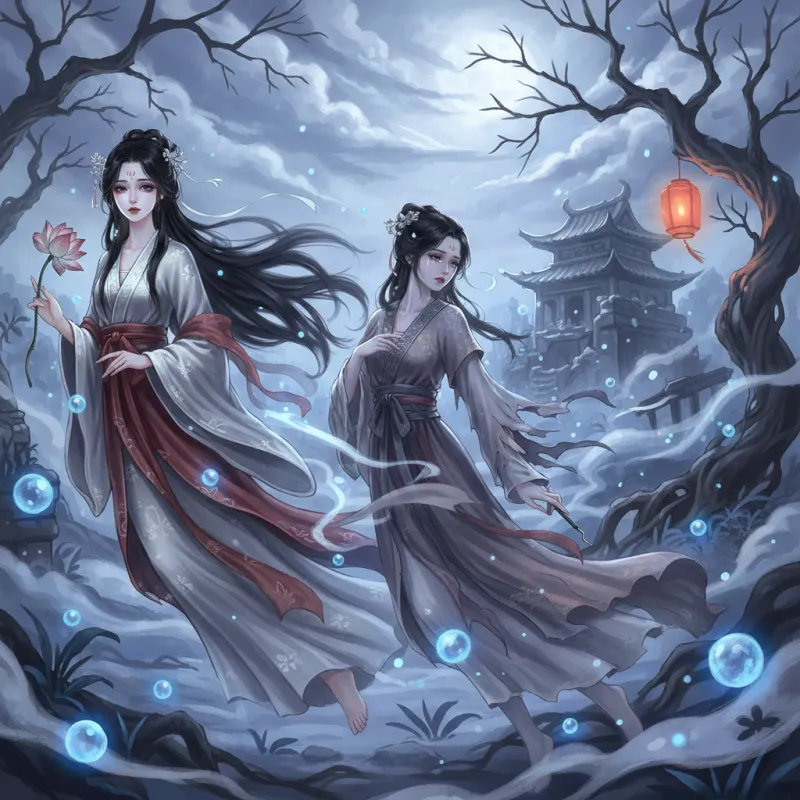
A young scholar walks alone through a moonlit garden, drawn by the scent of jasmine and the sound of silk rustling in the windless night. He turns a corner and sees her—a woman of impossible beauty, her pale face luminous against the darkness, her embroidered robes from a dynasty long fallen to dust. He knows, even as his heart races, that she is not alive. Yet he cannot look away. This is the moment that has haunted Chinese literature for over a thousand years: the encounter with the female ghost, beautiful and doomed, seductive and sorrowful, forever trapped between worlds.
The Paradox of Power and Powerlessness
Female ghosts in Chinese literature occupy a fascinating contradiction. In life, these women were often victims—murdered by jealous rivals, abandoned by faithless lovers, driven to suicide by unbearable social pressure. The patriarchal structures of imperial China gave them little agency, little voice, little hope. Yet in death, they become powerful. They can cross boundaries that living women never could. They seduce scholars, demand justice, even kill those who wronged them. The ghost Nie Xiaoqian (聂小倩, Niè Xiǎoqiàn) from Pu Songling's Strange Tales from a Chinese Studio (Liaozhai Zhiyi, 聊斋志异) perfectly embodies this transformation—forced to lure men to their deaths by a demon who controls her, she ultimately finds the courage to rebel and seek protection from a righteous scholar.
What makes these stories so compelling is that they don't simply reverse the power dynamic. The female ghost remains tragic even in her supernatural state. Xiaoqian may escape her demonic master, but she can never truly live. The fox spirits and vengeful ghosts that populate these tales are forever marked by what was done to them in life. Their beauty becomes a weapon, yes, but also a curse—it was often their beauty that led to their destruction in the first place.
The Scholar and the Ghost: A Recurring Romance
The most enduring narrative pattern in Chinese ghost literature is the romance between a living scholar and a dead woman. This trope appears again and again, from Tang dynasty tales through Qing dynasty collections. In these stories, the scholar—usually young, idealistic, and somewhat naive—encounters a beautiful woman in an isolated setting: an abandoned temple, a deserted garden, a lonely inn. They fall in love. The relationship is often consummated. Only later does he discover her true nature.
The most famous example is probably the story of Cui Yingying and Zhang Sheng, though technically Yingying isn't a ghost—but the ghostly romance reached its apex in stories like "Peony Pavilion" (Mudan Ting, 牡丹亭) by Tang Xianzu, written in 1598. In this masterpiece, Du Liniang (杜丽娘, Dù Lìniáng) dies of lovesickness after dreaming of her ideal lover. Three years later, she returns as a ghost to find him—the scholar Liu Mengmei, who has been dreaming of her too. Their love is so powerful that she is eventually resurrected, but only after navigating the bureaucracy of the underworld and the skepticism of the living world.
What's remarkable about these scholar-ghost romances is their subversive quality. In a society where marriages were arranged and romantic love was secondary to family duty, these stories offered a fantasy of pure emotional connection. The ghost woman chooses her lover based on his character and talent, not his family connections or wealth. She is often more educated, more passionate, and more loyal than any living woman could safely be. The fact that she's dead removes her from the social constraints that would otherwise make such a relationship impossible.
Beauty as Burden and Weapon
The physical beauty of female ghosts in Chinese literature is never incidental—it's central to their tragedy and their power. These ghosts are described in language that borders on the obsessive: skin like jade, eyebrows like distant mountains, lips like cherry blossoms, waists so slender they might snap in a strong wind. This beauty is what attracted male attention in life, often leading to their downfall. In death, it becomes the tool of their revenge or redemption.
Consider the story of Yan Ruyu (颜如玉, Yán Rúyù), whose name literally means "face like jade," from Strange Tales. She was a concubine who died young and returns to help a poor scholar succeed in the imperial examinations. Her beauty is explicitly described as supernatural—no living woman could be so perfect. But this perfection is also a reminder of her artificiality, her separation from the world of the living. She can help the scholar, even love him, but she cannot give him children or grow old with him. Her beauty is frozen, eternal, and ultimately sterile.
The female fox spirits that often overlap with ghost stories in Chinese literature take this dynamic even further. These supernatural beings can transform into beautiful women to seduce men, sometimes draining their life force in the process. The line between ghost and fox spirit is often blurred—both represent feminine beauty as something dangerous, alluring, and not quite human.
The Wronged Woman's Revenge
Not all female ghosts in Chinese literature are romantic figures. Many are agents of vengeance, returning from death to punish those who wronged them. These stories tap into deep anxieties about justice, guilt, and the consequences of mistreating women in a patriarchal society. The ghost of a murdered concubine might appear to her killer, driving him mad with terror. The spirit of a woman who died in childbirth might haunt the husband who neglected her. These vengeful ghosts are often more frightening than their romantic counterparts, their beauty twisted into something terrible.
The story of Qian Nü (倩女, Qiàn Nǚ), which inspired the modern film "A Chinese Ghost Story," features elements of both romance and revenge. Qian Nü is controlled by a tree demon who forces her to seduce men so the demon can consume their essence. She falls genuinely in love with the scholar Ning Caichen and tries to save him, but her situation is complicated by her own need for survival in the supernatural realm. The story raises uncomfortable questions: Is she a victim or a predator? Can love redeem someone who has killed? The ambiguity is intentional and powerful.
Social Commentary Through Supernatural Lens
What makes female ghost stories in Chinese literature more than just entertaining tales is their function as social commentary. Writers like Pu Songling (1640-1715) used supernatural fiction to critique the society they lived in. The ghosts in Strange Tales from a Chinese Studio are often more moral, more honest, and more admirable than the living humans they encounter. The female ghosts, in particular, expose the hypocrisy of a system that valued women's chastity above their happiness, that treated them as property to be traded between families, that gave them no recourse when they were abused or abandoned.
In one story, a ghost woman helps a scholar understand that his living wife, though plain and uneducated, is more valuable than any supernatural beauty. In another, a female ghost reveals the corruption of local officials who covered up her murder. These stories allowed writers to say things about gender, power, and justice that would have been dangerous to express directly. The supernatural setting provided a safe distance, a layer of deniability—after all, these were just ghost stories, entertainment, not serious social criticism.
The Enduring Appeal
Female ghosts continue to haunt Chinese literature and popular culture today. Modern novels, films, and television series return again and again to these figures, reinterpreting them for contemporary audiences. The 1987 film "A Chinese Ghost Story" became a classic, spawning sequels and remakes. Recent works like "The Ghost Bride" by Yangsze Choo bring these traditions to English-language readers, while Chinese authors continue to explore the archetype in new ways.
Why do these stories endure? Perhaps because they speak to something universal about love, loss, and the desire for justice. Perhaps because they offer a fantasy of female agency in contexts where it was historically denied. Or perhaps because they capture something true about memory and grief—the way the dead continue to haunt us, beautiful and terrible, demanding to be remembered, refusing to be forgotten. The female ghost in Chinese literature is more than a supernatural creature. She is a mirror held up to society, reflecting its values, its fears, and its failures. She is beautiful because beauty was all she was allowed to be. She is tragic because that beauty could not save her. And she is powerful because death, at least in these stories, offers a kind of freedom that life never could.
Related Reading
- Chinese Ghost Stories for Beginners: Where to Start
- The Drowning Ghost (水鬼): China's Most Feared Water Spirit
- Exploring Chinese Supernatural Folklore: Ghosts, Spirits, and Afterlife Beliefs
- River Gods and Water Deities in Chinese Mythology
- Ghost Marriage: Wedding the Dead
- Unraveling the Mystique of Chinese Supernatural Folklore and Afterlife Beliefs
- Exploring the Depths of Chinese Supernatural Folklore: Ghosts, Spirits, and Afterlife Beliefs
- The Enigmatic Spirit-Animals of Chinese Supernatural Folklore and Afterlife Beliefs
Explore Chinese Culture
- Explore ancient mythical creatures
- Explore Daoist exorcism traditions
- Explore Chinese folk beliefs and superstitions