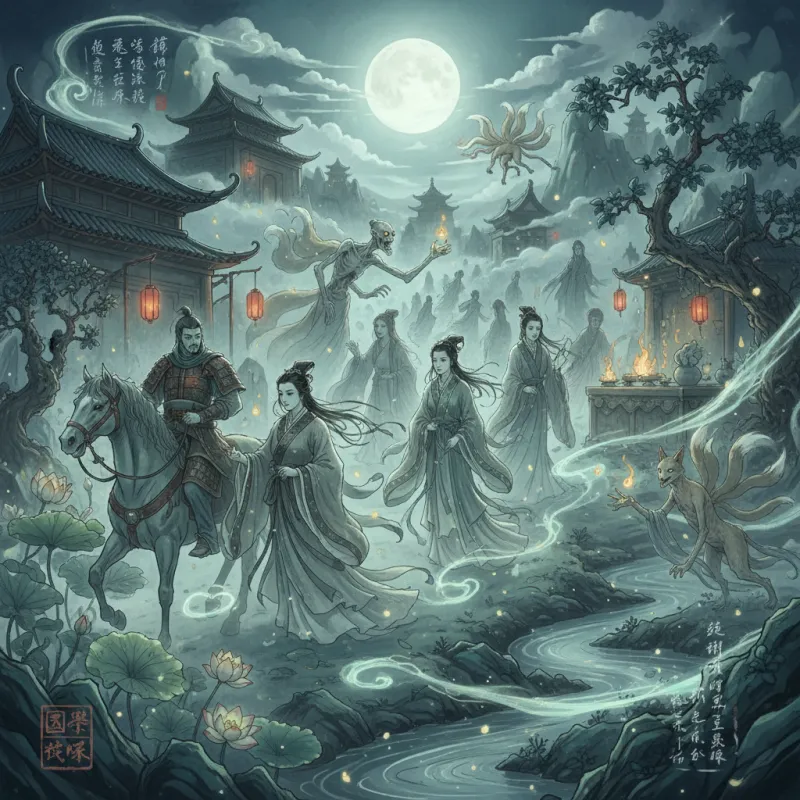
You're walking through a cemetery at dusk when you notice someone standing motionless between the graves. Their clothes are slightly wrong — the cut too old-fashioned, the fabric too pale. They turn to look at you, and you realize with a cold shock that their feet don't quite touch the ground. Congratulations: you've just spotted a yuānhún (冤魂), a wronged ghost, and your evening is about to get complicated.
Chinese ghost taxonomy is vast, specific, and deeply practical. Unlike Western ghost stories that treat all spirits as roughly equivalent spooky entities, Chinese folklore categorizes the dead with the precision of a field biologist sorting beetles. Each type of ghost has distinct characteristics, behaviors, and — most importantly — specific methods for dealing with them. This isn't academic. For centuries, knowing your èguǐ from your diàosǐguǐ could mean the difference between a peaceful night and a supernatural disaster.
The Hungry Ones: Starving in the Afterlife
The Hungry Ghost (饿鬼, èguǐ) is perhaps the most pitiable creature in Chinese supernatural folklore. Picture a being with a stomach the size of a mountain and a throat as narrow as a needle. They wander the mortal realm in perpetual agony, unable to consume enough to satisfy their hunger. Some descriptions give them distended bellies and stick-thin limbs. Others describe them as emaciated shadows that cluster around food offerings left for ancestors.
These aren't random punishments. Hungry Ghosts are created through karmic justice — they were greedy, wasteful, or stingy in life, and now they experience the ultimate consequence of their avarice. During the seventh lunar month, the Ghost Month, they're released from the underworld to roam freely. Smart families leave food offerings on the street, not out of generosity but out of self-preservation. A Hungry Ghost denied sustenance becomes desperate, and desperate ghosts cause problems.
The Yulanpen Sutra describes elaborate rituals to feed these spirits, and the Ghost Festival (中元节, Zhōngyuán Jié) exists primarily to prevent them from causing havoc. If you've ever wondered why your Chinese grandmother insists on leaving food out in July, this is why. She's not being superstitious — she's practicing preventive ghost management.
The Wronged Dead: Ghosts with Grievances
The yuānhún (冤魂) — literally "wronged soul" — is the ghost that refuses to move on because justice hasn't been served. These are murder victims, the falsely accused, those who died in disgrace. They're the engine that drives countless Chinese ghost stories, from classical tales in Strange Tales from a Chinese Studio to modern horror films.
Unlike Hungry Ghosts, wronged ghosts are focused and purposeful. They don't wander aimlessly — they haunt specific people or places connected to their injustice. The scholar who was framed for treason haunts the magistrate's office. The murdered concubine appears in her killer's bedroom. They're patient, calculating, and often terrifyingly effective at achieving revenge.
Nie Xiaoqian from Strange Tales is technically a wronged ghost, though she's been enslaved by a demon and forced to seduce men to their deaths. Her story illustrates an important principle: wronged ghosts can be sympathetic, even heroic, if their cause is just. The line between ghost and victim is often blurry. This complexity makes them far more interesting than simple monsters, and it's why they dominate Chinese supernatural fiction.
The Hanged and the Drowned: Death by Despair
Ghosts who died by suicide occupy a special category of danger. The diàosǐguǐ (吊死鬼) — hanging ghost — and the shuǐguǐ (水鬼) — drowning ghost — are trapped in an endless loop, compelled to recreate their deaths by finding substitutes. Only when someone else dies in the same manner can they escape to reincarnation.
This creates a grim supernatural economy. The hanging ghost lurks near the beam or tree where they died, whispering suggestions of despair to the depressed and desperate. The drowning ghost waits in rivers and ponds, pulling swimmers under. They're not evil by nature — they're trapped by the circumstances of their death, and they'll do anything to escape.
Folk wisdom offers protection: avoid swimming alone in unfamiliar waters, never stand under a beam where someone hanged themselves, and if you feel an inexplicable urge toward self-harm near a known suicide site, leave immediately. These aren't metaphors. In traditional belief, these ghosts are real, active, and hunting for release.
The Violent Dead: Ghosts Soaked in Blood
The lìguǐ (厉鬼) — fierce ghost — is what happens when someone dies violently and angry. Battlefield casualties, murder victims, those killed in accidents — if they died with rage in their hearts, they return as something dangerous. These ghosts have power proportional to the violence of their death. A soldier killed in battle might become a minor nuisance. A victim of torture who died cursing their killers becomes a supernatural catastrophe.
Lìguǐ don't just haunt — they attack. They can cause illness, madness, and death. They're the ghosts that require professional intervention, the ones that send families running to Taoist priests or Buddhist monks for exorcism rituals. The famous ghost Nie Yinniang in Tang dynasty tales was so fierce that even demons feared her.
These ghosts appear frequently in Chinese exorcism practices, where they represent the most challenging cases. A Taoist master might handle a dozen minor hauntings without breaking a sweat, but a single lìguǐ requires elaborate rituals, protective talismans, and sometimes the intervention of celestial bureaucrats.
The Forgotten Dead: Ghosts Without Descendants
Perhaps the saddest category is the gūhún yěguǐ (孤魂野鬼) — lonely souls and wild ghosts. These are the dead who have no living descendants to make offerings, no one to remember their names, no place in the ancestral tablets. They wander as spiritual homeless, neither fully in the underworld nor properly in the mortal realm.
Chinese ancestor veneration isn't just about respect — it's a practical system for maintaining the dead. Regular offerings of food, incense, and paper money keep ancestors comfortable in the afterlife and prevent them from becoming desperate ghosts. But what happens to those without families? They become gūhún, clustering around temples during festivals, hoping for scraps of attention from strangers' offerings.
Communities traditionally held rituals for these forgotten dead, recognizing that neglected ghosts become dangerous ghosts. The Ghost Festival includes provisions for feeding wandering spirits without families. It's a form of supernatural social welfare, acknowledging that even the dead need a safety net.
The Bureaucratic Dead: Ghosts with Jobs
Not all ghosts are suffering. Some have positions in the underworld bureaucracy. The guǐchāi (鬼差) — ghost messenger — works for the underworld administration, escorting newly dead souls to judgment. The niútóu mǎmiàn (牛头马面) — ox-head and horse-face — serve as underworld guards and enforcers.
These aren't ghosts in the traditional sense — they're more like civil servants who happen to be dead. They have authority, responsibilities, and the backing of celestial law. Encountering one means you're either dead yourself or witnessing official underworld business. Either way, it's best to be respectful.
This bureaucratic element distinguishes Chinese ghost lore from Western traditions. The afterlife isn't chaos — it's an organized system with rules, hierarchies, and paperwork. Even death has administrators. It's simultaneously comforting (there's order) and terrifying (you can't escape bureaucracy even after death).
Living with the Dead: Practical Ghost Management
Understanding ghost types isn't academic — it's survival knowledge. Different ghosts require different responses. Hungry Ghosts need offerings. Wronged ghosts need justice or appeasement. Suicide ghosts need to be avoided. Fierce ghosts need professional exorcists.
The sophistication of Chinese ghost taxonomy reflects centuries of practical experience. These categories emerged from countless encounters, observations, and experiments in dealing with the supernatural. They're refined through trial and error, passed down through families, and codified in religious texts.
Modern skeptics might dismiss this as superstition, but the system's internal logic is impressive. It treats ghosts as natural phenomena with predictable behaviors and manageable risks. You don't need to believe in ghosts to appreciate the psychological and social functions this taxonomy serves — providing explanations for misfortune, maintaining social bonds through ancestor veneration, and offering ritual solutions to grief and trauma.
The next time you encounter something inexplicable — a cold spot in a warm room, a shadow that moves wrong, a feeling of being watched in an empty house — you'll know what questions to ask. Is this a hungry ghost seeking offerings? A wronged soul demanding justice? Or just your imagination, shaped by centuries of stories about the dead who will not leave?
For more on specific ghost encounters and how to handle them, see Chinese Ghost Stories and Their Meanings. And if you're dealing with something more aggressive, you might need to consult guides on dealing with malevolent spirits.
Related Reading
- The Drowning Ghost (水鬼): China's Most Feared Water Spirit
- River Gods and Water Deities in Chinese Mythology
- Chinese Ghost Stories for Beginners: Where to Start
- Exploring Chinese Supernatural Folklore: Ghosts, Spirits, and Afterlife Beliefs
- Female Ghosts in Chinese Literature: Beauty and Tragedy
- Unraveling the Mystique of Chinese Supernatural Folklore and Afterlife Beliefs
- Jiangshi: The Hopping Vampire Genre That Conquered Hong Kong Cinema
- Unveiling Chinese Supernatural Folklore: Ghosts, Spirits, and Afterlife Beliefs
Explore Chinese Culture
- Explore ancient mythical creatures
- Explore Daoist exorcism traditions
- Explore Chinese folk beliefs and superstitions