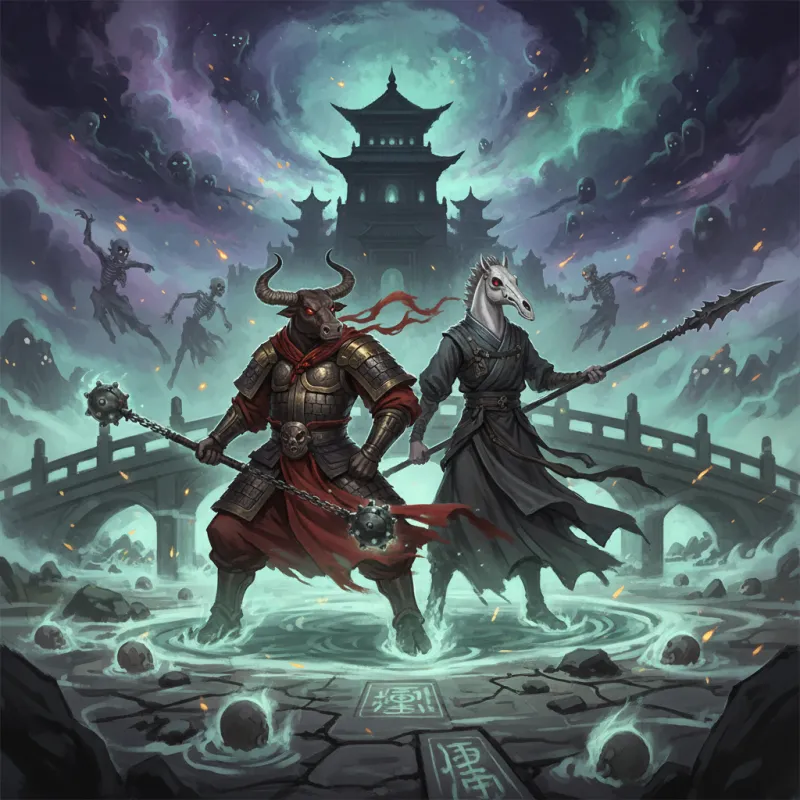
Picture this: you're lying in bed, fever burning through you, when the door opens. Two figures step inside—one with the massive, horned head of an ox, the other with the long, skeletal face of a horse. They're not here to negotiate. They pull out a scroll, check your name, and nod. Your time's up. In Chinese folklore, death doesn't send a single reaper—it sends a bureaucratic tag team.
The Underworld's Most Efficient Civil Servants
Ox-Head and Horse-Face (牛头马面, Niútóu Mǎmiàn) are the foot soldiers of the Chinese afterlife administration. While the Ten Kings of Hell sit in judgment and Yanluo Wang presides over the entire operation, these two are the ones who actually show up at your deathbed. They're not demons in the Western sense—they don't tempt, they don't torture (that comes later), and they certainly don't freelance. They're messengers, escorts, soul collectors with a job to do.
The ox-headed one, Niútóu, typically carries a trident or pitchfork. The horse-faced one, Mǎmiàn, often holds chains or a rope. Their appearance in Ming and Qing dynasty woodblock prints is consistent: humanoid bodies, animal heads, official robes or armor, and an air of grim professionalism. They're not there to scare you—though they absolutely will—they're there because your name appeared on a list.
What makes them fascinating is their neutrality. They don't decide who dies. They don't care if you were a saint or a serial killer. The Book of Life and Death says you're done? They come get you. It's nothing personal. It's just paperwork.
Origins: Buddhist Hell Meets Chinese Bureaucracy
The earliest mentions of Ox-Head and Horse-Face appear in Buddhist sutras translated into Chinese during the Tang Dynasty (618-907 CE). In Indian Buddhist cosmology, hell guardians often took animal forms—yaksha demons, multi-headed beasts, creatures designed to terrify. When these texts reached China, something interesting happened: the terrifying became administrative.
Chinese culture already had a deep reverence for bureaucracy. The imperial examination system, the complex hierarchy of officials, the obsessive record-keeping—all of this shaped how the Chinese imagined the afterlife. Why would the underworld be any different from the imperial court? So these Buddhist hell guardians got a job description, a chain of command, and a dress code.
By the Song Dynasty (960-1279 CE), Ox-Head and Horse-Face had become fixtures in popular literature and religious texts. They appeared in Journey to the West (西游记, Xīyóu Jì), written in the 16th century, where they're depicted as low-ranking but essential functionaries. When Sun Wukong storms the underworld and tears up the Book of Life and Death, Ox-Head and Horse-Face are there, panicking like middle managers during an audit.
The genius of their design is the choice of animals. Oxen and horses were the primary beasts of burden in agricultural China—strong, tireless, obedient. They pull plows, they haul carts, they do the heavy work without complaint. Perfect metaphor for underworld enforcers who carry souls whether those souls want to go or not.
What They Actually Do (And Don't Do)
Let's be clear about their job description. Ox-Head and Horse-Face are soul escorts, not executioners. When your death date arrives—predetermined and recorded in the underworld's ledgers—they receive the assignment. They manifest in the mortal realm, usually invisible to everyone except the dying person, and present themselves.
In traditional accounts, they're polite. They show you the paperwork. Your name, your death date, the seal of the underworld court. This isn't a kidnapping—it's a legal summons. You can't argue with it, but they'll at least show you the documentation.
Once you accept (or once your soul separates from your body, willing or not), they escort you down to the underworld. The journey varies depending on the text. Sometimes it's through a dark tunnel, sometimes across a bridge, sometimes through a series of gates. But Ox-Head and Horse-Face stay with you the entire way, making sure you don't get lost, don't try to run, and arrive at the correct court for judgment.
They don't torture. That's not their department. Once they deliver you to the appropriate King of Hell, their job is done. The actual punishment—the grinding, the boiling, the mountain of knives—that's handled by specialized demons under the supervision of the judges. Ox-Head and Horse-Face are logistics, not enforcement.
There are stories, though, of them making mistakes. Grabbing the wrong soul because of a clerical error, showing up too early because someone in the underworld bureaucracy miscalculated. In these tales, they're usually apologetic and willing to fix the problem—after all, they're just following orders. The most famous example involves a man who convinces them to check their paperwork again, discovers the error, and gets sent back to life with an apology and a few extra years added to his lifespan as compensation.
The Iconography: Why They Look Like That
Walk into any traditional Chinese temple with an underworld section, and you'll see them. Ox-Head on one side of the entrance, Horse-Face on the other, like bouncers at the world's most exclusive (and least desirable) club. The statues are usually life-sized or larger, painted in vivid colors—red skin, black armor, white teeth bared in permanent grimaces.
The ox head is almost always depicted with horns, sometimes multiple sets, and a ring through the nose. The symbolism is deliberate: oxen are controlled by nose rings, led where their masters want them to go. Ox-Head, despite his fearsome appearance, is ultimately obedient to the underworld hierarchy.
Horse-Face typically has an elongated skull, prominent teeth, and wild eyes. Horses in Chinese culture represent speed and endurance—appropriate for a messenger who must travel between the realms of the living and the dead. Some depictions give him a mane of wild hair, others show him with a more skeletal, death-like appearance.
Both figures wear official robes or armor, often with insignia indicating their rank in the underworld bureaucracy. This is crucial: they're not wild demons or chaotic spirits. They're uniformed officers of a cosmic government. The clothing legitimizes their authority and reminds viewers that the afterlife operates under law, not chaos.
In folk art and opera, they're sometimes played for dark comedy. Their animal heads make them instantly recognizable, and their bureaucratic nature allows for satire about government officials, corruption, and the absurdity of paperwork even in death. A Ming Dynasty play features them arguing about whose turn it is to collect a particularly difficult soul, like coworkers fighting over who has to handle the annoying client.
Cultural Impact: From Temple Guardians to Pop Culture
Ox-Head and Horse-Face have transcended their religious origins to become cultural icons. They appear in Chinese opera, where actors wear elaborate masks and perform stylized movements suggesting their animal nature. They show up in ghost stories as harbingers of death—if you see them, even in a dream, it's considered a very bad omen.
Modern Chinese horror films and TV shows love them. They're visually striking, immediately recognizable, and carry centuries of cultural weight. A 2017 fantasy film depicted them as conflicted enforcers, questioning their role in the cosmic order—a very modern take on ancient mythology. Video games set in Chinese mythological worlds almost always include them as boss fights or NPCs, usually guarding the entrance to underworld levels.
What's interesting is how they've maintained their bureaucratic nature even in contemporary retellings. They're rarely portrayed as evil, just as doing their job. This reflects something deep in Chinese cultural attitudes toward authority and fate—the system may be harsh, but it's not personal. The officials enforcing it are just following orders.
In Taiwan and Hong Kong, you'll still find people making offerings to Ox-Head and Horse-Face at temples, asking them to delay their visit or to be gentle with deceased relatives. It's a pragmatic approach to death: you can't avoid it, but maybe you can negotiate with the messengers.
The Philosophy Behind the Messengers
There's something almost comforting about Ox-Head and Horse-Face, despite their terrifying appearance. They represent the idea that death, while inevitable, is orderly. You're not snatched away by random chance or malevolent spirits—you're collected according to a schedule, by authorized personnel, with proper documentation.
This reflects the Chinese philosophical approach to death, influenced by both Buddhism and Confucianism. Death isn't an ending or a punishment; it's a transition, a bureaucratic process. You die, you're escorted to judgment, you're assigned to the appropriate afterlife based on your deeds. It's systematic, it's fair (in theory), and it's managed by a vast administrative apparatus.
The animal heads serve another purpose: they make death slightly less human, slightly more bearable. If death came as a human figure, it might be too relatable, too personal. The animal heads create distance, make the messengers into something other, something that exists outside normal human categories. You can't reason with them, can't appeal to their humanity, because they're not quite human.
Yet they're not entirely inhuman either. They speak, they follow rules, they can make mistakes. They exist in that liminal space between human and animal, living and dead, chaos and order—which is exactly where death itself exists.
Meeting Them: What the Stories Say
Traditional accounts of encounters with Ox-Head and Horse-Face follow certain patterns. They typically appear at night, often during the hour of the ox (1-3 AM) or the hour of the horse (11 AM-1 PM)—a nice touch of cosmic synchronicity. The dying person sees them first as shadows, then as distinct figures, then in full terrifying detail.
Some stories describe them as cold to the touch, others say they smell of incense and decay. They rarely speak unless spoken to, and when they do, their voices are described as harsh, animal-like, but perfectly understandable. They're not there to chat—they're there to collect.
The most detailed accounts come from people who claim to have been taken by mistake and sent back. These near-death experiences, recorded in texts like Yuewei Caotang Biji (阅微草堂笔记, Notes from the Yuewei Hermitage) by Ji Yun in the 18th century, describe the journey to the underworld in vivid detail. Ox-Head and Horse-Face are portrayed as efficient but not cruel, hurrying the soul along but not mistreating it.
One famous story tells of a scholar who, upon seeing them, immediately started reciting Buddhist sutras. Ox-Head and Horse-Face waited patiently until he finished, then politely informed him that while his devotion was admirable, it wouldn't change the fact that his time was up. They appreciated the effort, though.
The message is clear: you can't bargain with death's messengers. But you can face them with dignity, and they'll respect that. They're not monsters—they're professionals doing an unpleasant but necessary job. And in the end, everyone meets them. Even emperors. Even saints. Even the people who spent their lives trying to achieve immortality.
When Ox-Head and Horse-Face come for you, the only thing that matters is whether your name is on their list. And if it is, you're going with them. No exceptions, no appeals, no second chances. Just two figures with animal heads, a scroll with your name on it, and a one-way trip to the underworld courts.
That's the deal. That's always been the deal.
Related Reading
- How to Avoid Punishment in Chinese Hell: Loopholes, Bribes, and Good Behavior
- The Ten Kings of Hell: A Complete Guide to Chinese Underworld Justice
- The Underworld Courts: How Chinese Hell Judges the Dead
- Mengpo Soup: The Drink That Erases Memory
- Fox Spirits in Chinese Culture: Tricksters, Lovers, and Gods
- Ghosts of the Beijing Subway: Urban Legends Underground
- Exploring the Multifaceted World of Chinese Supernatural Folklore and Afterlife Beliefs
Explore Chinese Culture
- Explore ancient mythical creatures
- Explore Daoist exorcism traditions
- Explore Chinese folk beliefs and superstitions