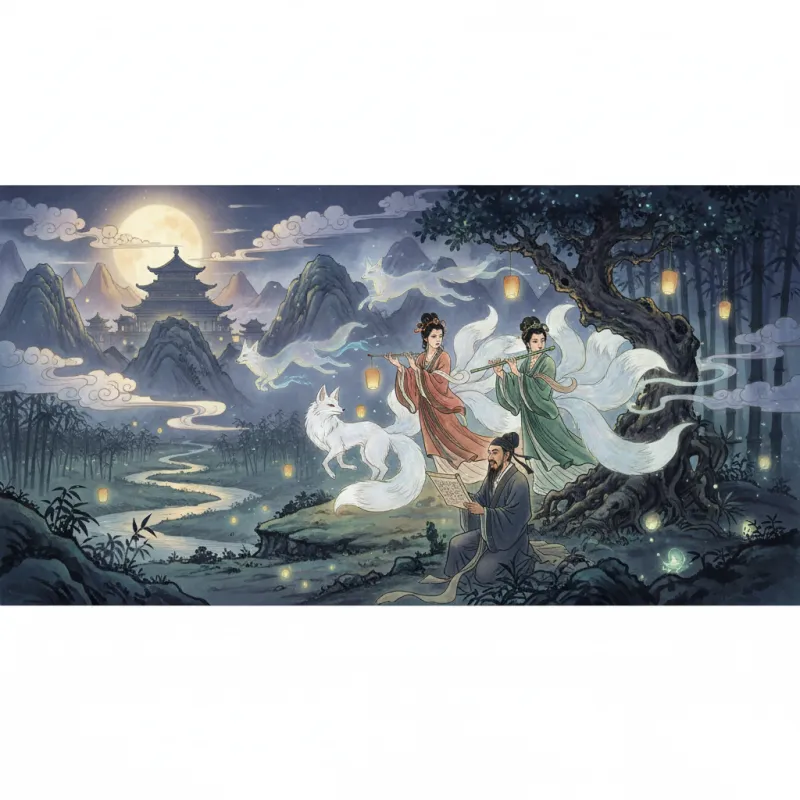
A nine-tailed fox once seduced an emperor and nearly destroyed a dynasty. She wasn't the first, and she certainly wasn't the last. For over two thousand years, fox spirits—huli jing (狐狸精)—have haunted Chinese literature, slipping between human and animal form, between virtue and vice, between this world and the next. They're lovers and tricksters, enlightened sages and vengeful demons, and they've captivated storytellers from the Han dynasty to modern cinema.
The Ancient Origins: When Foxes First Spoke
The Shan Hai Jing (山海经, Shānhǎi Jīng, Classic of Mountains and Seas), compiled sometime during the Warring States period (475-221 BCE), gives us our earliest written glimpse of supernatural foxes. But these weren't the seductive beauties of later tales—they were omens. A nine-tailed fox appearing in the Qingqiu hills signaled either great fortune or imminent disaster, depending on which scholar you asked. The text describes them matter-of-factly, the way you'd catalog any other strange creature: "Its voice is like that of an infant, it eats people, and whoever eats it will be protected from insect poison."
By the Han dynasty (206 BCE - 220 CE), foxes had evolved from simple omens into something more complex. They could live for centuries, and after fifty years, a fox could transform into a woman. After a hundred years, it could become a beautiful young girl or a medium who communicated with the dead. The longer a fox lived, the more tails it grew—up to nine—and the more powerful it became. This wasn't just folklore; scholars debated fox transformation in serious philosophical texts, trying to understand how an animal could accumulate enough qi (气) to transcend its nature.
Daji: The Fox Who Toppled a Dynasty
Every discussion of fox spirits eventually circles back to Daji (妲己), the concubine who seduced King Zhou of Shang and brought about his dynasty's collapse around 1046 BCE. The historical Daji was probably just a woman, but by the time the Ming dynasty novel Fengshen Yanyi (Investiture of the Gods) was written in the 16th century, she'd become something far more sinister: a thousand-year-old nine-tailed fox spirit who possessed a human woman's body.
The novel describes her crimes in lurid detail. She invented new tortures for the king's entertainment, including the infamous "roasting pillar"—a bronze column heated until it glowed red, which prisoners were forced to walk across. She had the king's pregnant concubine cut open to settle a bet about whether she was carrying a boy or a girl. She bathed in wine pools and wandered through forests of hanging meat, turning the palace into a den of depravity. When the dynasty finally fell, the fox spirit fled, but not before leaving a template that would define malevolent fox spirits for centuries: beautiful, seductive, cruel, and ultimately destructive to the men who desired them.
The Golden Age: Pu Songling's Strange Tales
If Daji represents the dark side of fox spirit lore, Pu Songling's (蒲松龄) Liaozhai Zhiyi (聊斋志异, Strange Tales from a Chinese Studio, 1740) shows us the full spectrum. This collection of nearly five hundred supernatural tales includes dozens of fox spirit stories, and they're remarkably varied. Some fox spirits are indeed seductresses who drain men's life force through sex, but others are devoted wives, loyal friends, or even victims themselves.
Take "Xiao Cui," a story about a fox spirit who helps a young scholar recover from an illness caused by another supernatural entity. She's competent, compassionate, and completely uninterested in seduction. Or "Lotus Fragrance," where a fox spirit and a ghost become lovers, and the fox is the more virtuous of the two. Pu Songling wrote during the Qing dynasty, when fox spirit cults had become widespread—people actually built shrines to fox spirits and prayed to them for help with everything from illness to business ventures. His stories reflect this complexity: foxes could be dangerous, yes, but they could also be more honorable than humans.
The scholar Judith Zeitlin has argued that Pu Songling's fox spirits often serve as social critics, pointing out the hypocrisy and corruption of human society. When a fox spirit chooses to live as a faithful wife rather than return to the wild, she's making a statement about what it means to be civilized. When she's more honest than the human scholars around her, Pu Songling is asking uncomfortable questions about who the real monsters are.
The Mechanics of Transformation
Chinese folklore is surprisingly specific about how fox transformation works. It's not instant magic—it requires cultivation, discipline, and time. A fox must live for at least fifty years before attempting human form, and the process involves absorbing yang energy (阳气, yáng qì), typically from the sun, moon, or from humans themselves.
The most common method described in texts is caiyáng bǔyīn (采阳补阴, "harvesting yang to supplement yin"). A fox spirit in female form seduces men and absorbs their vital essence through sexual intercourse, gradually becoming more human while the man weakens and eventually dies. This is why fox spirits in folklore are so often depicted as beautiful women who prey on scholars—scholars were seen as having particularly refined jing (精, vital essence) worth stealing.
But there are other paths. Some texts describe foxes bowing to the moon for decades, slowly accumulating celestial energy. Others mention foxes studying Daoist texts or Buddhist sutras, achieving transformation through spiritual cultivation rather than predation. The Yuewei Caotang Biji (Notes from the Yuewei Hermitage), written by Ji Yun (纪昀) in the late 18th century, includes several stories of scholarly foxes who've achieved human form through meditation and study, never harming anyone.
The physical transformation itself is often described as imperfect. A fox spirit might forget to hide its tail, or its shadow might still show fox ears. Some can't completely eliminate their fox smell, which dogs can detect even when humans can't. In many stories, the fox spirit's true nature is revealed at a moment of strong emotion—anger, fear, or passion—when the illusion briefly slips.
Fox Spirits and Gender Politics
It's impossible to discuss fox spirits without addressing the obvious: the vast majority are female, and their stories are deeply entangled with Chinese attitudes toward women and sexuality. The term huli jing itself became slang for a seductive, dangerous woman—a homewrecker, essentially. Even today, calling someone a huli jing is an insult implying sexual manipulation and moral corruption.
But this gendering is more complex than simple misogyny. Rania Huntington, in her book Alien Kind: Foxes and Late Imperial Chinese Narrative, points out that fox spirits occupy a liminal space that allowed writers to explore ideas about gender, sexuality, and social roles that would be dangerous to address directly. A fox spirit woman could be educated, sexually assertive, and independent—qualities that would be scandalous in a human woman—because she wasn't quite human. She existed outside the Confucian social order, which meant she could critique it.
Male fox spirits do exist in the literature, though they're far less common. They tend to appear as scholars or officials, and their stories often focus on friendship rather than seduction. The Zibuyu (What the Master Would Not Discuss), compiled by Yuan Mei (袁枚) in the 18th century, includes several tales of male fox spirits who help human friends pass examinations or navigate bureaucratic challenges. These stories suggest that male fox spirits had to prove their worth through Confucian virtues—loyalty, scholarship, proper conduct—while female fox spirits were defined primarily by their sexuality.
Fox Cults and Religious Practice
By the Qing dynasty (1644-1912), fox spirit worship had become so widespread that the government tried repeatedly to suppress it. Shrines to Húxiān (狐仙, fox immortals) appeared throughout northern China, particularly in homes and businesses. People offered incense, food, and prayers, asking fox spirits for protection, prosperity, and help with illness. Some families maintained fox shrines for generations, treating the resident spirit as a household guardian similar to kitchen gods and household deities.
These weren't the seductive, dangerous foxes of literature—or rather, they were the same beings, but approached with respect and caution. The logic was simple: fox spirits were powerful and potentially dangerous, so it was better to have them as allies than enemies. Offerings and proper respect could ensure their benevolence. Neglect or disrespect could bring disaster.
The practice was particularly common among merchants and performers, groups that existed on the margins of respectable Confucian society. Fox spirits, themselves liminal beings, became patron deities for those who lived by their wits rather than by land or official position. Shamanistic mediums, usually women, would claim to channel fox spirits, delivering prophecies and healing advice. The Qing government viewed these practices with deep suspicion, seeing them as heterodox and potentially subversive, but they persisted anyway.
Modern Transformations
Fox spirits never disappeared from Chinese culture—they just shapeshifted again, adapting to new media and new audiences. In the 20th century, they moved from classical tales into popular fiction, film, and television. The 1987 television series Liaozhai brought Pu Songling's stories to millions of viewers, cementing the fox spirit as a staple of Chinese fantasy. More recently, films like Painted Skin (2008) and its sequel have reimagined fox spirits for contemporary audiences, often emphasizing their tragic aspects—creatures caught between two worlds, belonging fully to neither.
In these modern retellings, fox spirits often become sympathetic protagonists rather than antagonists. They're outsiders seeking acceptance, lovers willing to sacrifice everything for human partners, or rebels against a cosmic order that denies them full personhood. This shift reflects changing attitudes toward the "other" in Chinese society, but it also continues a tradition that was always present in the literature: the recognition that fox spirits, for all their strangeness, might be more human than humans themselves.
The internet age has given fox spirits yet another transformation. They appear in web novels, video games, and anime-influenced art, often stripped of their darker associations and reimagined as cute, mischievous, or heroic. The jiǔwěihú (九尾狐, nine-tailed fox) has become a popular character archetype in Chinese fantasy, sometimes barely recognizable from its origins in the Shan Hai Jing.
Why Fox Spirits Endure
After two millennia, fox spirits remain one of Chinese folklore's most compelling figures because they embody fundamental human anxieties and desires. They represent the fear of deception—that the beautiful person you love might be something else entirely. They represent the desire for transformation—the hope that through cultivation and effort, you can transcend your nature. They represent the tension between civilization and wildness, between the social order and individual desire.
Fox spirits also offer something that purely human characters cannot: the perspective of an outsider who has chosen to enter human society. They can see our absurdities and hypocrisies clearly because they're not bound by them. When a fox spirit in Pu Songling's tales acts with more integrity than the human scholars around her, it's a devastating critique of what civilization has become.
Perhaps most importantly, fox spirits are survivors. They've adapted to every dynasty, every social change, every new medium of storytelling. They've been omens, demons, lovers, friends, deities, and pop culture icons. Like the creatures themselves, the stories shapeshift to fit new contexts while maintaining their essential nature. As long as humans are fascinated by transformation, seduction, and the boundaries between human and animal, self and other, fox spirits will continue to haunt our stories—beautiful, dangerous, and impossible to pin down.
Related Reading
- The Complete Guide to Chinese Supernatural Folklore: Ghosts, Demons, and Spirit World
- Exploring Chinese Supernatural Folklore: Ghosts, Spirits, and Afterlife Beliefs
- Door Gods: Guardians Against Evil Spirits
- Door Gods and Protective Spirits: China's Supernatural Security System
- Hungry Ghost Festival: Traditions and Taboos
- Unveiling the Secrets of Chinese Supernatural Folklore and Afterlife Beliefs
- Chinese Ghosts: A Field Guide to the Dead Who Will Not Leave
- Zhong Kui: The Demon Queller Who Failed His Exams
Explore Chinese Culture
- Explore ancient mythical creatures
- Explore Daoist exorcism traditions
- Explore Chinese folk beliefs and superstitions