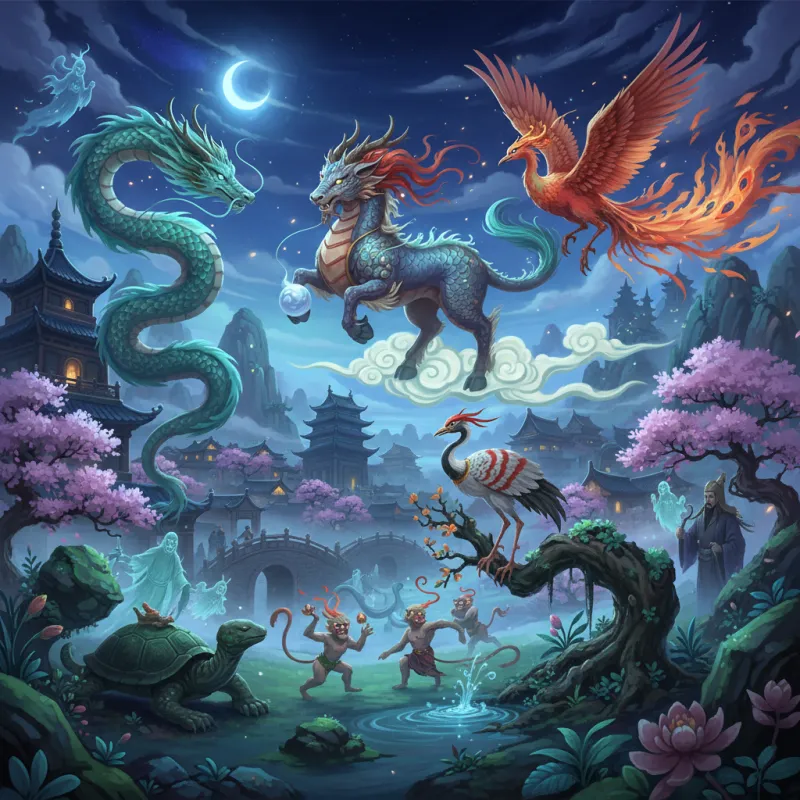
A white snake coils around a Buddhist monk's staff in a flooded temple. A turtle the size of a house rises from West Lake, its shell carved with ancient characters. A weasel stands on its hind legs in a moonlit courtyard, bowing to the North Star. If you think Chinese supernatural animals begin and end with fox spirits, you've been watching too many period dramas. The fox spirit might dominate modern adaptations, but the classical texts tell a different story — one populated by dozens of species, each with their own cultivation methods, regional strongholds, and relationships with humans.
The Cultivation Hierarchy: Not All Animals Are Created Equal
Chinese folk religion operates on a simple principle: time plus spiritual practice equals power. Any animal that survives long enough — we're talking centuries, not decades — can begin the process of 修炼 (xiūliàn, cultivation). But here's where it gets interesting: different species have different aptitudes. The texts are remarkably consistent about this hierarchy.
Foxes, snakes, and weasels sit at the top tier. They're the natural talents, the animals that can achieve human transformation within a few hundred years of dedicated practice. Turtles and cranes occupy the middle tier — they live longer but cultivate slower, often requiring a thousand years to match what a fox accomplishes in three hundred. At the bottom, you have hedgehogs, cats, and rats. They can cultivate, but it's an uphill battle. A hedgehog spirit in 聊斋志异 (Liáozhāi Zhìyì, Strange Tales from a Chinese Studio) complains about this exact problem: "We hedgehogs must work three times as hard as foxes for half the result."
The 五大仙 (wǔ dà xiān, Five Great Immortals) of northeastern China formalized this hierarchy into folk religion: Fox (狐), Weasel (黄, literally "yellow"), Snake (蛇 or 柳, "willow"), Hedgehog (刺猬), and Rat (鼠). Notice what's missing? Tigers, dragons, phoenixes — the animals that dominate imperial symbolism are largely absent from folk supernatural traditions. The Five Great Immortals are all small, adaptable creatures that live in close proximity to humans. There's a logic here: supernatural power comes from observing and mimicking human behavior, and you can't do that from a mountain peak or ocean depths.
Snake Spirits: The Underestimated Rivals
If foxes are the celebrities of Chinese supernatural animals, snakes are the method actors — less flashy, more dangerous, and often more powerful. The most famous snake spirit in Chinese literature is 白素贞 (Bái Sùzhēn) from 白蛇传 (Bái Shé Zhuàn, Legend of the White Snake), but she's an outlier. Most snake spirits in the classical texts are not romantic heroines. They're territorial, vengeful, and deeply invested in their cultivation progress.
Snake spirits have several advantages over foxes. First, they're harder to identify. A fox spirit might give herself away through vulpine mannerisms or the lingering scent of fox musk, but a snake spirit in human form is nearly indistinguishable from a real human. Second, snake spirits are often more powerful in direct confrontation. 聊斋 contains multiple stories where snake spirits defeat or kill fox spirits in territorial disputes. Third — and this is crucial — snake spirits have better relationships with Buddhist and Daoist institutions. Many temples keep snake spirits as guardians. The fox's reputation as a seductress works against her in religious contexts; the snake's association with dragons and water deities works in her favor.
Regional variations matter enormously. In southern China, particularly around Hangzhou and the Yangtze River Delta, snake spirits are more common than fox spirits in local folklore. The climate supports larger snake populations, and the region's Buddhist temples have long traditions of snake veneration. Northern snake spirits, by contrast, are rarer and often portrayed as refugees from the south, seeking new territory.
Weasel Spirits: The Tricksters Nobody Talks About
黄鼠狼 (huángshǔláng, yellow weasel) spirits occupy a strange position in Chinese supernatural taxonomy. In northeastern China and parts of Shandong, they're members of the Five Great Immortals and receive regular offerings. In other regions, they're considered pests — supernatural vermin that possess humans, steal offerings meant for other spirits, and generally cause chaos.
The weasel's signature ability is possession. While fox spirits typically seduce and snake spirits intimidate, weasel spirits jump into human bodies and take control. The possessed person — called 黄大仙附体 (huáng dàxiān fùtǐ, possessed by the Great Yellow Immortal) — speaks in a different voice, displays superhuman strength, and often demands specific offerings before releasing the victim. This is not metaphorical. In rural northeastern China, weasel possession was (and in some areas still is) a recognized medical condition with specific treatment protocols.
Weasel spirits are also notorious shapeshifters, but with a twist: they prefer to transform into specific human types. Old women, traveling merchants, and Buddhist monks are favorite disguises. Why? Because these identities allow weasels to move freely through human society while explaining away any odd behavior. An old woman acting strangely is just senile; a traveling merchant with unusual goods is just exotic; a monk with peculiar habits is just eccentric. The weasel spirit understands social camouflage in ways that fox spirits, with their preference for beautiful young women, never quite master.
Turtle and Crane Spirits: The Long Game
If foxes are sprinters and snakes are middle-distance runners, turtles and cranes are ultramarathoners. These species cultivate slowly but can reach extraordinary ages and power levels. The trade-off is time — a turtle spirit might need two thousand years to achieve what a fox accomplishes in five hundred.
Turtle spirits (龟精, guījīng) appear frequently in stories set near large bodies of water. They're almost always portrayed as ancient, patient, and deeply knowledgeable. Unlike fox and snake spirits, who often seek human interaction, turtle spirits are content to cultivate in isolation for centuries. When they do interact with humans, it's usually because someone has disturbed their territory or because they're seeking a specific item needed for their cultivation. The turtle spirit in 西游记 (Xīyóu Jì, Journey to the West) who carries the pilgrims across a river is typical: helpful but transactional, with a very long memory.
Crane spirits (鹤精, hèjīng) are rarer in folk tales but prominent in Daoist literature. They're associated with immortals and often serve as mounts or messengers for cultivated humans. The interesting thing about crane spirits is that they seem to skip the "dangerous to humans" phase that most other animal spirits go through. Perhaps it's because cranes don't eat meat, or perhaps it's their association with Daoist practice, but crane spirits in the literature are almost universally benevolent or neutral. They're the vegetarians of the supernatural animal world.
The Weird Ones: Hedgehogs, Cats, and Regional Specialists
Hedgehog spirits (刺猬精, cìwèijīng) are the underdogs of Chinese supernatural animals. They're part of the Five Great Immortals, but barely. Most hedgehog spirit stories involve them trying to prove themselves, seeking recognition, or complaining about how hard cultivation is for their species. There's something almost comedic about hedgehog spirits in the literature — they're earnest, hardworking, and perpetually overshadowed by more glamorous species.
Cat spirits (猫精, māojīng) occupy an ambiguous position. In some regions, particularly in southern China, cats are considered capable of cultivation and potentially dangerous. In other areas, cats are seen as protectors against supernatural threats, particularly rat spirits. The inconsistency might stem from the cat's relatively recent domestication in China (compared to dogs) and its association with both Buddhist temples and folk superstitions about corpses.
Then you have the regional specialists. In Yunnan and Guizhou, you find stories of monkey spirits (猴精, hóujīng) that are largely absent from northern literature. Coastal regions have fish and crab spirits. Sichuan has a tradition of pig spirits that doesn't exist elsewhere. These regional variations suggest that supernatural animal folklore developed locally, based on which animals people actually encountered, rather than being imposed from a central textual tradition.
Why Fox Spirits Dominate Modern Adaptations
Given this diversity, why do fox spirits dominate modern Chinese media? The answer is partly literary and partly cultural. 聊斋志异, published in the early Qing Dynasty, contains dozens of fox spirit stories and relatively fewer stories about other species. When modern writers and filmmakers look for source material, they turn to 聊斋, and the fox spirit's prominence in that text gets amplified.
But there's also an aesthetic reason. Fox spirits in the literature are almost always beautiful women who seduce scholars. This narrative is easy to adapt into romance plots for modern audiences. Snake spirits can work in romance (see: every adaptation of 白蛇传), but weasel spirits possessing people and turtle spirits cultivating in isolation don't translate as easily into romantic drama. The market shapes which supernatural animals we see on screen.
The irony is that this modern focus on fox spirits would puzzle readers of the original texts. In 聊斋, fox spirits are common but not dominant. They share space with snake spirits, weasel spirits, flower spirits, tree spirits, and dozens of other supernatural entities. The supernatural ecosystem of classical Chinese literature is far more diverse than modern adaptations suggest.
The Cultivation Question: What Are They Cultivating Toward?
Here's the question that underlies all animal spirit stories: what's the endgame? What are these animals actually trying to achieve through centuries of cultivation? The texts give several answers, and they're not always consistent.
Some animal spirits are cultivating toward immortality — they want to transcend their animal nature entirely and become 仙 (xiān, immortals). This usually requires transforming into human form, living virtuously, and eventually shedding the physical body altogether. It's essentially the same path that human Daoist cultivators follow, just starting from a different baseline.
Other animal spirits are cultivating toward power and longevity within their animal form. They want to become stronger, smarter, and longer-lived, but they're not trying to become human or transcend physicality. These spirits often become local deities or guardians, receiving offerings from humans in exchange for protection or favors.
A third category — and this is where it gets morally complicated — are animal spirits who cultivate by stealing human essence. These are the spirits that seduce humans, drain their life force, and use that stolen energy to accelerate their own cultivation. The fox spirit seductress is the most famous example, but snake spirits and weasel spirits do this too. The texts are ambiguous about whether this is evil or just pragmatic. Some stories condemn it; others present it as a morally neutral survival strategy.
The diversity of cultivation goals suggests that animal spirits, like humans, have different values and priorities. Not every fox wants to become an immortal; some just want to live comfortably for a few extra centuries. Not every snake spirit is interested in seducing scholars; some prefer to guard temples and receive regular offerings. The supernatural animal kingdom is not monolithic.
Related Reading
- The Nine-Tailed Fox: From Divine Symbol to Ultimate Villain
- Fox Spirits: The Complete Guide to China's Most Famous Shapeshifters
- Snake Spirits and the Legend of the White Snake
- Fox Spirits in Chinese Culture: Tricksters, Lovers, and Gods
- The Shapeshifters of Chinese Folklore: Fox Spirits, Snake Demons, and Beyond
- Temple Legends: The Ghost Stories That Live in China's Sacred Spaces
- Ghosts of the Beijing Subway: Urban Legends Underground
- Painted Skin: The Most Terrifying Story in Chinese Literature
Explore Chinese Culture
- Explore ancient mythical creatures
- Explore Daoist exorcism traditions
- Explore Chinese folk beliefs and superstitions