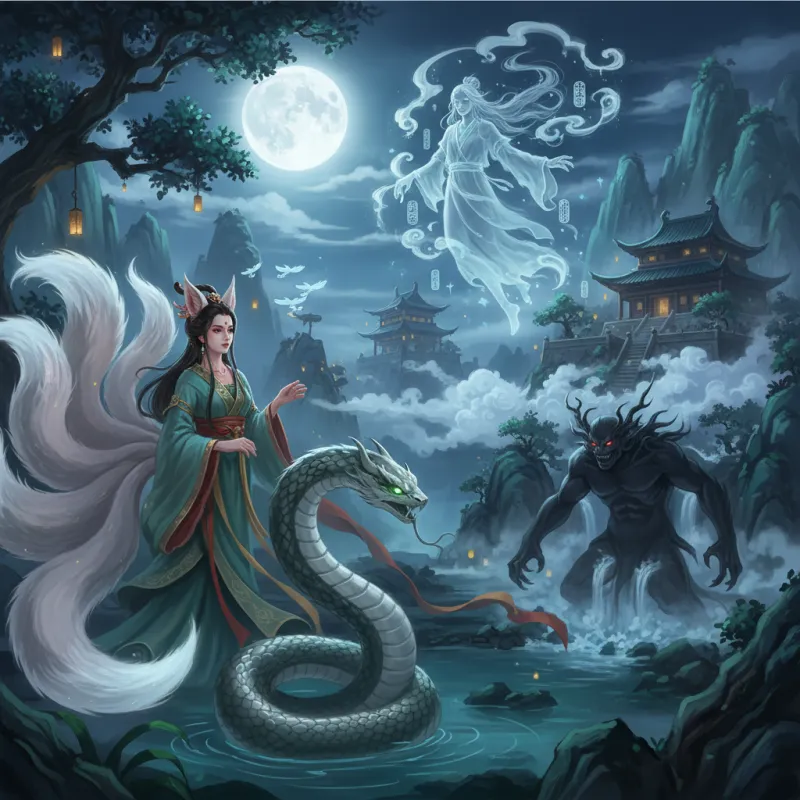
A young scholar walks home through the mist. A beautiful woman appears at the roadside, her silk robes impossibly clean despite the mud. She smiles. He follows. By morning, he's aged twenty years, his life force drained to feed something that was never human at all. This scene plays out in hundreds of Chinese tales, and the woman is almost always the same creature: a fox spirit who's spent centuries learning to wear a human face.
The Logic of Transformation
Chinese folklore doesn't treat shapeshifting as random magic. It operates on a principle of spiritual cultivation that makes perfect sense within its own logic: any creature that lives long enough accumulates spiritual energy (灵气, língqì) and eventually gains the ability to transform. A fox needs five hundred years. A snake needs a thousand. A turtle might need ten thousand. Time itself becomes a form of power.
This connects directly to the Daoist concept of cultivation (修炼, xiūliàn) — the refinement of one's spiritual essence. Humans cultivate through meditation, breathing exercises, and moral discipline. Animals cultivate simply by surviving. The longer they live, the more they absorb the energies of heaven and earth, until transformation becomes inevitable. It's not a gift or a curse. It's spiritual physics.
The implications are unsettling. That ancient tree in your courtyard? It might be watching you. The snake you saw near the temple last year? It could remember your face. Chinese folklore treats the natural world as fundamentally alive and aware, with every creature on a path toward consciousness and power.
Fox Spirits: Seduction and Survival
The fox spirit (狐狸精, húlijīng) dominates Chinese shapeshifter lore, appearing in everything from Tang dynasty poetry to modern television dramas. But calling them simply "evil" misses the point entirely. Fox spirits exist on a moral spectrum that reflects their age, their choices, and their relationship with humanity.
Young fox spirits — those with only a few centuries of cultivation — typically appear as seductresses who drain men's vital essence (精气, jīngqì) to fuel their own transformation. The Liaozhai Zhiyi (聊斋志异), Pu Songling's 17th-century collection of supernatural tales, is packed with these encounters. In "Xiao Cui," a fox spirit nearly kills a young man before a Daoist priest intervenes. In "Lotus Fragrance," another fox spirit actually falls in love with her intended victim and chooses to protect him instead.
This is the crucial detail: fox spirits can choose. The most famous example is Daji (妲己), the nine-tailed fox who possessed a concubine during the Shang dynasty and helped bring down an empire through her influence over King Zhou. She's portrayed as purely malevolent in Fengshen Yanyi (封神演义, Investiture of the Gods). But other fox spirits in Chinese literature become protectors, lovers, even Buddhist disciples who renounce their predatory nature entirely.
The nine-tailed fox (九尾狐, jiǔwěihú) represents the pinnacle of fox spirit cultivation. Each tail marks centuries of accumulated power. In some traditions, a nine-tailed fox has transcended the need to steal human essence and can survive on spiritual energy alone. In others, the nine tails mark a creature so powerful it's essentially immortal — and therefore more dangerous than any demon.
Snake Demons: The Path to Dragons
If fox spirits are seductive and ambiguous, snake demons (蛇妖, shéyāo) are transformative and ambitious. Chinese folklore treats snakes as proto-dragons, creatures on a thousand-year journey toward ultimate power. A snake that survives five hundred years develops a human form. At a thousand years, it can become a dragon (龙, lóng) — if it passes certain trials.
The most famous snake spirit in Chinese culture is Bai Suzhen (白素贞) from The Legend of the White Snake (白蛇传, Bái Shé Zhuàn). She's a white snake who cultivated for a thousand years, took human form, and fell in love with a mortal man named Xu Xian. The story is complicated: Bai Suzhen is genuinely devoted to her husband, but a Buddhist monk named Fahai sees her as an abomination that must be destroyed. She's not evil, but she's not entirely safe either. Her power is too great, her nature too alien.
The story asks an uncomfortable question: can love bridge the gap between human and demon? Bai Suzhen tries. She saves lives with her medical knowledge, she protects her husband, she even gives birth to his son. But when she reveals her true form — accidentally, after drinking wine during the Dragon Boat Festival — Xu Xian dies of shock. She has to steal a magical herb from the gods themselves to revive him. Love isn't enough. The difference in their natures creates tragedy.
Green Snake (青蛇, Qīng Shé), Bai Suzhen's companion and sister, represents a different path. She's younger, less powerful, more playful. In some versions of the tale, she's more interested in experiencing human life than in transcending it. She wants pleasure, adventure, freedom — not enlightenment. The contrast between the two snake spirits shows the range of choices available to shapeshifters: cultivation toward godhood, or engagement with the mortal world on its own terms.
Beyond Foxes and Snakes
Chinese folklore is crowded with shapeshifters that get less attention but are equally fascinating. The raccoon dog (狸猫, límāo) appears in stories as a trickster figure, less dangerous than a fox but more mischievous. The weasel (黄鼠狼, huángshǔláng) is feared in northern China as a creature that can possess humans and demand worship. Refuse a weasel spirit's shrine, and your family might suffer mysterious illnesses for generations.
Tree spirits (树妖, shùyāo) appear when ancient trees accumulate enough spiritual energy to manifest a consciousness. The dryad in A Chinese Ghost Story (倩女幽魂, Qiànnǚ Yōuhún) is actually a tree demon who controls the ghost Nie Xiaoqian, forcing her to lure men to their deaths. The tree itself is the real threat — ancient, rooted, patient, feeding on death for centuries.
Even household objects can transform. The umbrella spirit (伞妖, sǎnyāo) appears in Japanese folklore but has Chinese roots — the idea that an object used for a hundred years develops a soul. This connects to the broader concept of spirit possession and haunted objects in Chinese supernatural belief.
The Shapeshifter's Dilemma
What makes Chinese shapeshifters compelling is that they're caught between worlds. They're not human, but they desperately want to be — or at least to experience what humans have. They cultivate for centuries to gain human form, human speech, human emotions. But the transformation is never complete. They're always one moment away from revealing their true nature: a tail appearing in moonlight, a reflection showing scales instead of skin, a shadow cast in the wrong shape.
This creates a fundamental tension. Shapeshifters need humans — for essence, for companionship, for validation of their transformation. But proximity to humans is dangerous. A Daoist priest might recognize them. A Buddhist monk might try to destroy them. Even genuine love can be fatal, as Bai Suzhen discovers when her husband sees her true form.
The most successful shapeshifters in Chinese folklore are those who find a balance. They don't try to become fully human, but they don't remain fully animal either. They exist in the liminal space between, using their powers carefully, choosing their relationships wisely, always aware that their nature makes them vulnerable. The fox spirit who becomes a scholar's loyal companion. The snake demon who practices medicine. The tree spirit who protects a village from bandits.
Why Shapeshifters Matter
Chinese shapeshifter folklore reflects deep anxieties about identity, deception, and the boundaries between categories. If a fox can become a woman, how do you know the woman you love is really human? If a snake can cultivate into a dragon, what separates a demon from a god? The answer Chinese folklore gives is uncomfortable: time, power, and choice. A creature that lives long enough and chooses virtue can transcend its nature. But the choice has to be genuine, and the cost is often terrible.
These stories also reveal something about Chinese cosmology that Western readers often miss. The universe isn't divided into neat categories of human and animal, natural and supernatural, good and evil. Everything exists on a spectrum of spiritual cultivation. Humans can become immortals through practice. Animals can become demons through time. Demons can become gods through virtue. The boundaries are permeable, which makes the world both more wondrous and more dangerous.
Modern Chinese media continues to explore these themes. The 2020 film Legend of Deification reimagines Daji's story, asking whether she was truly evil or simply a victim of forces beyond her control. The animated series The Legend of Hei features a cat spirit navigating the modern world, trying to find his place between human society and the supernatural realm. The questions remain the same: what does it mean to be human? Can transformation ever be complete? And what do we owe to creatures who are trying, desperately, to become something they're not?
The shapeshifters of Chinese folklore don't have easy answers. They seduce and save, destroy and protect, love and betray. They're mirrors held up to human nature, showing us what we might become if we lived long enough, accumulated enough power, and faced the choice between our true nature and our aspirations. That's why these stories have survived for centuries, and why they still matter today.
Related Reading
- 10 Famous Fox Spirit Stories That Defined Chinese Supernatural Fiction
- Snake Spirits and the Legend of the White Snake
- Fox Spirits in Chinese Culture: Tricksters, Lovers, and Gods
- How Animals Become Demons: The Yaoguai Transformation Process
- Supernatural Animals in Chinese Culture: Not Just Foxes
- Unraveling the Mystique of Chinese Supernatural Folklore and Afterlife Beliefs
- Ghost Marriage: When the Dead Need a Spouse
- Exploring Chinese Supernatural Folklore: Ghosts, Spirits, and Afterlife Beliefs
Explore Chinese Culture
- Explore ancient mythical creatures
- Explore Daoist exorcism traditions
- Explore Chinese folk beliefs and superstitions