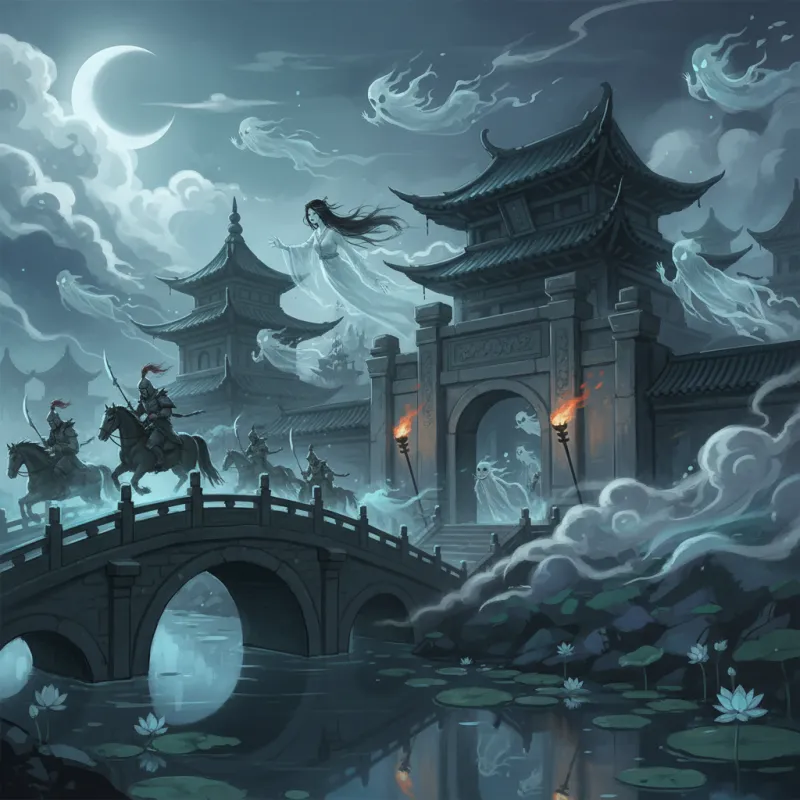
The old caretaker at Lingyin Temple in Hangzhou will tell you about the well behind the main hall if you ask nicely. Not the decorative well tourists photograph — the other one, covered with an iron grate and a stone slab that hasn't been moved in three hundred years. "There's something down there," he'll say, lowering his voice even though you're standing in bright afternoon sunlight. "The abbot in 1720 sealed it. We don't talk about what it was."
Every temple in China old enough to have survived a few dynasties carries stories like this. Not the polished histories in the tourist brochures, but the whispered legends that live in the gaps between official records. These temple ghost stories (寺庙鬼故事, sìmiào guǐ gùshì) form a shadow archive of Chinese supernatural belief — too persistent to dismiss, too strange to canonize, too good not to tell.
The Architecture of Containment
Chinese temples weren't just built for worship. They were built to hold things.
The most common temple legend across China involves something sealed beneath the structure — a demon under the pagoda, a ghost in the foundation, an evil spirit trapped in the well. Leifeng Pagoda in Hangzhou supposedly imprisoned the White Snake (白蛇, Bái Shé) for centuries. When it collapsed in 1924, locals swore they saw a white serpent slither from the rubble, though this was likely added to the legend after the fact.
But the sealed-demon motif predates the White Snake story by centuries. The pattern appears in Tang Dynasty (618-907 CE) temple records: a community plagued by supernatural trouble, a powerful monk who performs a binding ritual, a structure built to maintain the seal. The temple becomes both sanctuary and prison.
What's fascinating is how these legends reflect actual architectural choices. Many temples have forbidden areas — halls that remain locked, courtyards visitors cannot enter, wells covered with elaborate stone caps. The legends provide narrative justification for spatial restrictions that may have originated for entirely mundane reasons. A structurally unsound floor becomes "the room where the ghost walks." A contaminated well becomes "the place where the demon was drowned."
The Monk Who Wouldn't Die
The second major category of temple legends involves monks who transcend normal human limitations through meditation or spiritual practice.
At Shaolin Temple, guides tell stories about the monk Bodhidharma (达摩, Dámó) meditating facing a wall for nine years until his shadow burned into the stone. The "shadow stone" is still displayed, though it looks suspiciously like natural rock discoloration. But the legend matters more than the artifact — it establishes Shaolin as a place where human will can literally leave marks on reality.
These stories follow a pattern: extreme ascetic practice, supernatural endurance, physical transformation. A monk meditates without moving for forty years and his body becomes mummified while still alive. A nun fasts for so long she becomes translucent. An abbot sits in meditation posture at the moment of death and his body doesn't decay.
Some of these legends have kernels of truth. The practice of self-mummification (肉身菩萨, ròushēn púsà) was real, though rare. Monks would gradually reduce their diet over years, eventually consuming only water and lacquer tree sap, which preserved their bodies from the inside. Several temples in China still display these "flesh body Bodhisattvas" — mummified monks in meditation posture, their skin like leather, their faces serene.
The legends exaggerate, but they point to something genuine: the Chinese Buddhist belief that sufficient spiritual cultivation can fundamentally alter physical reality. The temple becomes the stage where this transformation happens, and the stories are evidence that it worked.
Hungry Ghosts at the Gate
Not all temple spirits are sealed demons or enlightened monks. Some are just hungry ghosts (饿鬼, èguǐ) who won't leave.
Temple kitchens have their own folklore. Cooks report food disappearing overnight — not stolen by rats, but vanished completely, as if eaten by something that leaves no trace. Offerings left on altars are found disturbed in the morning, the incense burned down to nothing, the fruit withered as if something drained it.
The standard explanation is hungry ghosts — spirits of people who died with unfulfilled desires or without proper burial rites. They're drawn to temples because temples perform feeding rituals (施食, shīshí) for wandering spirits. But some ghosts become permanent residents, lingering in the liminal spaces: the gap between buildings, the area behind the main hall, the path that leads to the cemetery.
At Fayuan Temple in Beijing, there's a courtyard that monks avoid after dark. Not forbidden, exactly, but understood to be occupied. "The old spirits eat there," one monk told me. "We leave them alone, they leave us alone." This practical coexistence — neither exorcism nor worship, just acknowledgment and avoidance — characterizes many temple ghost relationships.
The hungry ghost legends reveal something about Chinese religious pragmatism. Temples don't claim to eliminate all supernatural problems. They manage them. They create spaces where humans and spirits can coexist with minimal conflict. The ghost gets its offerings, the monks get their peace, and everyone understands the boundaries.
The Possessed Statue
Some temple legends center on statues that are more than carved wood or molded clay.
At Guangji Temple in Zhejiang, there's a Guanyin statue that supposedly weeps real tears during disasters. Locals claim it wept before the 1976 Tangshan earthquake, before the 2008 Sichuan earthquake, before floods and famines. The temple keeps records, though they're vague about dates and details.
These animated statue legends (灵验, língyàn — literally "spiritually efficacious") serve a specific function: they prove the deity's presence. A statue that moves, weeps, or speaks isn't just a representation of the divine — it's a vessel the divine actively inhabits. The legend transforms the statue from symbol to portal.
The most elaborate version of this legend involves statues that leave their pedestals at night. Guards report hearing footsteps in empty halls. In the morning, the statue's robes are dusty, or its feet are muddy, or it's facing a different direction. The implication is clear: the deity walks among us, checking on things, maintaining order in both spiritual and physical realms.
Skeptics note that these legends conveniently increase temple donations and visitor traffic. True enough. But they also reflect a distinctly Chinese approach to religious imagery — not as mere representation but as potential habitation. The statue is a house the deity might choose to occupy. The legend is evidence of occupancy.
The Exorcism That Failed
Not all temple legends are about successful containment. Some are about failures — and those are often the most unsettling.
There's a temple in Shanxi Province (I'm deliberately not naming it — the monks asked me not to) where an exorcism went wrong in the 1930s. A family brought their possessed daughter to the temple. The abbot performed the standard rituals. But instead of leaving the girl, the possessing spirit jumped to the abbot. He died three days later, raving in a language no one recognized.
The temple still functions, but that hall is kept locked. The current abbot told me they perform cleansing rituals there monthly, "just to be safe." When I asked what they were being safe from, he smiled uncomfortably and changed the subject.
These failure legends are rarer than success stories, but they're more revealing. They acknowledge that spiritual power has limits, that rituals don't always work, that some supernatural problems resist solution. They make the temple feel more honest — not a place of guaranteed salvation but a place where people try their best against forces they don't fully understand.
The failure legends also serve as warnings. They remind visitors that supernatural matters are dangerous, that proper respect and caution are necessary, that some doors shouldn't be opened. They're the temple's way of saying: we know what we're doing, but we also know what we don't know.
Why Temples Need Ghost Stories
These legends aren't accidental folklore. They're structural to how Chinese temples function.
First, they make the temple feel powerful. A temple with ghost stories is a temple where supernatural forces are real and active. The legends prove the temple sits at the intersection of human and spirit worlds, which is exactly where a temple should sit.
Second, they create narrative continuity. Temples survive dynasties, wars, revolutions. The ghost stories connect present to past, making the temple feel ancient and enduring. The demon sealed in 1720 is still sealed today — the temple's spiritual function continues unbroken.
Third, they regulate behavior. Don't go in that hall. Don't disturb that well. Don't mock the spirits. The legends establish rules through story rather than prohibition, which is more effective and more memorable.
Finally, they make the temple interesting. Official religious doctrine can be abstract and difficult. Ghost stories are concrete and compelling. They give visitors something to talk about, something to remember, something to bring them back.
The temple legends exist in a strange space between belief and entertainment, between warning and attraction. The monks tell them with a slight smile, acknowledging their legendary status while never quite dismissing them as false. "Maybe it's true, maybe not," they'll say. "But the well stays covered."
The Living Tradition
These stories aren't static folklore from centuries past. New temple legends are still being created.
After the 2008 Sichuan earthquake, stories emerged about temples that survived when everything around them collapsed, about Buddha statues found intact in rubble, about monks who predicted the disaster. Some of these stories are probably true. Some are definitely exaggerated. All of them are becoming temple legends, told and retold, smoothed and shaped by repetition.
The process is the same as it's always been: something unusual happens, people talk about it, the story gets attached to a place, the place becomes known for the story. Give it a few decades and it'll be indistinguishable from the older legends — just another tale about the time something supernatural happened at the temple.
This living quality is what makes temple legends fascinating. They're not museum pieces. They're active folklore, adapting to new circumstances while maintaining old patterns. The demon under the pagoda becomes the ghost in the earthquake rubble. The monk who meditated for forty years becomes the monk who predicted the disaster. The stories change, but the structure remains.
Visit any old temple in China and ask the caretaker if there are any stories about the place. They'll pause, look around to see who's listening, and then lean in close. "Well," they'll say, "there is one thing..." And you'll hear a story that's been told for centuries, or maybe just decades, or maybe it happened last week. In temple legends, time works differently. The past is always present, and the spirits are always just behind the next door.
For more on Chinese supernatural traditions, see The Hungry Ghost Festival and Exorcism Rituals in Chinese Buddhism.
Related Reading
- The Most Haunted Temples in China: Ghost Stories from Sacred Ground
- Temple Guardian Spirits: The Supernatural Protectors of Sacred Spaces
- Haunted Temples: Where Gods and Ghosts Coexist
- Cursed Objects in Chinese Folklore: Things You Should Never Touch
- Taoist Exorcism: Methods of Spirit Removal
- Exploring the Multifaceted World of Chinese Supernatural Folklore and Afterlife Beliefs
- Exploring the Depths of Chinese Supernatural Folklore: Ghosts, Spirits, and Afterlife Beliefs
Explore Chinese Culture
- Explore ancient mythical creatures
- Explore Daoist exorcism traditions
- Explore Chinese folk beliefs and superstitions