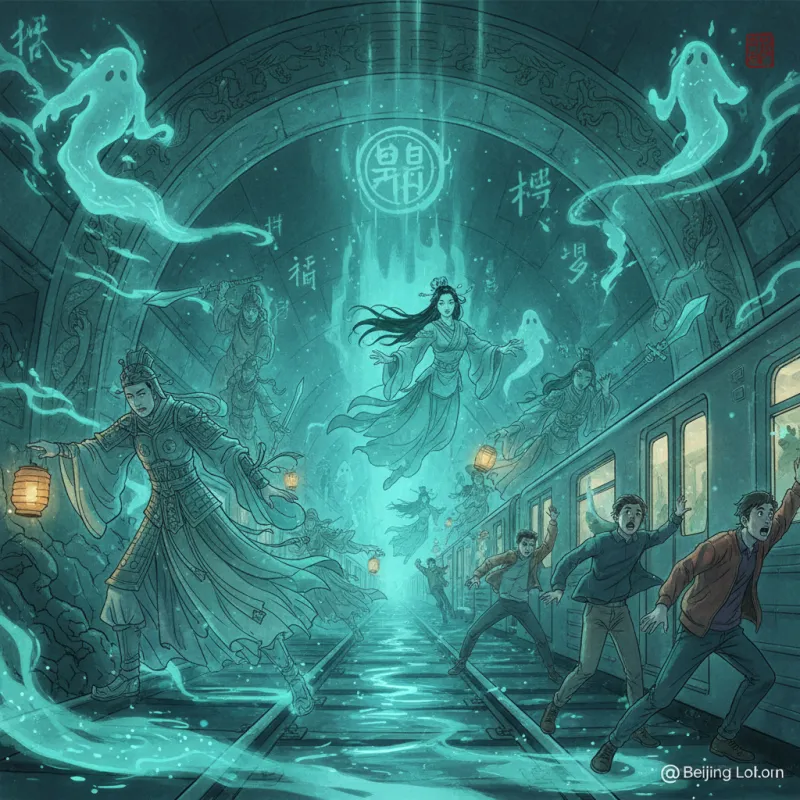
The last train on Line 1 pulls into Guomao Station at 12:47 AM. The platform should be empty. But according to dozens of subway workers, security guards, and late-night commuters, it rarely is. They report figures in Qing Dynasty robes standing motionless near the tunnel entrance, passengers who board the train but cast no reflection in the windows, and the persistent smell of incense and funeral flowers that has no source. Beijing's subway system, built by tunneling through 3,000 years of continuous human habitation, didn't just disturb the earth — it disturbed the dead.
The Geography of Ghosts
Beijing's subway system runs beneath one of the world's oldest continuously inhabited cities. Every tunnel boring machine that carved through the earth pushed through compressed layers of history: Ming Dynasty foundations, Qing Dynasty sewer channels, Song Dynasty grave sites, and archaeological deposits stretching back millennia. Line 1, which opened in 1969, follows Chang'an Avenue directly beneath Tiananmen Square, the Forbidden City, and Wangfujing. Line 2 traces the route of the old city walls, demolished in the 1960s. Line 13 cuts through what were once execution grounds during the Qing Dynasty.
This isn't speculation. Construction records document the constant discovery of burial sites, mass graves, and forgotten cemeteries. When Line 5 was being built in the early 2000s, workers uncovered over 3,000 ancient tombs. The extension of Line 10 through Fengtai District revealed a Ming Dynasty graveyard that delayed construction for eight months. You are quite literally traveling through the graves of millions every time you swipe your transit card.
In Chinese folk belief, disturbing burial sites without proper ritual appeasement invites supernatural retaliation. The dead whose rest is interrupted become yuan gui (冤鬼, yuān guǐ) — wronged ghosts — who linger in the places where their bones were moved. The subway system, by this logic, should be one of the most haunted locations in China. And according to urban legends that have circulated since the 1970s, it is.
The Woman in White at Jianguomen
The most persistent Beijing subway legend involves a woman in a white qipao (旗袍, qípáo) — the traditional Chinese dress — who appears on the platform at Jianguomen Station on Line 1. Multiple accounts describe her standing near the edge of the platform, always in the same spot, always facing the tunnel. She never boards the train. She never moves. And she's always there between 11 PM and midnight.
The legend gained traction in the 1980s when a security guard reported seeing her five nights in a row. He approached her on the fifth night to ask if she needed help. She turned to face him, and he saw that her features were blurred, as if viewed through frosted glass. He ran. The next morning, he requested a transfer to a different station.
What makes this legend particularly unsettling is its specificity. Witnesses consistently describe the same location on the platform — near the fourth pillar from the eastern entrance — and the same time window. Some versions of the story claim she's waiting for someone who died in the Cultural Revolution. Others say she herself died during the station's construction in the 1960s. The station management has never officially acknowledged the reports, but workers at Jianguomen have a saying: bù yào kàn dì sì gēn zhùzi (不要看第四根柱子) — "don't look at the fourth pillar."
The Phantom Passengers of Line 13
Line 13, which runs through northern Beijing, has its own collection of ghost stories, most involving passengers who shouldn't exist. The line passes through areas that were execution grounds during the Qing Dynasty, where criminals and political prisoners were beheaded. During the Qing, these grounds were deliberately placed outside the city walls, in desolate areas meant to discourage lingering spirits from entering the city proper. Line 13 now connects these former death sites directly to the city center.
Multiple conductors and passengers report seeing figures in historical clothing — Qing Dynasty robes, Republican-era suits — boarding the train at Longze or Huilongguan stations late at night. These passengers sit quietly, never speak, and disappear before the train reaches the next station. One conductor in 2008 reported a man in a changshan (长衫, chángshān) — a traditional long robe — who boarded at Longze carrying what appeared to be his own severed head under his arm. The conductor requested immediate psychiatric leave.
The severed head detail connects to a specific type of Chinese ghost: the duàn tóu guǐ (断头鬼, duàn tóu guǐ), or "severed head ghost," the spirit of someone who died by decapitation. In traditional Chinese belief, those who die violently or unjustly cannot reincarnate properly and become trapped in the location of their death. If Line 13 truly passes through former execution grounds, the appearance of duàn tóu guǐ would be grimly appropriate.
The Singing at Xizhimen
Xizhimen Station, one of Beijing's busiest transfer hubs, has a reputation among subway workers for unexplained sounds. Multiple employees report hearing traditional Chinese opera singing — specifically jingju (京剧, jīngjù), or Peking Opera — echoing through the tunnels late at night when the station is closed. The singing always comes from the same section of tunnel between Xizhimen and Chegongzhuang stations on Line 2.
What makes this legend particularly eerie is that Xizhimen was one of the nine gates of the old Beijing city wall, and historically, condemned prisoners were paraded through this gate on their way to execution grounds. During the Cultural Revolution, the area around Xizhimen saw significant violence, and some accounts suggest bodies were temporarily stored in the area before burial. The opera singing, according to some interpretations, represents the ghosts of performers who died during the Cultural Revolution, when traditional opera was banned and performers were persecuted.
I find this legend more psychologically complex than simple ghost stories. The choice of Peking Opera — a highly stylized, almost otherworldly art form — as the supernatural manifestation suggests cultural memory, not just individual haunting. It's as if the tunnel itself remembers what was lost. Similar legends about phantom sounds and voices appear throughout Beijing's historical sites.
The Construction Worker Who Never Left
During the construction of Line 4 in 2004, a worker named Zhang Wei (a pseudonym used in most tellings) disappeared during a night shift. His body was never found, and the official explanation was that he had abandoned his post and left Beijing. But workers on that section of Line 4 — particularly between Xidan and Lingjing Hutong stations — report seeing a figure in a yellow safety vest and hard hat walking through the tunnels during maintenance hours.
The figure never responds to calls. He walks with purpose, as if inspecting the tunnel walls, then vanishes when approached. Multiple maintenance crews have reported him, always in the same section of tunnel, always wearing the same outdated safety equipment from the mid-2000s. Some workers leave offerings of cigarettes and baijiu (白酒, báijiǔ) — Chinese liquor — near the tunnel entrance, a traditional gesture to appease restless spirits.
This legend follows a common pattern in Chinese workplace ghost stories: the worker who dies on the job and continues working in death. It reflects both respect for the deceased's dedication and anxiety about the human cost of rapid infrastructure development. Beijing's subway system expanded from 2 lines in 2000 to 27 lines by 2024 — one of the fastest metro expansions in human history. That speed came with a price, and not all of it was financial.
The Scientific Explanation (And Why It Doesn't Matter)
Skeptics point to rational explanations: the "ghosts" are homeless people seeking shelter, the sounds are acoustic anomalies in the tunnels, the disappearing passengers are simply people who moved to different cars. The woman in white at Jianguomen could be a mentally ill person who frequents the station. The opera singing at Xizhimen might be sound bleeding through from street-level performances or someone's radio.
These explanations are probably correct. But they miss the point entirely.
Urban legends aren't about objective truth — they're about psychological truth. The Beijing subway ghost stories express genuine anxieties about rapid modernization, the destruction of historical sites, and the displacement of the dead. When you tunnel through 3,000 years of burial grounds to build a metro system in under 25 years, you're not just moving earth. You're severing connections to the past, literally and metaphorically.
The ghosts of the Beijing subway represent what was lost in the rush to modernize: the graves that were relocated without proper ceremony, the historical sites demolished for stations, the workers who died building the system, the cultural memory buried under concrete and steel. Whether or not you believe in literal ghosts, these stories serve a function. They force us to remember that the ground beneath our feet is not neutral space — it's saturated with history, and history has a way of making itself known.
Riding the Haunted Rails
I've ridden the Beijing subway hundreds of times, including late-night trips on Line 1 and Line 13. I've never seen a ghost. But I've felt the weight of the place, particularly on Line 2 as it traces the route of the demolished city walls. There's a heaviness to certain stations, a sense of compressed time, as if the past and present occupy the same space.
Whether that feeling comes from actual supernatural presence or simply from knowing the history doesn't particularly matter. The Beijing subway is haunted — if not by literal ghosts, then by the accumulated weight of everything that was disturbed, destroyed, or displaced to build it. Every time you descend into those stations, you're entering a space where the boundary between past and present is thinner than usual.
The next time you're waiting on a platform late at night and you smell incense, or hear opera singing, or see someone in clothing from another era — don't dismiss it immediately. You might be experiencing an acoustic anomaly or a trick of the light. Or you might be one of the few people who can perceive what's always been there, just beneath the surface, traveling the same rails we do.
For more on Beijing's supernatural geography, see The Forbidden City's Ghost Legends and Haunted Hutongs: Old Beijing's Restless Spirits.
Related Reading
- Exploring Chinese Supernatural Folklore: Ghosts, Spirits, and Afterlife Beliefs Unveiled
- Chinese Campus Ghost Stories: The Haunted Universities
- Modern Ghost Sightings in China: When Ancient Beliefs Meet the Digital Age
- Chinese Urban Legends: The Ghost Stories Your Taxi Driver Tells
- Chinese Urban Legends That Went Viral: From Elevator Ghosts to Cursed Phone Numbers
- How Animals Become Demons: The Yaoguai Transformation Process
- Funeral Rituals in Chinese Culture: A Guide to Sending Off the Dead
- Unveiling the Secrets of Chinese Supernatural Folklore and Afterlife Beliefs
Explore Chinese Culture
- Explore ancient mythical creatures
- Explore Daoist exorcism traditions
- Explore Chinese folk beliefs and superstitions