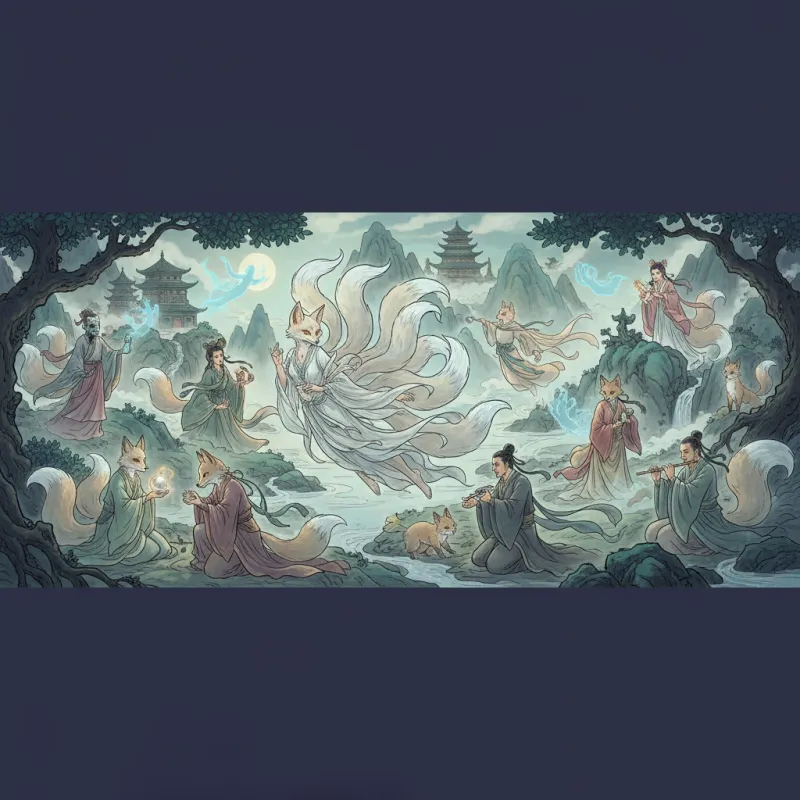
A nine-tailed fox walks into the palace of the last Shang king, wearing the face of the most beautiful woman in the realm. Within months, the dynasty that had ruled China for six centuries lies in ruins, its king dead by his own hand, his capital city burning. This isn't a cautionary tale about female seduction — it's the origin story of Chinese supernatural fiction's most enduring archetype, and it's far stranger than you think.
The fox spirit (狐狸精, húlijīng) occupies a unique position in Chinese folklore: simultaneously demon and deity, seductress and scholar, monster and romantic heroine. Unlike Western vampires or werewolves, which remain consistently monstrous, the Chinese fox spirit has evolved across three thousand years of storytelling into something far more complex. These ten stories represent the tradition's defining moments — the tales that established tropes, subverted expectations, and continue to influence everything from modern C-dramas to contemporary horror fiction.
Daji: The Fox Who Toppled a Dynasty
Every tradition needs its villain origin story, and Chinese fox lore has Daji (妲己). According to the Ming Dynasty novel Fengshen Yanyi (封神演义, Investiture of the Gods), the goddess Nüwa sends a nine-tailed fox spirit to possess a woman named Daji and seduce King Zhou of Shang, the last ruler of the dynasty. The mission: destroy the corrupt king and his regime.
The fox succeeds spectacularly. As Daji, she convinces the king to create the "wine pool and meat forest" (酒池肉林, jiǔchí ròulín) — a garden where trees are hung with meat and a pond is filled with wine, where orgies last for days. She invents the "炮烙" (páoluò), a bronze cylinder heated until red-hot, which prisoners are forced to embrace. She has the king's advisors executed for sport. The dynasty collapses in 1046 BCE.
What makes this story foundational isn't just its historical setting — it's that Daji is explicitly following divine orders. She's not acting from personal malice or hunger; she's an instrument of cosmic justice. This establishes a pattern that will echo through Chinese supernatural fiction: the fox spirit as agent of fate, punishing human corruption through the very desires humans cannot control. The story also introduces the nine-tailed fox (九尾狐, jiǔwěihú) as the most powerful variant, a detail that will become crucial in later tales.
The Scholar and the Fox: Nie Xiaoqian's Redemption
Pu Songling's Liaozhai Zhiyi (聊斋志异, Strange Tales from a Chinese Studio, 1740) contains over thirty fox spirit stories, but "Nie Xiaoqian" (聂小倩) stands apart. A young scholar named Ning Caichen stays at a haunted temple. A beautiful woman appears — Nie Xiaoqian, who died young and whose spirit has been enslaved by a demon to lure men to their deaths.
The twist: Xiaoqian falls in love with Ning and warns him of the danger. She's not the predator but the prisoner. Ning, with the help of a Taoist swordsman, defeats the demon and liberates Xiaoqian's spirit. In some versions, she's reincarnated and marries Ning in her new life.
This story revolutionized fox spirit fiction by introducing genuine romance and moral complexity. Xiaoqian isn't punished for being a supernatural being — she's rewarded for her courage and love. The story spawned countless adaptations, including the 1987 film A Chinese Ghost Story, which cemented the "scholar meets ghost/fox" romance as a genre unto itself. It also established the pattern of the fox spirit seeking redemption through love, a theme that dominates modern retellings.
The Fox Who Became a God: Hu Tianbao's Transformation
From the Qing Dynasty collection Zi Bu Yu (子不语, What the Master Would Not Discuss) comes one of Chinese literature's strangest fox tales. Hu Tianbao (胡天保) is a man who falls in love with a handsome imperial inspector. When discovered spying on the official in the bathhouse, Hu is beaten to death.
In the underworld, the judges take pity on him. They transform him into the Rabbit God (兔儿神, tù'ér shén), a deity who protects same-sex love. In some versions, Hu becomes a fox spirit first, then ascends to godhood.
This story is remarkable for several reasons. It's one of the few fox tales centered on male same-sex desire, a topic usually relegated to the margins of Chinese literature. It also demonstrates the fox spirit's liminal nature — neither fully demon nor deity, capable of transformation in both directions. The story suggests that fox spirits aren't born but made, created from human desires that society cannot accommodate. It's a radical idea that challenges the entire taxonomy of Chinese supernatural beings.
The Painted Skin: Horror's Perfect Metaphor
Another Liaozhai masterpiece, "Painted Skin" (画皮, huàpí) is Chinese horror at its most visceral. A scholar named Wang brings home a beautiful woman he finds on the road. His wife grows suspicious. One night, Wang peeks into the woman's room and sees a hideous demon painting a human skin, which it then wears like a costume.
The demon kills Wang by ripping out his heart. A Taoist beggar eventually defeats the creature, but only after Wang's devoted wife endures humiliation to obtain a magical cure that resurrects her husband.
"Painted Skin" introduces body horror to fox spirit fiction. The image of the demon carefully painting facial features onto a skin suit has haunted Chinese readers for three centuries. It's been adapted into multiple films, most notably the 2008 version starring Zhou Xun, which reimagines the demon as a tragic figure seeking to become human.
The story works as a metaphor for deception in relationships — the beautiful surface concealing monstrous reality — but it's also about the labor of maintaining appearances. The demon must repaint the skin regularly, suggesting that beauty itself is a kind of exhausting performance. This adds psychological depth to what could have been a simple monster tale.
The Loyal Fox Wife: Ying Ning's Laughter
"Ying Ning" (婴宁) from Liaozhai presents the fox spirit as ideal wife. A young man named Wang Zifu meets a girl whose constant laughter enchants him. He discovers she's a fox spirit raised by her fox mother in the mountains. They marry, and Ying Ning becomes the perfect daughter-in-law — cheerful, obedient, and devoted.
The subversion: Ying Ning's laughter isn't innocent. When a lecherous neighbor harasses her, she laughs him to death — literally. Her laughter becomes a weapon, revealing that beneath the submissive exterior lies genuine power. She's not pretending to be human; she's performing humanity while retaining her fox nature.
This story influenced how later fiction portrayed fox spirit wives, establishing the pattern of the supernatural bride who's simultaneously more and less than human. Ying Ning is more loyal, more devoted, more beautiful than any human wife — but she's also capable of casual murder, and her morality operates on non-human principles. The story asks: what do we really want from marriage? Perfect performance or genuine nature?
The Fox Examination: Bureaucracy Meets Magic
In "The Fox Examination" (狐试, húshì) from Liaozhai, a scholar stumbles upon fox spirits taking their own version of the imperial examinations. The foxes have created a parallel bureaucracy in the spirit world, complete with testing halls, proctors, and rankings.
The scholar is invited to participate. He writes an essay, receives a ranking, and is offered a position in the fox spirit administration. He declines, returns to the human world, and later passes the real imperial examination with the same essay.
This story satirizes the examination system by suggesting that even fox spirits — creatures of chaos and transformation — have been infected by Confucian bureaucracy. It also implies that the human and spirit worlds operate on similar principles of hierarchy and merit. The story's humor comes from treating the supernatural as mundane: of course fox spirits would have civil service exams. What else would they do?
The tale reflects Pu Songling's own frustration with the examination system (he failed repeatedly) and suggests that supernatural beings might be more rational than the human institutions that claim to represent order and civilization.
The Fox Debt: Karma and Reincarnation
"The Fox Debt" (狐债, húzhài) from the Qing Dynasty collection Yuewei Caotang Biji (阅微草堂笔记, Notes from the Yuewei Hermitage) tells of a man who, in a previous life, saved a fox from hunters. In his current incarnation, a beautiful woman appears and insists on becoming his concubine. She brings wealth, bears him children, and after twenty years, reveals herself as the fox he saved. Her debt repaid, she vanishes.
This story introduces Buddhist karma into fox spirit fiction. The fox isn't acting from desire or malice but from obligation. She's repaying a debt across lifetimes, suggesting that the relationship between humans and fox spirits operates according to cosmic accounting principles.
The story also normalizes fox spirit relationships. The man lives happily with his fox wife for two decades. Their children are healthy and successful. The revelation of her true nature doesn't retroactively poison the relationship — it explains and validates it. This represents a significant shift from earlier tales where fox spirit relationships always end in tragedy or exorcism.
The Fox Library: Knowledge and Power
In "The Fox Library" (狐藏书, húcángshū) from Liaozhai, a poor scholar discovers that fox spirits have been stealing books from human libraries and creating their own collection in a hidden cave. The foxes invite him to study there, giving him access to rare texts and tutoring him in classical literature.
The scholar becomes successful, passing his examinations and achieving official rank. Years later, he returns to thank the foxes, but the library has vanished.
This story inverts the usual dynamic. Instead of fox spirits seducing humans, they're educating them. The foxes are portrayed as scholars themselves, suggesting that the pursuit of knowledge transcends the human/non-human boundary. It also implies that fox spirits might be better custodians of Chinese culture than humans, who let books decay or burn in wars.
The tale reflects the anxiety of Chinese intellectuals during the Qing Dynasty, when Manchu rule raised questions about who truly represented Chinese civilization. By making fox spirits the guardians of classical learning, Pu Songling suggests that culture exists independent of political power.
The Fox Tribunal: Justice in the Spirit World
"The Fox Tribunal" (狐判, húpàn) from Yuewei Caotang Biji describes a corrupt magistrate who dies and finds himself on trial in the underworld. The judges are fox spirits who have been observing his crimes for years. They present detailed evidence of his bribery, false convictions, and abuse of power.
The magistrate is sentenced to reincarnation as a pig, to be slaughtered and eaten by the families he wronged.
This story positions fox spirits as moral authorities, capable of judging human behavior according to standards humans themselves claim to uphold but routinely violate. The foxes aren't chaotic or amoral — they're more ethical than the human legal system. The story suggests that supernatural beings might be necessary to enforce justice when human institutions fail.
It also introduces the idea of fox spirits as witnesses. They live alongside humans, invisible but observing, keeping records of human behavior. This makes them perfect agents of karmic justice, since they see everything humans try to hide.
The Modern Fox: Qing Qiu and the Nine-Tailed Legacy
While not a classical tale, the 2017 drama Eternal Love (三生三世十里桃花, sānshēng sānshì shílǐ táohuā) deserves mention for how it synthesizes and transforms the fox spirit tradition. The protagonist Bai Qian is a nine-tailed fox from Qing Qiu (青丘), the mythical fox spirit kingdom, who falls in love with a god.
The drama draws on all the classical tropes — the fox seeking cultivation to become immortal, the romance between human (or god) and fox, the nine-tailed fox as the most powerful variant, the connection to Qing Qiu from the Classic of Mountains and Seas (山海经, Shānhǎi Jīng). But it reimagines the fox spirit as unambiguously heroic, powerful, and morally superior to most of the gods and humans around her.
This represents the culmination of the fox spirit's evolution from Daji the destroyer to Bai Qian the savior. The modern fox spirit retains her power and otherworldliness but has been fully rehabilitated, transformed from demon to romantic heroine. The story's massive popularity (it's been viewed billions of times) suggests that contemporary audiences prefer their fox spirits powerful, loyal, and unambiguously good — a far cry from the morally ambiguous creatures of classical fiction.
The Enduring Appeal
These ten stories span two thousand years, from the Shang Dynasty's fall to modern streaming dramas. What unites them is the fox spirit's fundamental ambiguity. She (or occasionally he) exists at the boundary between human and animal, civilization and wilderness, order and chaos. Fox spirits can be demons or deities, seductresses or scholars, monsters or romantic heroines — sometimes all at once.
This flexibility explains why fox spirit stories continue to proliferate. Every generation can reimagine the fox according to its own anxieties and desires. The Ming Dynasty needed Daji to explain dynastic collapse. The Qing Dynasty needed Nie Xiaoqian to explore romantic love outside arranged marriage. Contemporary audiences need Bai Qian to imagine female power unconstrained by patriarchal limitations.
The fox spirit endures because she represents everything human society cannot fully control or categorize: desire, transformation, the wild intelligence that refuses domestication. These stories aren't just entertainment — they're how Chinese culture thinks about the boundaries of the human, and what happens when those boundaries dissolve. As long as those questions remain urgent, the fox spirit will continue to haunt Chinese fiction, shape-shifting through new forms but always recognizable by her nine tails and knowing smile.
Related Reading
- How Animals Become Demons: The Yaoguai Transformation Process
- The Shapeshifters of Chinese Folklore: Fox Spirits, Snake Demons, and Beyond
- Snake Spirits and the Legend of the White Snake
- Fox Spirits: The Complete Guide to China's Most Famous Shapeshifters
- Fox Spirits in Chinese Culture: Tricksters, Lovers, and Gods
- Unraveling the Mystique of Chinese Supernatural Folklore and Afterlife Beliefs
- Ancestor Worship: The Living Relationship with the Dead
- Unveiling the Secrets of Chinese Supernatural Folklore and Afterlife Beliefs
Explore Chinese Culture
- Explore ancient mythical creatures
- Explore Daoist exorcism traditions
- Explore Chinese folk beliefs and superstitions