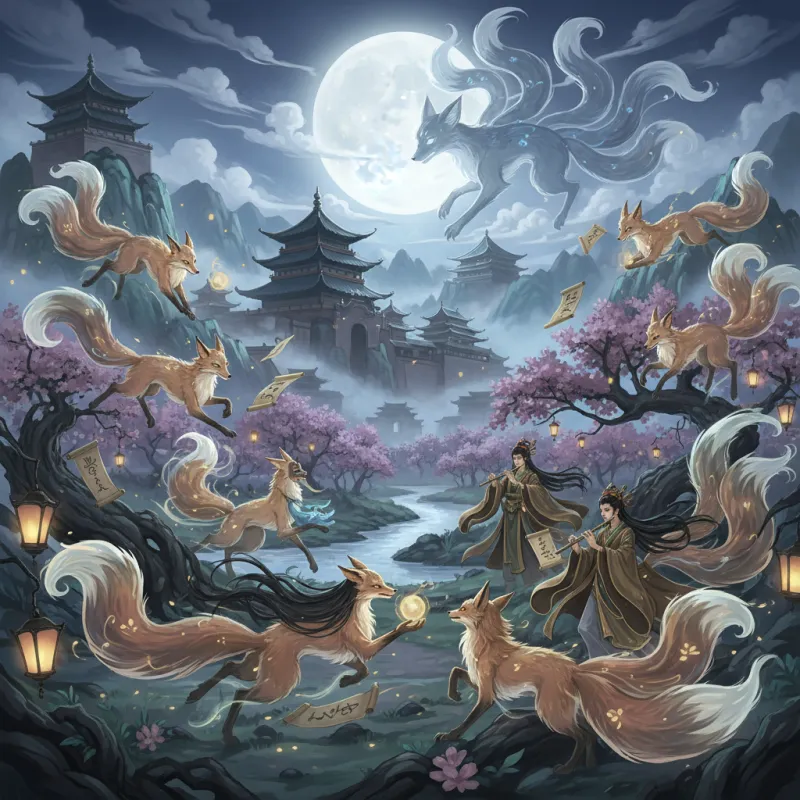
A young scholar walks home through moonlit bamboo groves after a night of drinking. A woman in white silk appears on the path ahead — impossibly beautiful, impossibly alone. She smiles. He follows. By morning, he's found collapsed outside the city gates, aged thirty years, his life force drained to a whisper. The magistrate's report lists cause of death as "fox seduction." The year is 1247 CE, and this is the third case this month.
This is not folklore. This is documented history. Fox spirits — 狐狸精 (húlijīng) or 狐仙 (húxiān) — appear in Chinese legal records, medical texts, and official government reports spanning three millennia. They're not metaphors. They're not symbols for female sexuality or political corruption, though scholars love claiming that. They're recognized supernatural entities with specific behaviors, documented weaknesses, and a body count that would make any jiangshi jealous.
What Makes Fox Spirits Different
Here's what separates Chinese fox spirits from every other shapeshifter tradition: they earn their power. A werewolf gets bitten. A vampire gets turned. A fox spirit spends fifty to a thousand years cultivating 修炼 (xiūliàn) — absorbing moonlight, practicing meditation, studying human behavior, and slowly accumulating 道行 (dàoxíng), spiritual merit. The transformation isn't biological. It's metaphysical achievement.
The classic texts establish clear progression stages. After fifty years of cultivation, a fox can speak human language. After a hundred years, it can assume human form for short periods. After three hundred years, the transformation becomes stable. After a thousand years, the fox can pass any test — it casts reflections, leaves footprints, even bleeds red blood. The Taiping Guangji (太平广记), compiled in 978 CE, documents dozens of cases where even Taoist masters couldn't detect millennium-old fox spirits without specialized rituals.
But here's the catch: transformation requires constant maintenance. Fox spirits must regularly absorb human 精气 (jīngqì) — vital essence — to maintain their human form. This is why they seduce. Not from malice necessarily, but from need. It's supernatural metabolism. Some do it gently, taking just enough to sustain themselves. Others drain their victims completely, leaving behind the aged husks that fill dynastic medical records.
The Three Types You'll Actually Encounter
Forget the academic classifications. If you're dealing with a fox spirit, you need to know which kind you're facing, because the difference determines whether you walk away or get carried away.
野狐 (yěhú) — Wild Foxes are the dangerous ones. These are spirits with less than three hundred years of cultivation, still unstable in their transformations, still hungry. They're the ones who appear in lonely places, who seduce travelers, who leave bodies. The Liaozhai Zhiyi (聊斋志异) by Pu Songling is packed with wild fox encounters — the scholar who notices his lover's shadow has a tail, the merchant who wakes to find fox tracks in the snow leading from his bed. Wild foxes are impulsive, powerful, and often genuinely confused about human morality. They don't understand why draining someone's life force is wrong. It's just eating.
狐仙 (húxiān) — Fox Immortals have crossed the thousand-year threshold. They've achieved stability, wisdom, and often genuine spiritual merit. These are the foxes who protect households, who appear in dreams to warn of danger, who've been worshipped in northern China for centuries. The fox temples of Shandong and Hebei provinces aren't folklore — they're active religious sites where people still leave offerings. Fox Immortals can be petitioned like minor deities. They grant wishes, cure illnesses, and occasionally fall in love with humans without killing them. The famous Qing dynasty case of the Fox Immortal of Pingyang involved a spirit who protected a family for three generations before finally ascending to full immortality.
狐妖 (húyāo) — Fox Demons are the corrupted ones. These are spirits who've deliberately chosen the dark path, who cultivate through murder rather than meditation, who've given up on achieving immortality through merit. They're rare but devastating. The Fengshen Yanyi (封神演义) features Daji, the nine-tailed fox demon who possessed the concubine of the last Shang emperor and orchestrated atrocities that ended a dynasty. Fox demons don't just drain essence — they corrupt it, spreading madness and moral decay. They're what happens when a fox spirit decides that power matters more than transcendence.
How They Actually Seduce You
The seduction techniques are documented with uncomfortable precision in texts like the Yuewei Caotang Biji (阅微草堂笔记). Fox spirits don't rely on supernatural compulsion — they're too smart for that. They study human psychology for decades before attempting a transformation. They know exactly what you want before you do.
The classic approach: appear in a moment of vulnerability. You're traveling alone, you're drunk, you're grieving, you're ambitious and frustrated. The fox spirit manifests as exactly what you need — the understanding companion, the passionate lover, the mentor who sees your potential. They're patient. They'll court you for weeks or months, building genuine emotional connection. By the time they start feeding, you're too attached to care about the exhaustion, the weight loss, the way you look older each morning.
The sophisticated ones don't even need to seduce. They integrate into communities, becoming the helpful neighbor, the talented musician, the brilliant student. The Zibuyu (子不语) records a case from 1740s Jiangsu where a fox spirit lived as a respected scholar for fifteen years, teaching students and writing poetry, before someone noticed he never ate in public and his room had no dust. He'd been feeding on the ambient life force of the town, taking tiny amounts from hundreds of people so no one noticed the drain.
The Exorcism Problem
Here's what the texts don't tell you: exorcising a fox spirit is genuinely difficult, and the success rate is terrible. The standard Taoist methods — peach wood swords, cinnabar talismans, mirror arrays — work on spirits with less than two hundred years of cultivation. Beyond that, you need a master, and masters are rare.
The most reliable method is also the most disturbing: starve them out. Fox spirits maintaining human form need regular essence intake. Cut off their food supply — isolate the victim, surround them with protective wards, wait — and eventually the fox must either flee or reveal itself. The Yueli (阅历) describes a 1820s case where Buddhist monks protected a merchant for forty days while his fox spirit "wife" slowly lost cohesion, her human form flickering like a failing lamp before she finally fled as a white fox.
But here's the ethical nightmare: what if the relationship is genuine? The texts are full of cases where the human victim refuses exorcism, where they'd rather die young with their fox lover than live long alone. The famous story of "Xiao Cui" from Liaozhai involves a fox spirit who genuinely loves her human husband, who feeds carefully to avoid harming him, who bears him children (yes, that's possible — the offspring are usually human with fox tendencies). When his family tries to exorcise her, he threatens suicide. They stay together until his natural death at seventy, and she's seen weeping at his grave for years afterward.
Why Fox Spirits Still Matter
The last documented official fox spirit case in Chinese government records is from 1952. A commune in Hebei reported mysterious illnesses and blamed a fox spirit. The Communist Party sent investigators who concluded it was mass hysteria and malnutrition. Case closed. Officially, fox spirits ended with the revolution.
Except they didn't. Travel to rural Shandong, Hebei, or Liaoning, and you'll still find fox shrines receiving fresh offerings. Talk to older people in these regions, and they'll tell you about the fox family that lives in the old temple, about the beautiful woman who appears on certain roads at night, about the neighbor who never seems to age. The belief didn't disappear — it went underground.
Modern Chinese horror has rediscovered fox spirits with enthusiasm. Films like "Painted Skin" (2008) and "The Sorcerer and the White Snake" (2011) update the mythology for contemporary audiences, but the core remains unchanged: beautiful, dangerous, neither fully human nor fully other. The fox spirit endures because it represents something genuinely unsettling — the idea that the person next to you, the one you love, the one you trust, might be something else entirely, something that's been studying humans for centuries and knows exactly how to pass.
Living With Fox Spirits
The practical texts — the ones written by Taoist priests and Buddhist monks who actually dealt with fox spirits rather than just writing about them — offer surprisingly pragmatic advice. Don't travel alone at night in fox territory (mountainous regions, bamboo groves, abandoned temples). Don't accept invitations from beautiful strangers who appear in unlikely places. Don't follow mysterious lights. If you suspect fox spirit activity, wear jade (they dislike its purity), carry peach wood, avoid mirrors at night (foxes use them as portals).
But the most interesting advice is this: if you encounter a fox spirit who isn't actively harming anyone, leave it alone. The experienced exorcists knew that fox spirits exist on a spectrum. Some are predators. Some are just trying to survive. Some have lived peacefully in communities for generations, taking only what they need, giving back through protection and wisdom. The Zibuyu records a Taoist master's words: "Not all foxes are demons, just as not all humans are saints. Judge by behavior, not by nature."
That's the real lesson of three thousand years of fox spirit lore. They're not symbols or metaphors. They're a reminder that the world is stranger than we admit, that categories blur, that the beautiful stranger might be exactly what she appears to be — or might be something that's been perfecting that appearance for five hundred years. The question isn't whether fox spirits are real. The question is whether you'd recognize one if you met her, and whether you'd care once you did.
The scholar in the bamboo grove certainly didn't. Even as his life drained away, witnesses reported, he was smiling.
Related Reading
- The Nine-Tailed Fox: From Divine Symbol to Ultimate Villain
- Fox Spirits in Chinese Culture: Tricksters, Lovers, and Gods
- Snake Spirits and the Legend of the White Snake
- Supernatural Animals in Chinese Culture: Not Just Foxes
- 10 Famous Fox Spirit Stories That Defined Chinese Supernatural Fiction
- Spirit Mediums in Chinese Culture: The Living Who Speak for the Dead
- Exploring the Depths of Chinese Supernatural Folklore: Ghosts, Spirits, and Afterlife Beliefs
- The Enigmatic Spirit-Animals of Chinese Supernatural Folklore and Afterlife Beliefs
Explore Chinese Culture
- Explore ancient mythical creatures
- Explore Daoist exorcism traditions
- Explore Chinese folk beliefs and superstitions