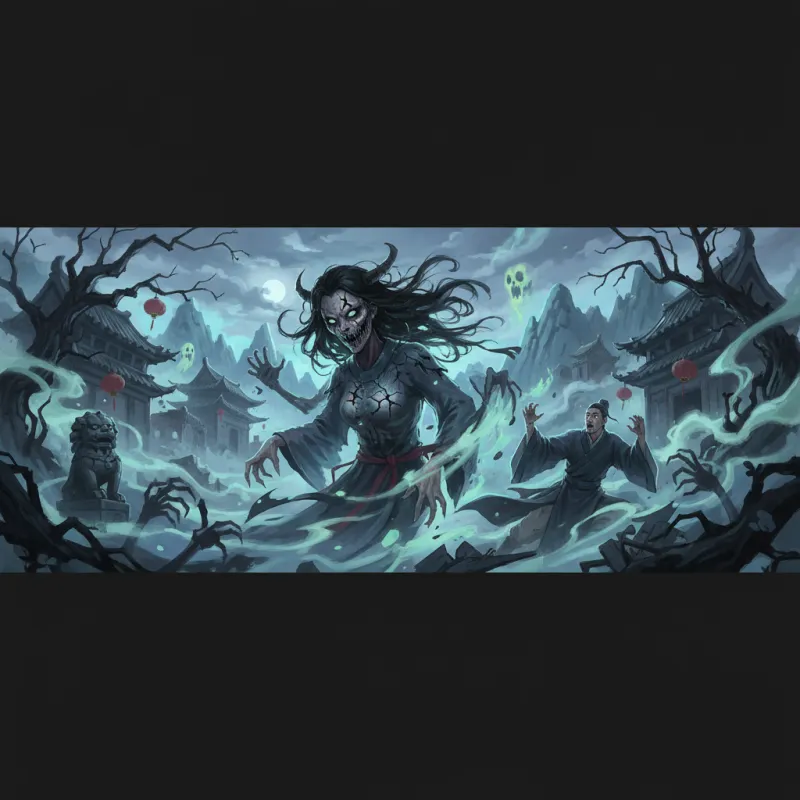
A scholar wakes in the middle of the night. Through a crack in the door, he watches a woman peel off her face like a mask, revealing the rotting green flesh beneath. She hangs the beautiful skin on a hook like a coat, then proceeds to paint it with fresh colors for the next day's deception. This scene from 画皮 (huàpí, "Painted Skin") has terrified Chinese readers for three centuries, and it remains the single most visceral image in all of 聊斋志异 (Liáozhāi Zhìyì, "Strange Tales from a Chinese Studio").
Why This Story Refuses to Die
Pu Songling wrote hundreds of supernatural tales in the late 17th century, but "Painted Skin" stands apart. It's been adapted into films, television series, operas, and graphic novels more than any other Liaozhai story. The 2008 film adaptation alone grossed over $40 million, and a 2012 sequel followed. What makes this particular tale so enduring isn't just the horror—it's the way the horror operates on multiple levels simultaneously.
The surface narrative is straightforward enough. Wang Sheng (王生), a scholar, encounters a beautiful woman claiming to be a concubine fleeing abuse. He takes her home, hiding her from his wife. But this woman is actually a 妖魔 (yāomó, demon) wearing a painted human skin, and she's been feeding on Wang's vital essence. When a Taoist priest exposes her true nature, she rips out Wang's heart and flees. Only through his wife's desperate intervention—crawling through the streets begging a filthy beggar for help—is Wang restored to life.
But that plot summary doesn't capture what makes the story genuinely disturbing. The horror isn't in the monster reveal—it's in the implications that linger after you finish reading.
The Demon Who Tells the Truth
Here's what makes "Painted Skin" different from typical monster stories: the demon never actually lies. When Wang first encounters her, she says she's fleeing an abusive situation. Later, when the Taoist priest confronts her, she doesn't deny what she is. She simply argues that Wang invited her in, that he wanted what she offered. And she's right.
This is the story's genius. The 画皮鬼 (huàpí guǐ, painted skin demon) functions as a mirror for human desire and self-deception. Wang sees a beautiful woman in distress and immediately constructs an entire fantasy around her—the damsel, the secret romance, the validation of his own heroism and desirability. He never asks hard questions. He never investigates her story. He wants to believe, so he does.
The painted skin itself becomes a metaphor that works in multiple directions. Yes, it's the demon's disguise. But it's also the beautiful surface that Wang projects onto her, the fantasy he paints over reality. When his friend Chen (陈) tries to warn him that something seems wrong, Wang dismisses him. The demon doesn't need to maintain the illusion—Wang does that work himself.
The Wife Who Saves Him
The story's second act shifts focus to Wang's wife, and this is where Pu Songling's social commentary cuts deepest. After the demon kills Wang, his wife doesn't collapse in grief or wait for male relatives to handle things. She runs into the streets in the middle of the night, searching for help. She finds a filthy, possibly insane beggar and literally begs him—a woman of her social class prostrating herself before someone society considers beneath contempt.
The beggar agrees to help, but only after making her eat his phlegm as proof of her sincerity. It's a grotesque test, and she passes it without hesitation. This scene has made modern readers uncomfortable for obvious reasons, but within the story's logic, it's the wife's willingness to abandon all social pretense, all concern for status and dignity, that proves her love is real—unlike Wang's attraction to the demon, which was always about his own ego.
The beggar then produces a 还魂丹 (huánhún dān, soul-returning pill) from his throat, which the wife places in Wang's chest cavity where his heart used to be. Wang revives, and the demon is eventually destroyed by the Taoist priest's magic sword.
What the Story Actually Says About Gender
Modern interpretations often frame "Painted Skin" as a straightforward cautionary tale about female deception—the dangerous woman who destroys the foolish man. But Pu Songling's text is more complex and more critical of Wang than that reading suggests.
The demon is certainly dangerous, but she's also honest about what she is once confronted. Wang, by contrast, lies to his wife, lies to himself, and constructs an entire false reality to justify his desires. The story's moral isn't "women are deceivers"—it's "men deceive themselves and blame women for it."
Meanwhile, the wife demonstrates every virtue that Confucian society claimed to value: loyalty, courage, humility, and genuine love. Yet Wang never appreciates this. Even after she saves his life through extraordinary effort and sacrifice, the story ends with Wang simply resuming his normal life. There's no transformation, no growth, no recognition of what his wife did for him.
This is the story's darkest element—darker than the demon, darker than the heart-ripping. Wang learns nothing. The experience doesn't change him. He was willing to die for a fantasy, and his wife was willing to debase herself to save him, and none of it matters. He'll probably do something similar again.
The Taoist Priest and the Beggar
The two figures who actually possess power in the story—the Taoist priest who identifies the demon and the beggar who resurrects Wang—exist outside conventional social structures. The priest is a wandering holy man, the beggar is literally society's refuse. Neither has official position or recognized authority, yet both can do what the educated scholar cannot: see reality clearly and act effectively.
This reflects a common theme in Liaozhai stories—the failure of the educated elite and the Confucian system they represent. Wang has all the markers of success: education, social position, a good marriage. But when confronted with genuine danger, his learning is useless. He can't recognize a demon standing in front of him. He can't save himself. He can't even properly value the wife who saves him.
The priest and beggar represent alternative sources of wisdom—Taoist mysticism and folk knowledge—that the official culture dismisses but that prove more effective than classical education. For Pu Songling, who spent his life failing the imperial examinations despite his obvious literary talent, this wasn't just philosophical speculation. It was personal.
Why It Still Scares Us
"Painted Skin" endures because its horror is fundamentally psychological rather than supernatural. The demon is frightening, yes—that image of her painting the skin is genuinely nightmarish. But the real horror is how easily Wang deceives himself, how completely he constructs a fantasy and then inhabits it despite all evidence.
We've all done versions of this. We've all wanted something badly enough that we ignored warning signs, dismissed friends' concerns, and convinced ourselves that our fantasy was reality. The demon in "Painted Skin" doesn't need to be a supernatural creature. She could be a con artist, a toxic relationship, an addiction, a political ideology—anything we paint with our desires until we can't see what's actually there.
The story also captures something true about how we respond to being saved from our own mistakes. Wang doesn't become grateful or humble after his wife resurrects him. He just goes back to normal. This is painfully realistic. People rarely learn from close calls. We rationalize, minimize, and move on, carrying the same vulnerabilities that endangered us in the first place.
The Legacy in Modern Adaptations
Contemporary film and television adaptations of "Painted Skin" typically soften the story's edges. They make the demon more sympathetic, give Wang more redeeming qualities, and often turn the tale into a tragic romance. The 2008 film, for instance, adds a complex backstory for the demon and transforms her into a figure worthy of empathy rather than pure horror.
These adaptations aren't wrong, exactly—they're responding to different cultural moments and audience expectations. But they do lose something of Pu Songling's sharp-edged critique. The original story isn't romantic. It's not even particularly sympathetic to anyone except the wife. It's a cold-eyed examination of self-deception, misplaced desire, and the gap between what we claim to value and what we actually choose.
For readers interested in how Liaozhai stories blend horror with social commentary, "Painted Skin" represents the collection's aesthetic at its most refined. It shares thematic DNA with stories like The Laughing Girl, where supernatural encounters reveal human character, and Nie Xiaoqian, where the boundaries between human and demon prove more permeable than we'd like to believe.
Reading It Today
Three centuries after Pu Songling wrote it, "Painted Skin" remains unsettling because it refuses easy resolutions. The demon is destroyed, Wang lives, but nothing is really solved. Wang hasn't changed. His wife's sacrifice hasn't been properly recognized. The social structures that enabled Wang's self-deception remain intact.
This is what makes it literature rather than just a scary story. It doesn't offer the comfort of a moral universe where good is rewarded and evil punished. It offers something more valuable and more disturbing: a mirror that shows us how we actually behave, not how we imagine we'd behave in extraordinary circumstances.
The painted skin isn't just the demon's disguise. It's the beautiful surface we paint over uncomfortable realities—about ourselves, about others, about the world. And the story's lasting power comes from its insistence that underneath that painted surface, something hungry is always waiting.
Related Reading
- What is Liaozhai Zhiyi? A Guide to China's Greatest Ghost Stories
- Pu Songling: The Failed Scholar Who Wrote China's Greatest Ghost Stories
- The Liaozhai Stories That Hollywood Should Adapt (But Probably Won't)
- Liaozhai Zhiyi: The Ghost Stories That Changed Chinese Literature
- Nie Xiaoqian: The Ghost Romance That Conquered Cinema
- Spirit Writing: Fuji Divination and Messages from the Gods
- Hungry Ghosts and Wandering Souls: The Unquiet Dead of Chinese Folklore
- Chinese Death Customs That Surprise Westerners
Explore Chinese Culture
- Explore ancient mythical creatures
- Explore Daoist exorcism traditions
- Explore Chinese folk beliefs and superstitions