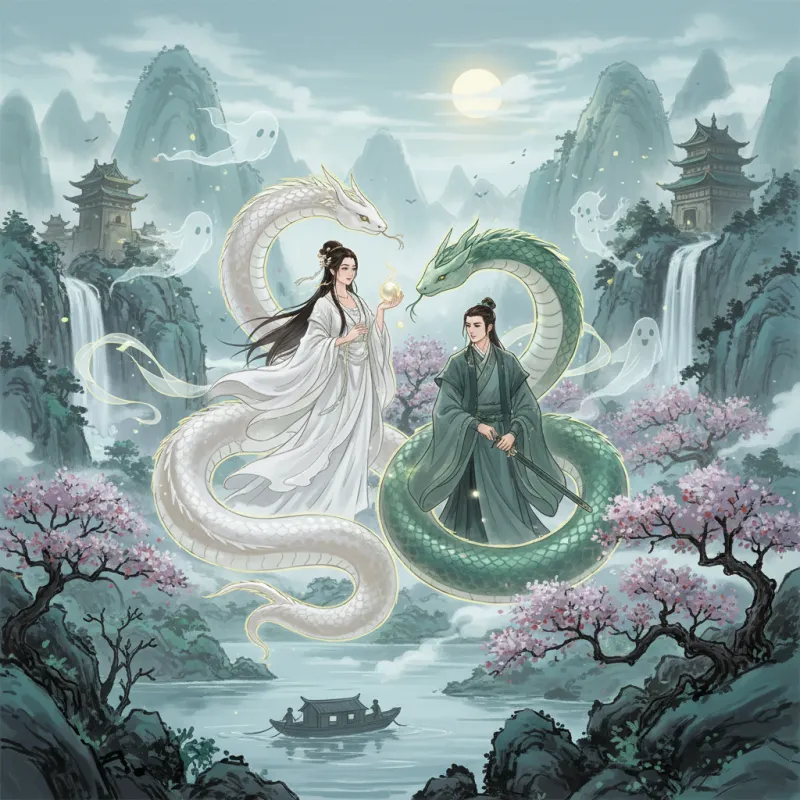
A white snake coils around a pagoda for a thousand years, and when she finally breaks free, the first thing she does is fall in love with a pharmacist. This is not a metaphor. In Chinese folklore, snake spirits (蛇精, shéjīng) are among the most dangerous and seductive of all shapeshifters — creatures that blur the line between demon and deity, between predator and protector. And nowhere is this ambiguity more profound than in the Legend of the White Snake (白蛇传, Báishé Zhuàn), a story that has haunted Chinese imagination since the Song Dynasty.
The Cultivation of Snake Spirits
Snake spirits occupy a peculiar position in the Chinese supernatural hierarchy. Unlike fox spirits, who seduce for survival, or cat demons, who feed on human essence, snake spirits cultivate (修炼, xiūliàn) — they practice spiritual refinement over centuries, absorbing moonlight, swallowing pearls of wisdom, and slowly transforming their cold-blooded nature into something approaching humanity.
The process is brutal. Classical texts like the Taiping Guangji (太平广记) from the 10th century describe snakes that must survive five hundred years before achieving speech, another five hundred before taking human form. During this time, they are vulnerable — hunted by Daoist exorcists, Buddhist monks, and anyone who recognizes the telltale signs: eyes that don't blink quite right, a preference for cool places, an aversion to realgar wine (雄黄酒, xiónghuáng jiǔ).
Bai Suzhen (白素贞), the White Snake herself, supposedly cultivated for a full millennium before descending to Hangzhou's West Lake. This matters. A thousand years of spiritual practice should, theoretically, elevate her beyond mere demon status. She has earned her humanity through discipline and time. And yet, when she falls in love with the mortal herbalist Xu Xian (许仙), the entire celestial bureaucracy mobilizes to destroy her.
The Umbrella and the Debt
The story's inciting incident is deceptively simple: a rainstorm, a broken bridge, a borrowed umbrella. Xu Xian, a gentle pharmacist with no particular spiritual awareness, offers his umbrella to two beautiful women caught in the rain. One is Bai Suzhen. The other is Xiao Qing (小青), a green snake spirit and Bai Suzhen's companion — younger, fiercer, less interested in human conventions.
But this is not random kindness. In some versions of the tale, Bai Suzhen is repaying a debt from a previous life, when Xu Xian (in an earlier incarnation) saved a small white snake from a beggar boy's cruelty. This is crucial to understanding Chinese supernatural ethics: the cosmos keeps accounts. A life saved must be repaid, even if it takes a thousand years and requires crossing the boundary between species.
They marry. Bai Suzhen uses her supernatural knowledge to help Xu Xian's pharmacy thrive — she can identify any herb, diagnose any illness, compound medicines that work miracles. For a time, they are genuinely happy. The text descriptions from the Ming Dynasty play Leifeng Pagoda (雷峰塔) emphasize this: Bai Suzhen is not pretending to be human. She has become human in every way that matters — she cooks, she laughs, she worries about money, she wants a child.
Fahai: The Monk Who Ruins Everything
Enter Fahai (法海), a Buddhist monk from the Jinshan Temple (金山寺) who sees through Bai Suzhen's disguise immediately. In modern retellings, Fahai is often portrayed as a villain — rigid, cruel, obsessed with rules over compassion. But in earlier versions, his position is more complex. He is not wrong that Bai Suzhen is a demon. He is not wrong that human-demon marriages violate the natural order. He is not even wrong that Xu Xian is in potential danger.
What makes Fahai monstrous is his certainty. He cannot conceive that a demon might genuinely love, that cultivation might genuinely transform, that the rules might be wrong. When he tricks Xu Xian into giving Bai Suzhen realgar wine during the Dragon Boat Festival (端午节, Duānwǔ Jié) — a substance toxic to snake spirits — she reverts to her true form: a massive white serpent. Xu Xian, confronted with his wife's true nature, dies of fright.
Bai Suzhen, desperate and grieving, travels to the sacred Mount Emei (峨眉山) to steal a magical herb that can resurrect the dead. She fights celestial guardians, nearly dies herself, and succeeds — because her love is real enough to move heaven. Xu Xian returns to life. And this is when the story becomes truly tragic, because he forgives her. He accepts her nature. He chooses to stay married to a snake spirit.
Fahai cannot allow this.
The Flooding of Jinshan Temple
The climax of the White Snake legend is one of the most spectacular scenes in Chinese folklore. When Fahai imprisons Xu Xian in Jinshan Temple, refusing to release him, Bai Suzhen does what any desperate wife would do: she summons the waters of the Yangtze River and attempts to drown the entire temple.
This is not metaphorical flooding. In the traditional opera versions, the stage fills with acrobats in blue silk representing waves, while Bai Suzhen and Xiao Qing command armies of aquatic demons — shrimp soldiers and crab generals (虾兵蟹将, xiābīng xièjiàng) — in a full-scale assault on Buddhist authority. The battle is cosmic in scale. Fahai counters with his monk's staff and Buddhist sutras, holding back the flood through sheer spiritual power.
Bai Suzhen is pregnant during this battle. This detail appears in most versions and transforms the entire conflict. She is not just fighting for her husband — she is fighting for her unborn child's right to exist, for her family's right to be a family. The fact that she loses, that Fahai ultimately traps her beneath Leifeng Pagoda (雷峰塔) on the shores of West Lake, makes the story unbearable.
The terms of her imprisonment are specific: she will remain trapped until the lake dries and the pagoda falls. In other words, forever.
What the White Snake Means
The Legend of the White Snake has been reinterpreted constantly since its first written appearance in the Song Dynasty collection Qingping Shantang Huaben (清平山堂话本). During the Ming and Qing dynasties, it became a popular opera. In the 20th century, it was adapted into films, television series, and even a Taiwanese puppet show. Each era finds something different in the story.
For traditional Confucian scholars, it was a cautionary tale about the dangers of demonic seduction and the importance of maintaining boundaries between human and supernatural realms. For early 20th-century reformers, it became a story about oppressive religious authority crushing individual freedom. For modern audiences, it is simply a love story — perhaps the greatest love story in Chinese folklore, precisely because it is doomed.
What makes Bai Suzhen different from other shapeshifters is her completeness. Fox spirits seduce and drain; they are fundamentally parasitic. Weasel spirits possess and torment; they are fundamentally malicious. But Bai Suzhen gives more than she takes. She heals the sick, enriches her husband, risks everything for love. If she is a demon, she is a demon who has transcended her nature through sheer force of will and affection.
The question the story never answers — never can answer — is whether this is enough. Does a thousand years of cultivation erase what you fundamentally are? Can love truly transform a cold-blooded predator into a warm-blooded wife and mother? Or is Fahai right that some boundaries exist for good reason, that human and demon cannot mix without catastrophe?
The Pagoda Falls
Here is the epilogue that most people forget: Leifeng Pagoda actually collapsed. On September 25, 1924, the real pagoda on West Lake's southern shore — the one that supposedly imprisoned Bai Suzhen — fell into ruins. Locals had been stealing its bricks for years, believing they brought good luck and fertility. When it finally crumbled, people joked that the White Snake was finally free.
A new pagoda was built in 2002, a gleaming reconstruction that looks nothing like the original. Tourists visit it constantly, taking photos, buying white snake souvenirs, leaving offerings. Some leave umbrellas — a reference to the story's beginning, to the kindness that started everything.
The legend says that Bai Suzhen's son, Xu Shilin (许仕林), grew up to become a brilliant scholar and imperial official. On the day he returned home in glory, wearing his official robes, Leifeng Pagoda cracked open and his mother emerged — still beautiful, still devoted, finally free. They reunited. Fahai, in some versions, was so ashamed of his cruelty that he hid inside a crab shell, which is why crabs have monk-shaped patterns on their backs to this day.
It is a happy ending grafted onto a tragedy, the kind of narrative compromise that Chinese folklore specializes in. The truth is darker and more interesting: Bai Suzhen probably never escaped. The pagoda fell not because of destiny but because of poverty and superstition and the slow decay of all physical things. And yet the story persists, retold and reimagined, because it asks questions that matter.
Can you love someone whose nature is fundamentally different from yours? What do you owe to someone who saved your life in a previous incarnation you don't remember? When does spiritual authority become tyranny? These are not questions with easy answers, which is why the White Snake has been coiled around Chinese imagination for eight centuries, and why she shows no signs of letting go.
Related Reading
- 10 Famous Fox Spirit Stories That Defined Chinese Supernatural Fiction
- The Shapeshifters of Chinese Folklore: Fox Spirits, Snake Demons, and Beyond
- Fox Spirits: The Complete Guide to China's Most Famous Shapeshifters
- How Animals Become Demons: The Yaoguai Transformation Process
- Fox Spirits in Chinese Culture: Tricksters, Lovers, and Gods
- The Complete Guide to Chinese Supernatural Folklore: Ghosts, Demons, and Spirit World
- Exploring Chinese Supernatural Folklore: The Haunting World of Ghosts and Spirits
- Yin Feng Shui: The Art of Placing Graves for Good Fortune
Explore Chinese Culture
- Explore ancient mythical creatures
- Explore Daoist exorcism traditions
- Explore Chinese folk beliefs and superstitions