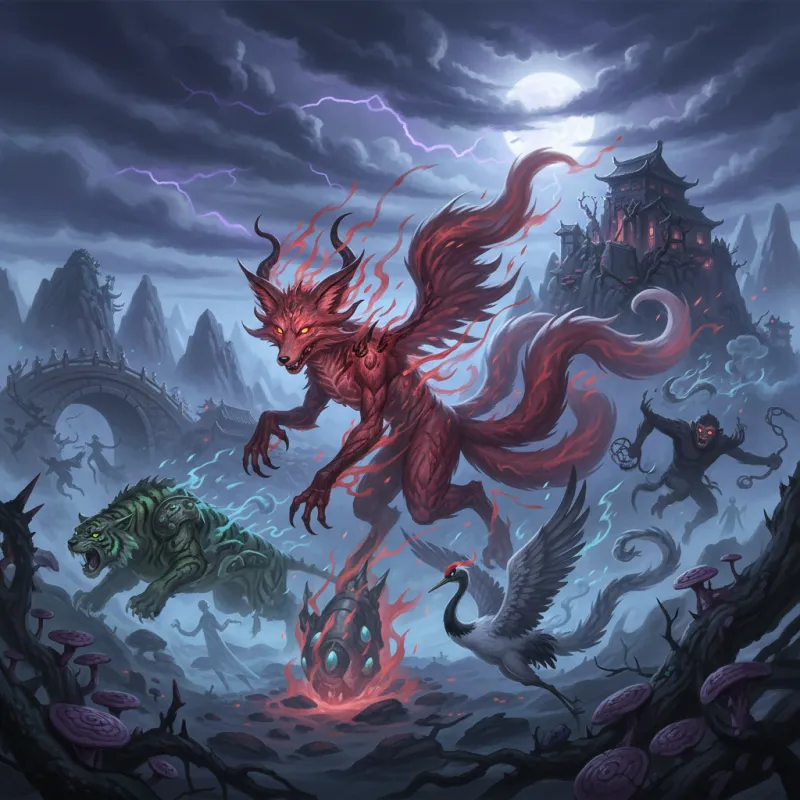
A fox sits motionless in moonlight for three hundred years, absorbing lunar essence through its breath. A snake coils around the same ancient tree for five centuries, never moving, never eating, slowly condensing the wood's vital energy into a pearl beneath its jaw. A house cat watches your family for generations, learning speech patterns, memorizing gestures, waiting for the moment its tail splits in two and it can finally speak your language. This is 修炼 (xiūliàn) — cultivation — and in Chinese supernatural tradition, it's not magic. It's work.
The Mechanics of Transformation
The process by which an ordinary animal becomes a 妖怪 (yāoguài) — a demon or supernatural creature — follows rules as rigid as any scientific principle. The baseline requirement is time, measured not in years but in centuries. Most texts agree on a minimum threshold: one hundred years to develop basic spiritual awareness, three hundred years to achieve human speech, five hundred years to master shapeshifting, and one thousand years to transcend the yaoguai category entirely and become a 仙 (xiān) — an immortal.
But time alone accomplishes nothing. The animal must actively cultivate, and cultivation requires three elements: a source of spiritual energy, a method of absorption, and unbroken concentration. The most common energy source is moonlight, particularly during full moons, which is why so many transformation stories feature animals sitting in specific positions, facing the moon, practicing breathing techniques that would look perfectly at home in a Daoist monastery. Foxes, the most famous cultivators in Chinese folklore, are said to bow to the moon exactly 108 times each night, a number that echoes Buddhist prayer beads and suggests the spiritual discipline required.
Alternative energy sources include sunlight (less potent but more constant), the essence of living beings (dangerous and morally corrupting), sacred locations like mountain peaks or ancient forests, and in some traditions, the energy released at the moment of human death. The 17th-century collection Strange Tales from a Chinese Studio (聊斋志异, Liáozhāi Zhìyì) by Pu Songling includes multiple stories of animals lurking near battlefields or execution grounds, not to feed on corpses but to absorb the sudden release of life force.
The Physical Markers of Progress
Cultivation produces visible changes long before an animal achieves full transformation. These markers serve as warning signs in folklore, ways for humans to identify which animals have crossed the threshold from natural to supernatural.
The most universal marker is unusual longevity. A cat that lives thirty years, a snake that grows beyond natural size limits, a crow that your great-grandfather remembers from his childhood — these are animals that have begun the process. The second marker is behavioral abnormality: animals that seem to understand human speech, that appear in places they shouldn't be able to reach, that show emotional responses beyond instinct. The third marker is physical mutation, and this is where things get specific.
Foxes develop additional tails, one for each century of cultivation, until they reach nine tails and transcend into 九尾狐 (jiǔwěihú) — nine-tailed fox spirits of immense power. Snakes grow horns, then legs, then dragon-like features as they progress toward becoming 蛟 (jiāo) or 龙 (lóng). Cats develop split tails, becoming 猫又 (māoyòu) — though this term is more common in Japanese folklore, Chinese traditions describe similar bifurcated-tail cats with supernatural abilities. Weasels, particularly yellow weasels (黄鼠狼, huángshǔláng), develop the ability to stand upright and emit a paralyzing gas, which is not metaphorical — multiple Qing dynasty accounts describe this as an actual defensive mechanism of cultivated weasels.
The physical changes reflect the animal's progress in bridging the gap between beast and human form. A fox with three tails can speak but not shapeshift. A fox with five tails can assume human form but only for short periods. A fox with seven tails can maintain human form indefinitely but will revert if injured or emotionally distressed. Only a nine-tailed fox has complete mastery over its form.
The Moral Dimension of Cultivation
Here's where Chinese supernatural tradition diverges sharply from Western monster narratives: cultivation is not inherently evil. A yaoguai is not a demon in the Christian sense — it's simply an animal that has achieved supernatural abilities through disciplined practice. Whether that yaoguai becomes benevolent or malevolent depends entirely on the choices it makes during and after transformation.
The tradition recognizes three paths. The first is the righteous path (正道, zhèngdào), where the cultivating animal adheres to Buddhist or Daoist principles, avoids harming humans, and seeks enlightenment rather than power. These animals often become protectors, helpers, or teachers. The white snake Bai Suzhen from Legend of the White Snake (白蛇传, Báishé Zhuàn) represents this path — a snake who cultivated for a thousand years, achieved human form, fell in love with a human man, and despite being hunted by a zealous monk, never abandoned her compassion.
The second path is the demonic path (魔道, módào), where the animal accelerates cultivation by consuming human essence, typically through seduction and sexual energy transfer. This is the path of the stereotypical fox spirit who appears as a beautiful woman, seduces scholars, and drains their life force. It's faster than righteous cultivation but carries severe karmic consequences and often ends with the yaoguai being hunted down by exorcists or Daoist priests.
The third path, less discussed but more common in actual folklore, is the pragmatic path — animals who cultivate through natural means but interact with humans based on circumstance rather than ideology. They might help a kind farmer, punish a cruel hunter, or simply avoid humans entirely. Most animal spirits in classical Chinese literature fall into this category, neither saints nor monsters but beings with their own motivations and moral complexity.
The Tribulation System
The most fascinating aspect of yaoguai cultivation is the tribulation system (天劫, tiānjié) — a concept borrowed from Daoist immortality practices and applied to animal transformation. The universe itself, according to this tradition, opposes unnatural transformations. An animal that accumulates too much power triggers a heavenly response, typically in the form of lightning strikes that occur at specific intervals.
The first tribulation comes at the three-hundred-year mark, when the animal first attempts to speak human language. The second comes at five hundred years, when it attempts its first full transformation. The third comes at one thousand years, when it seeks to transcend yaoguai status entirely. Each tribulation is more severe than the last, and failure means death — not just physical death but the destruction of the accumulated spiritual energy, erasing centuries of work in an instant.
This system explains why so many yaoguai in folklore are desperate, calculating, or willing to take moral shortcuts. They're not evil by nature; they're under deadline pressure. A fox at 499 years of cultivation knows that in one year, lightning will strike, and if it hasn't accumulated enough power to survive, everything ends. This creates incentive to seek faster cultivation methods, even if those methods involve harming humans.
The tribulation system also explains the relationship between yaoguai and human cultivators. A Daoist priest who has survived his own tribulations understands exactly what the yaoguai is experiencing. Some priests hunt yaoguai on principle, but others — particularly in Buddhist-influenced traditions — offer protection or guidance, recognizing the yaoguai's cultivation as a legitimate spiritual path. The Journey to the West (西游记, Xīyóu Jì) features multiple yaoguai who, after being defeated by Sun Wukong, are recruited by Buddhist bodhisattvas and given positions as guardians or disciples rather than being destroyed.
Species-Specific Cultivation Methods
Not all animals cultivate the same way, and folklore is surprisingly specific about which species use which methods. Foxes, as mentioned, focus on lunar energy and are associated with seduction and illusion. Their cultivation emphasizes mental and spiritual development over physical power, which is why fox spirits in literature are typically portrayed as clever, manipulative, and skilled in magic rather than direct combat.
Snakes cultivate through stillness and concentration, often remaining motionless for decades while absorbing earth energy through their bodies. Their cultivation emphasizes physical transformation — the gradual development of legs, horns, and dragon features. Snake spirits in folklore are typically portrayed as powerful, dignified, and associated with water and weather control. The distinction between a cultivated snake and a true dragon is primarily one of time and power level rather than fundamental nature.
Weasels, particularly yellow weasels, cultivate through a method that seems almost parasitic — they attach themselves to human households and absorb the ambient energy of human activity. This is why weasel spirits in folklore are so often associated with possession and why rural Chinese tradition includes specific taboos against killing weasels near one's home. A weasel that has lived in your walls for a century has been feeding on your family's energy; killing it might trigger revenge, but it's also been protecting your home from other supernatural threats as part of its territorial behavior.
Cats cultivate through observation and mimicry, which is why cat spirits are portrayed as particularly skilled at impersonating specific humans rather than just assuming generic human form. A cat that has watched your family for generations knows not just how humans move but how you specifically move, how your grandmother spoke, what gestures your father used when angry. This makes cat spirits particularly dangerous in folklore — they don't just shapeshift, they replace.
The Modern Cultivation Problem
Contemporary Chinese fantasy literature, particularly the 修真 (xiūzhēn) cultivation novel genre, has complicated the traditional yaoguai transformation narrative by introducing systematic power levels, cultivation techniques that can be taught and learned, and a much faster timeline. In these novels, an animal might achieve human form in decades rather than centuries, and the process is less about patient accumulation of energy and more about finding rare resources, learning secret techniques, or consuming spiritual medicines.
This represents a fundamental shift from folklore to fantasy gaming logic, where cultivation becomes less about spiritual discipline and more about resource optimization. The traditional yaoguai, who spent three hundred years sitting in moonlight, has been replaced by the yaoguai who raids ancient ruins for cultivation manuals and fights other supernatural beings for control of energy-rich territories.
Whether this represents evolution or degradation of the tradition depends on your perspective. The gaming-influenced approach makes cultivation more accessible as a narrative device and allows for more dynamic storytelling. But it loses something essential about the original concept — the idea that transformation requires not just power but time, patience, and the kind of sustained focus that most humans, ironically, could never achieve. The traditional yaoguai wasn't a monster or a power fantasy. It was a meditation on what it means to transcend your nature through centuries of disciplined effort, knowing that the universe itself will try to stop you, and doing it anyway.
That fox sitting in your garden, staring at the moon? It's not plotting. It's working. And it's been working longer than your family has owned this house.
Related Reading
- The Nine-Tailed Fox: From Divine Symbol to Ultimate Villain
- 10 Famous Fox Spirit Stories That Defined Chinese Supernatural Fiction
- Snake Spirits and the Legend of the White Snake
- Fox Spirits in Chinese Culture: Tricksters, Lovers, and Gods
- Supernatural Animals in Chinese Culture: Not Just Foxes
- Dream Interpretation in Chinese Culture: When the Spirit Wanders at Night
- Jiangshi: The Hopping Vampire Genre That Conquered Hong Kong Cinema
- Exploring the Multifaceted World of Chinese Supernatural Folklore and Afterlife Beliefs
Explore Chinese Culture
- Explore ancient mythical creatures
- Explore Daoist exorcism traditions
- Explore Chinese folk beliefs and superstitions