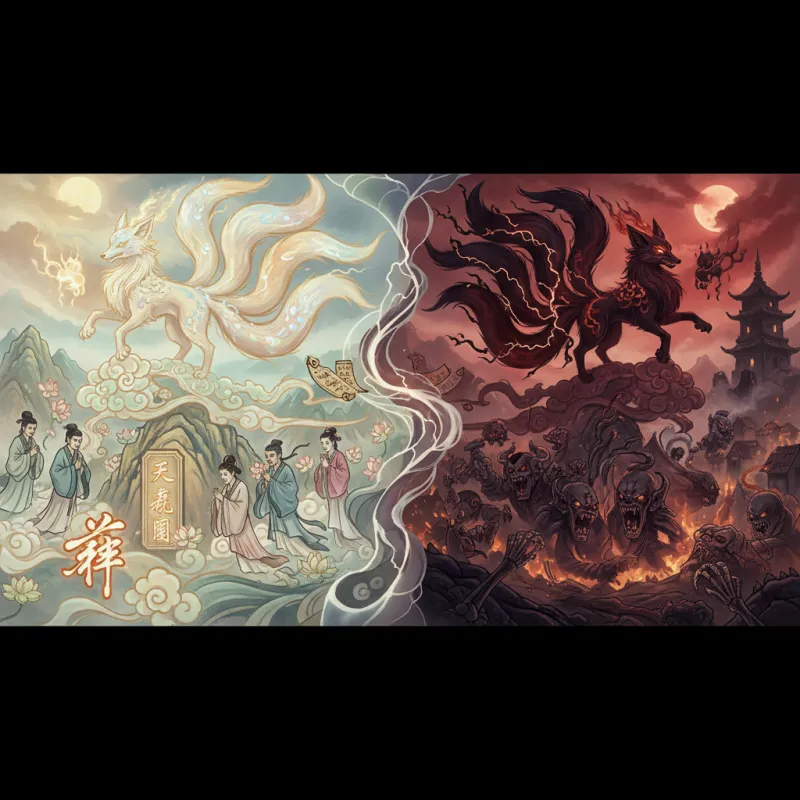
A fox with nine tails appears in the court of King Yu the Great, and the assembled ministers fall to their knees in celebration. This isn't fear — it's joy. The creature's arrival signals that heaven approves of the new dynasty, that peace will reign, that children will be plentiful. Fast forward two thousand years, and that same nine-tailed fox is seducing emperors, possessing concubines, and orchestrating the collapse of entire kingdoms. What happened? How did Chinese culture's most auspicious omen transform into its most terrifying demon?
The answer reveals something profound about how societies project their fears onto the bodies of women and the supernatural creatures that represent them.
When Foxes Meant Good Fortune
The Nine-Tailed Fox (九尾狐, Jiǔwěi Hú) makes its debut in the Shanhai Jing (山海经, Classic of Mountains and Seas), a text compiled around the 4th century BCE. In this earliest appearance, the creature is described matter-of-factly: "The Country of Qingqiu is in its north. Its foxes have four legs and nine tails." The text then adds a crucial detail — where this fox appears, there will be no strange disasters, and the land will be suitable for raising children.
This wasn't metaphorical. Ancient Chinese officials and diviners treated the appearance of a nine-tailed fox as a concrete political omen. When one supposedly appeared during the reign of King Yu, founder of the Xia Dynasty, it was recorded as proof of his mandate from heaven. The Baihutong (白虎通, Debates in the White Tiger Hall), a Han Dynasty text, explicitly states: "When a king does not favor his own kin over strangers, then the nine-tailed fox appears."
The fox represented impartial justice and cosmic order. Its nine tails symbolized the nine provinces of China unified under virtuous rule. Some scholars even argued that the nine tails represented the nine generations of descendants a ruler would have if he governed well.
The Turning Point: Buddhism and Moral Panic
The transformation began during the Tang Dynasty (618-907 CE), when Buddhist concepts of karma and reincarnation collided with indigenous Chinese fox worship. Foxes had always been liminal creatures in Chinese thought — not quite wild, not quite domestic, living at the edges of human settlements. But Buddhism introduced a new framework: animals could cultivate spiritual power through meditation and discipline, potentially achieving human form or even immortality.
This created a theological problem. If foxes could become powerful through cultivation, what were their intentions? The Tang Dynasty saw an explosion of fox spirit tales, collected in texts like the Youyang Zazu (酉阳杂俎, Miscellaneous Morsels from Youyang). In these stories, fox spirits are ambiguous — sometimes helpful, sometimes dangerous, but always unsettling. They seduce scholars, grant wishes, and occasionally drain the life force from their victims.
The nine-tailed fox, as the most powerful of all fox spirits, became the focus of particular anxiety. It appeared less frequently in literature during this period, as if writers were uncertain how to handle a creature that had once been purely auspicious but now carried darker implications.
Daji: The Face of Dynastic Collapse
The nine-tailed fox's complete transformation into villain crystallizes in the Fengshen Yanyi (封神演义, Investiture of the Gods), a 16th-century novel that reimagines the fall of the Shang Dynasty (c. 1600-1046 BCE). In this version, the tyrant King Zhou's infamous concubine Daji (妲己, Dájǐ) isn't merely a bad influence — she's a thousand-year-old nine-tailed fox spirit who has possessed a human woman's body.
The novel's Daji is spectacular in her cruelty. She invents the "炮烙" (páoluò), a bronze cylinder heated until red-hot, which prisoners are forced to embrace. She fills a pool with wine and hangs meat from trees to create the "酒池肉林" (jiǔchí ròulín, pools of wine and forests of meat) where orgies last for days. She convinces King Zhou to execute his most loyal ministers, including the virtuous Bi Gan, whose heart she wants to examine out of curiosity.
Every atrocity serves a purpose: the fox spirit is deliberately destroying the Shang Dynasty to fulfill heaven's mandate that it should fall. But the novel's genius — and its misogyny — lies in making this cosmic necessity wear the face of female sexuality. Daji's power comes from her beauty and her ability to cloud men's judgment through desire. She's not just evil; she's seductive evil, the kind that makes men betray everything they believe in.
The Fengshen Yanyi was wildly popular, going through numerous editions and adaptations. It cemented the nine-tailed fox's reputation for centuries. When Chinese people today think of fox spirits, they think of Daji first — beautiful, dangerous, and ultimately destructive.
The Mechanics of Fox Spirit Possession
Later texts developed an entire taxonomy of how nine-tailed fox spirits operated. Unlike lesser fox spirits who might simply take human form, the nine-tailed fox was said to possess actual human bodies, wearing them like clothing. The original human soul would be displaced or destroyed, and the fox would inhabit the body perfectly, with access to all the victim's memories and mannerisms.
This made the nine-tailed fox the perfect infiltrator. It could enter the imperial palace, the inner chambers, the most protected spaces of power. And because it typically chose to possess beautiful women, it had access to the one vulnerability that Chinese literature consistently attributed to male rulers: sexual desire.
The Liaozhai Zhiyi (聊斋志异, Strange Tales from a Chinese Studio), Pu Songling's 17th-century collection, includes several stories of fox possession. While most of his fox spirits are more sympathetic than Daji, the underlying mechanics are the same. The fox spirit is always more intelligent, more powerful, and more dangerous than it initially appears. It can maintain its disguise for years or even decades. And it always has an agenda that serves its own interests, not humanity's.
This paranoid logic reflects real anxieties about court politics during the Ming and Qing dynasties. How could you trust anyone when they might be something else entirely? The nine-tailed fox became a metaphor for the ultimate insider threat — the beautiful woman who whispers in the emperor's ear and leads the empire to ruin.
Gender, Power, and the Monstrous Feminine
It's impossible to discuss the nine-tailed fox without confronting the obvious: this is a story about the fear of female power. The transformation from auspicious omen to demonic seductress maps almost perfectly onto Chinese literature's increasing anxiety about women in positions of influence.
Consider the historical women who were compared to fox spirits: Empress Wu Zetian, the only woman to rule China in her own right; Yang Guifei, whose beauty supposedly caused the An Lushan Rebellion; Empress Dowager Cixi, blamed for the Qing Dynasty's decline. All were accused of using sexual influence to manipulate weak men and destroy the natural order.
The nine-tailed fox gave this anxiety a supernatural form. It wasn't just that women might be ambitious or politically skilled — they might not even be human. The fox spirit narrative allowed writers to express misogynistic ideas while maintaining plausible deniability. They weren't saying women were evil; they were saying that evil supernatural beings sometimes wore women's bodies.
This is why the nine-tailed fox is almost always female in later literature, despite early texts not specifying gender. The creature became a canvas for projecting fears about female sexuality, intelligence, and agency. A woman who was too beautiful, too clever, or too influential could be suspected of being a fox spirit. The accusation was unfalsifiable — after all, a really good fox spirit would be impossible to detect.
Modern Resurrections and Redemptions
Contemporary Chinese media has begun to complicate the nine-tailed fox's villainous reputation. Video games, television dramas, and web novels increasingly feature fox spirits as protagonists or sympathetic characters. Some explicitly reference the creature's ancient role as an auspicious omen, attempting to reclaim that earlier meaning.
The 2020 drama The Legends features a nine-tailed fox who is neither purely good nor evil, but a complex character navigating between human and supernatural worlds. Mobile games like Onmyoji present multiple fox spirits with different alignments and motivations. These modern interpretations often emphasize the tragedy of the fox spirit's position — a powerful being feared and hunted by humans who don't understand it.
This rehabilitation mirrors broader cultural conversations about gender and power in contemporary China. As women's roles in society expand, the narratives that once demonized female power are being questioned and rewritten. The nine-tailed fox, precisely because it was such a potent symbol of dangerous femininity, has become a site for exploring what female power might look like when it's not automatically coded as monstrous.
Yet the old associations persist. When Chinese media wants to depict a femme fatale or a seductive villain, the nine-tailed fox remains the go-to reference. The creature's two-thousand-year journey from blessing to curse has left it permanently marked by both meanings, unable to fully escape either.
The Fox That Contains Multitudes
The nine-tailed fox's transformation reveals how mythology adapts to serve changing social needs. When ancient China needed symbols of unity and prosperity, the fox's nine tails represented the nine provinces at peace. When later dynasties needed to explain political collapse without blaming male rulers, the fox became a seductress who corrupted virtuous men. When modern creators want to explore themes of otherness and persecution, the fox becomes a misunderstood being hunted for its power.
This flexibility is precisely what makes the nine-tailed fox such an enduring figure in Chinese supernatural lore. Unlike creatures with more fixed meanings, the fox spirit can be reimagined for each generation's anxieties and aspirations. It's a shape-shifter in more ways than one — not just in the stories, but in what those stories mean.
The next time you encounter a nine-tailed fox in Chinese media, look closely at how it's portrayed. Is it the auspicious omen of ancient texts, the demonic seductress of Ming novels, or something new entirely? The answer will tell you as much about the storyteller's time as about the creature itself. After all, we've been projecting our fears and desires onto those nine tails for over two thousand years. There's no reason to expect we'll stop now.
For more on supernatural creatures that transform and deceive, explore the Huli Jing and the Snake Demon — both share the nine-tailed fox's ability to wear human faces while harboring inhuman intentions.
Related Reading
- 10 Famous Fox Spirit Stories That Defined Chinese Supernatural Fiction
- Snake Spirits and the Legend of the White Snake
- Fox Spirits: The Complete Guide to China's Most Famous Shapeshifters
- Supernatural Animals in Chinese Culture: Not Just Foxes
- How Animals Become Demons: The Yaoguai Transformation Process
- Exploring the Multifaceted World of Chinese Supernatural Folklore and Afterlife Beliefs
- Unveiling the Secrets of Chinese Supernatural Folklore and Afterlife Beliefs
- Chinese Campus Ghost Stories: The Haunted Universities
Explore Chinese Culture
- Explore ancient mythical creatures
- Explore Daoist exorcism traditions
- Explore Chinese folk beliefs and superstitions