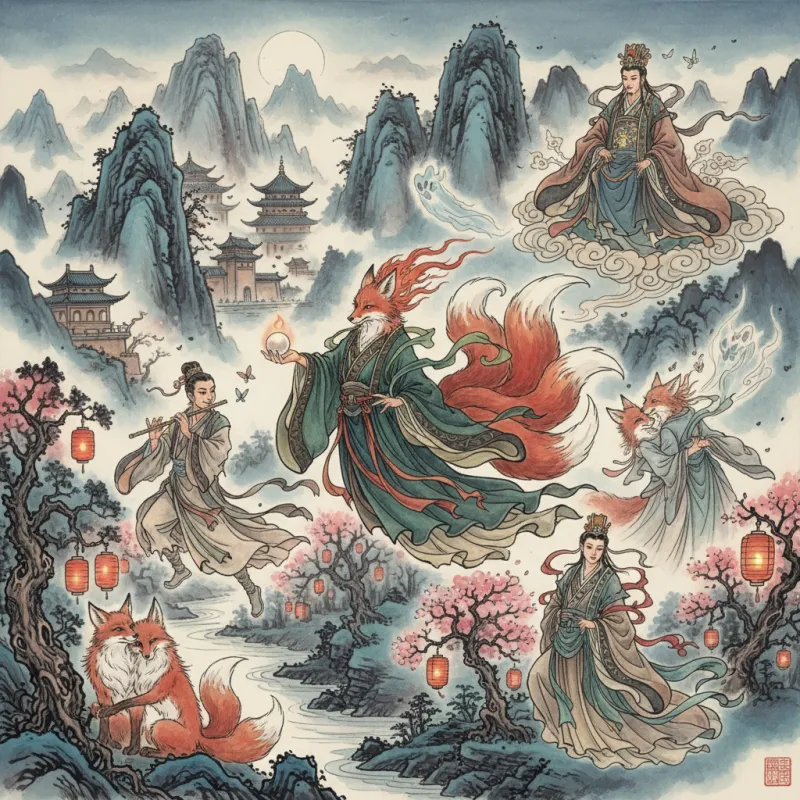
A young scholar burns the midnight oil in his study when a woman of impossible beauty appears at his window. Her skin glows like moonlight, her movements fluid as water. By morning, he's either dead, enlightened, or hopelessly in love — and the fox spirit responsible has vanished into legend. This scene, repeated across thousands of Chinese tales, reveals a truth: no supernatural being in Chinese culture is more contradictory, more dangerous, or more beloved than the fox spirit.
The Nine-Tailed Paradox
The fox spirit (狐狸精, húlijīng) didn't start as a seductress or demon. In the Shanhaijing (山海经, Classic of Mountains and Seas), compiled before the Han Dynasty, the nine-tailed fox (九尾狐, jiǔwěihú) appears as an auspicious omen. When this creature showed itself, the text claims, it signaled peace and prosperity for the realm. The Tushan clan, legendary ancestors of the Xia Dynasty, even claimed descent from a nine-tailed fox — hardly the origin story of a demonic lineage.
But something shifted. By the Tang Dynasty (618-907 CE), the same nine-tailed fox had become synonymous with the fall of dynasties. The most infamous example: Daji (妲己), the consort who supposedly bewitched King Zhou of Shang into such depravity that his kingdom collapsed. Later texts claimed she was a thousand-year-old fox spirit in disguise, though earlier histories simply called her a cruel human woman. The fox spirit had become a convenient scapegoat for male weakness and political failure.
This transformation wasn't accidental. As Confucian orthodoxy tightened its grip on Chinese society, anything associated with uncontrolled sexuality, female power, or spiritual cultivation outside official channels became suspect. The fox spirit — already liminal, already wild — became the perfect repository for these anxieties.
Pu Songling's Revolution
Everything changed with Liaozhai Zhiyi (聊斋志异, Strange Tales from a Chinese Studio), written by Pu Songling in the late 17th century. This collection of nearly 500 tales didn't just feature fox spirits — it rehabilitated them, complicated them, made them fully human in their desires and failures.
Take "Xiao Cui" (小翠), the story of a fox spirit who nurses a young man back from madness, endures his family's suspicion, and ultimately proves more loyal than any human wife could be. Or "Ying Ning" (婴宁), the fox girl whose constant laughter seems simple-minded until you realize it's a form of resistance against a world that demands women be somber and controlled. Pu Songling's fox spirits aren't metaphors — they're individuals, each with distinct personalities, motivations, and moral frameworks.
What made Pu Songling's approach radical was his refusal to moralize. His fox spirits could be virtuous or vicious, selfless or selfish, often within the same story. They reflected the complexity of human nature precisely because they weren't quite human. A fox spirit named Qingfeng (青凤) might help a poor scholar pass his exams, while another named Hu Siniang (胡四娘) might drain a man's life force for sport. The species didn't determine the character.
The Cultivation Path
Here's what most Western adaptations miss: fox spirits aren't born powerful. They're practitioners of internal alchemy (内丹, nèidān), following a cultivation path that mirrors Daoist spiritual practice. A fox must train for centuries, absorbing moonlight, practicing meditation, and accumulating virtue before it can transform into human shape.
The process is technical. According to folklore, a fox must first live to fifty years to gain supernatural awareness. At one hundred years, it can assume human form, though the disguise is imperfect. Only after a thousand years of cultivation can a fox spirit achieve a perfect human transformation and potentially ascend to immortality. Some texts specify that the fox must place a skull on its head and bow to the Big Dipper — if the skull doesn't fall, the transformation succeeds.
This cultivation framework explains why fox spirits in stories are so often obsessed with virtue and merit. They're not just being good for goodness' sake — they're accumulating spiritual currency. A fox spirit who saves a human life or performs a righteous deed accelerates their cultivation by years or decades. Conversely, killing humans or causing harm can destroy centuries of progress. The stakes are existential.
The parallel to human spiritual practice is intentional. Daoist texts often describe human cultivation in the same terms used for fox spirits: gathering qi (气), refining essence (精), achieving transformation. The fox spirit becomes a mirror for human spiritual ambition, with all its potential for both transcendence and corruption.
Gender, Power, and the Female Fox
Let's be direct: the overwhelming majority of fox spirits in Chinese literature are female, and this isn't coincidental. The fox spirit became a way to discuss female sexuality, ambition, and power in a society that officially denied women all three.
The typical narrative goes like this: a beautiful woman appears, seduces a man, and drains his yang essence (阳气, yángqì) through sexual intercourse, leaving him weakened or dead. This story appears hundreds of times across Chinese literature, and it's fundamentally about male anxiety. The fox spirit represents the terrifying possibility that women might have desires of their own, might use sexuality as a tool for their own ends rather than male pleasure.
But read closely, and the subtext becomes text. In "Lotus Fragrance" (莲香) from Liaozhai, a fox spirit and a ghost compete for the same man's affection — and ultimately decide to share him, forming a harmonious household that defies every Confucian norm. In "Painted Skin" (画皮), a demon disguises itself as a beautiful woman, but the real horror isn't the demon — it's the man's willingness to abandon his loyal wife for a pretty face. Pu Songling's sympathies are clear.
The fox spirit also offered women a fantasy of power. In a society where women's movements were restricted, their marriages arranged, their voices silenced, the fox spirit could go anywhere, choose her own lovers, and punish men who wronged her. She was dangerous precisely because she was free.
The Fox Immortal Cult
By the Qing Dynasty, something remarkable happened: people started worshipping fox spirits. The Fox Immortal (狐仙, húxiān) cult emerged primarily in northern China, where households would set up small shrines to fox spirits, offering incense and food in exchange for protection and prosperity.
This wasn't folk religion at the margins — it was mainstream enough that the Qing government repeatedly tried to suppress it. The Qianlong Emperor issued edicts against fox spirit worship in 1766 and 1768, calling it heterodox and socially destabilizing. The edicts failed. People kept their shrines, kept their offerings, kept their prayers.
Why? Because fox spirits delivered results. Unlike distant Buddhist bodhisattvas or Daoist immortals, fox spirits were local, accessible, and practical. They helped with business deals, cured illnesses, found lost objects, and punished enemies. They were supernatural beings who understood human problems because they'd spent centuries observing humans up close.
The cult also offered women a rare form of religious authority. Female spirit mediums (巫, wū) who claimed to channel fox spirits could speak with authority, give advice, and even criticize powerful men — all while attributing their words to the fox spirit. It was a loophole in patriarchal control, and women used it.
Modern Transformations
The fox spirit hasn't disappeared — it's adapted. In contemporary Chinese media, fox spirits appear as romantic leads in television dramas, as playable characters in video games, as metaphors in literary fiction. The 2020 drama "The Legends" (招摇) features a fox spirit as a major character, while the game "Onmyoji" (阴阳师) includes multiple fox spirit characters with distinct personalities and backstories.
But something's been lost in translation. Modern fox spirits are often sanitized, their dangerous edges smoothed away. They're quirky and cute rather than genuinely threatening. The moral ambiguity that made them interesting — the possibility that a fox spirit might be selfish, cruel, or simply indifferent to human welfare — gets replaced with straightforward heroism or villainy.
The exception is in literary fiction, where writers like Can Xue and Yan Lianke use fox spirits as they were originally intended: as figures of liminality that expose the contradictions in human society. In Can Xue's experimental fiction, fox spirits represent the unconscious, the repressed, the parts of ourselves we refuse to acknowledge. They're not characters so much as psychological forces.
Living With Foxes
Here's what I find most compelling about fox spirit lore: it's fundamentally about coexistence with the Other. Unlike Western supernatural traditions that emphasize exorcism and banishment, Chinese fox spirit tales often end with accommodation. The fox spirit stays, the human adapts, and they work out an arrangement.
This reflects a broader pattern in Chinese supernatural belief. Ghosts, demons, and spirits aren't separate from the human world — they're part of it, and humans must learn to navigate their presence. A household might discover a fox spirit living in their walls and, rather than calling an exorcist, simply leave out food and negotiate boundaries. The fox spirit gets shelter, the family gets protection, everyone benefits.
This pragmatic approach to the supernatural feels increasingly relevant. In a world of ecological collapse and technological disruption, we're surrounded by forces we don't fully understand and can't fully control. The fox spirit tradition suggests a response: acknowledge the Other's power, respect its autonomy, and look for ways to coexist rather than dominate.
The fox spirit endures because it represents something essential about the human condition: our capacity for transformation, our moral complexity, our simultaneous attraction to and fear of the wild. Every time a scholar opens his door to a mysterious woman, every time a household leaves offerings for an unseen presence, the question remains the same: Can we live with what we cannot fully understand? The fox spirit, laughing in the shadows, suggests we'd better learn.
For more on supernatural beings that blur the line between human and animal, see Snake Spirits and Dragon Wives and The Weasel Spirit's Revenge.
Related Reading
- How Animals Become Demons: The Yaoguai Transformation Process
- The Nine-Tailed Fox: From Divine Symbol to Ultimate Villain
- 10 Famous Fox Spirit Stories That Defined Chinese Supernatural Fiction
- The Shapeshifters of Chinese Folklore: Fox Spirits, Snake Demons, and Beyond
- Fox Spirits: The Complete Guide to China's Most Famous Shapeshifters
- Cursed Objects in Chinese Folklore: Things You Should Never Touch
- Chinese Dream Interpretation: What Your Dreams Mean in Traditional Culture
- Hungry Ghost Festival: Traditions and Taboos
Explore Chinese Culture
- Explore ancient mythical creatures
- Explore Daoist exorcism traditions
- Explore Chinese folk beliefs and superstitions