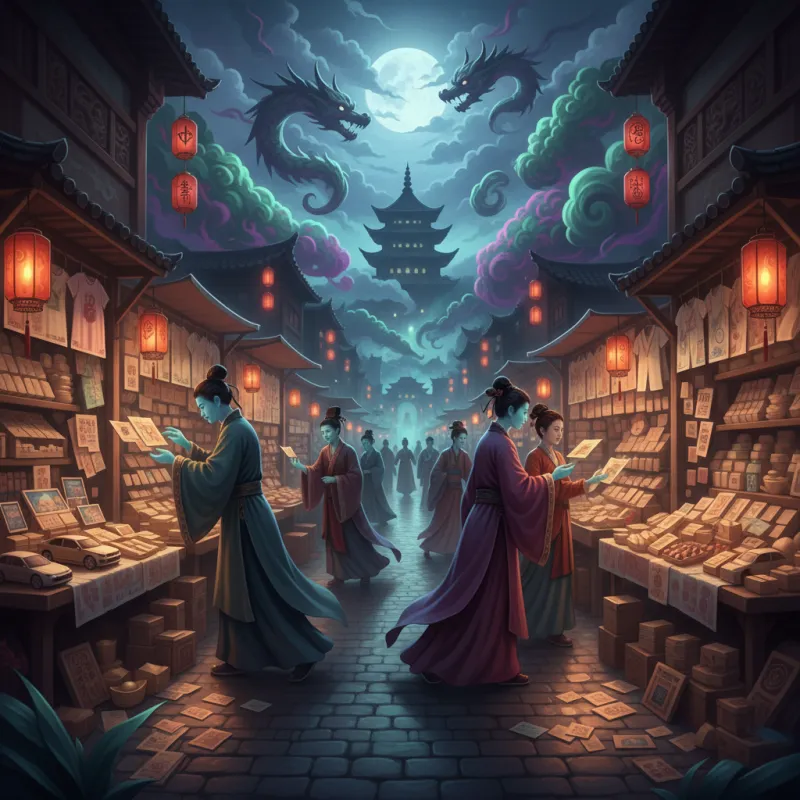
The old woman at the funeral supply shop unfolds a paper Mercedes-Benz the size of a shoebox, its windows carefully cut from translucent rice paper, its wheels painted silver. "Your father will need this in the underworld," she says matter-of-factly, as if discussing grocery delivery. Next to the car sits a paper mansion, a paper smartphone with a hand-drawn screen, and stacks of hell banknotes featuring the Jade Emperor's stern face. Welcome to the afterlife economy, where the dead shop just like the living.
The Logic of Burning
Joss paper (纸钱, zhǐqián) — also called spirit money or ghost money — operates on a principle that would make perfect sense to a physicist: matter changes form, but doesn't disappear. When you burn paper goods for the dead, you're not destroying them. You're transmuting them from physical objects in the yang world (阳间, yángjiān) to spiritual assets in the yin world (阴间, yīnjiān). The smoke carries the essence across the boundary between realms. What turns to ash here materializes there.
This isn't metaphor or wishful thinking in traditional Chinese cosmology — it's how the universe works. The living and dead exist in parallel economies, and burning is the transfer mechanism. Your grandmother needs money to bribe underworld bureaucrats? Burn it. Your grandfather wants new clothes? Burn them. The logic is airtight within its own framework, which is why the practice has survived dynasties, revolutions, and the arrival of smartphones.
The earliest archaeological evidence of burning offerings for the dead dates to the Shang Dynasty (1600–1046 BCE), though those were real objects — bronze vessels, jade, even human sacrifices. Paper money burning emerged much later, during the Tang Dynasty (618–907 CE), when paper currency itself became common in daily commerce. Someone had the brilliant realization: why burn real money when paper replicas work just as well in the spirit realm? The practice spread rapidly because it solved an economic problem — funeral costs were bankrupting families.
What the Dead Actually Need
Walk through any Chinese funeral supply shop and you'll see the afterlife's consumer catalog. Traditional offerings include gold and silver ingots (金银元宝, jīn yín yuánbǎo) — those boat-shaped paper blocks painted metallic colors — which represent concentrated wealth. There are hell banknotes (冥币, míngbì) in absurdly large denominations, often featuring the Jade Emperor or King Yama instead of Mao Zedong. The exchange rate between earthly and underworld currency remains, conveniently, undefined.
But the inventory has evolved dramatically. Modern shops stock paper credit cards, paper passports for international travel in the afterlife, paper air conditioners, paper laptops complete with hand-drawn keyboards. There are paper servants — yes, human figures — though this practice makes many contemporary Chinese uncomfortable for obvious reasons. The most elaborate offerings are paper mansions (纸房子, zhǐ fángzi), multi-story constructions with furniture, gardens, and garages for the paper cars.
The trend toward luxury goods accelerated in the 1990s as China's economy boomed. If you're wealthy in life, the thinking goes, your ancestors should share that prosperity. This has created a strange mirror economy where paper iPhones appear in shops within months of Apple's real product launches. Some families burn paper mistresses for deceased husbands — a practice that sparked heated debates about whether the afterlife should replicate earthly vices or transcend them.
The Hungry Ghost Festival (中元节, Zhōngyuán Jié) in the seventh lunar month sees the highest volume of burning, when the gates between worlds open and wandering spirits roam freely. Families burn offerings not just for their own ancestors but for anonymous ghosts who have no descendants to care for them — a kind of spiritual charity that prevents these hungry ghosts from causing trouble. The streets fill with smoke, and firefighters stay busy.
The Bureaucracy Never Ends
Here's where Chinese afterlife beliefs get deliciously specific: death doesn't free you from paperwork. The underworld operates like an imperial bureaucracy, complete with officials, courts, and endless administrative procedures. The Ten Courts of Hell (十殿阎罗, Shí Diàn Yánluó) process souls through a judicial system that would make Kafka weep. Each court examines different sins, assigns punishments, and eventually determines your next reincarnation.
This bureaucratic structure explains why the dead need money. Bribes smooth the process. A well-placed payment to an underworld clerk might reduce your sentence in the Mirror of Retribution or get you a better reincarnation assignment. It's corruption, yes, but it's cosmic corruption — the system is the system, whether you're alive or dead. Families burn money specifically designated for "travel expenses" (路费, lùfèi) to help souls navigate this bureaucratic maze.
The City God (城隍, Chénghuáng) serves as the local administrator of the dead, maintaining records of every soul in his jurisdiction. He's essentially the afterlife's mayor and judge combined, reporting to higher authorities in the celestial hierarchy. When someone dies, their soul must first report to the City God's temple for processing before moving on to the Ten Courts. Smart families burn extra offerings to ensure favorable treatment at this critical first checkpoint.
Some families hire Taoist priests to perform elaborate rituals that include burning official-looking documents — petitions, appeals, certificates — all carefully written in classical Chinese and stamped with red seals. These papers request specific favors from underworld officials: early release from punishment, better living conditions, or expedited reincarnation. The priests know the proper forms and protocols, like lawyers who specialize in afterlife law. For more on these ritual specialists, see Taoist Exorcism and Demon Binding.
The Economics of Devotion
Burning offerings is expensive, and that's partly the point. Filial piety (孝, xiào) — the cornerstone of Chinese family ethics — demands visible sacrifice. A modest paper offering suggests you don't care enough about your ancestors. An extravagant burning demonstrates proper devotion. This creates social pressure to spend more, turning funerals and annual memorial days into competitive displays of family wealth and loyalty.
The funeral supply industry has responded with increasingly elaborate products. You can buy paper versions of entire businesses — restaurants, shops, factories — so your ancestors can generate income in the afterlife rather than depending on your periodic offerings. There are paper stock certificates, paper real estate deeds, even paper insurance policies. The metaphysical implications are dizzying: if you burn a paper factory, does it employ paper workers? Do those workers need their own paper money?
Critics, both within and outside China, have attacked the practice as wasteful and superstitious. The Communist Party tried to suppress it during the Cultural Revolution as feudal nonsense, but it roared back after Mao's death. Environmental concerns are more recent: all that burning produces air pollution, and some cities have restricted when and where offerings can be burned. Digital alternatives have emerged — websites where you can "burn" virtual offerings — but most families consider these inadequate. The physical act of burning matters.
Yet there's something profound in the practice that transcends its material form. Burning offerings forces the living to imagine the dead's continued existence in concrete terms. What does grandmother need? What would make grandfather comfortable? These questions keep the deceased present in daily consciousness, preventing the absolute severance that death threatens. The paper goods are absurd, yes, but the emotional work they facilitate is real.
Regional Variations and Innovations
Southern China, particularly Guangdong and Fujian provinces, takes joss paper burning to extremes. Funerals in these regions can involve burning paper goods worth tens of thousands of yuan — entire paper estates complete with servants, vehicles, and livestock. The Cantonese are especially known for their elaborate paper offerings, which some attribute to the region's historical wealth and strong clan traditions.
In contrast, northern Chinese families tend toward simpler offerings, focusing on traditional items like ingots and basic necessities. This north-south divide mirrors other cultural differences in Chinese funeral practices, with southerners generally maintaining more elaborate death rituals. Taiwan has developed its own distinctive style, with shops selling paper offerings that blend traditional Chinese items with Japanese influences — a legacy of the island's colonial history.
Overseas Chinese communities have adapted the practice to local contexts. In Singapore and Malaysia, where Chinese form significant minorities, joss paper burning happens openly but with some modifications to avoid offending non-Chinese neighbors. In Western countries, Chinese families often burn offerings in private or at designated areas in cemeteries. Some temples provide burning facilities specifically for this purpose, creating community spaces for maintaining traditional practices in diaspora.
The most recent innovation is the paper passport, which appeared in shops in the early 2000s. The logic: globalization has made international travel normal for the living, so the dead should have the same mobility. These paper passports include visa stamps for various underworld destinations, suggesting a cosmopolitan afterlife where souls can tour different realms. It's simultaneously ridiculous and touching — a recognition that even death shouldn't limit one's horizons.
The Philosophical Puzzle
Joss paper burning raises genuine philosophical questions about the relationship between material and spiritual realms. If burning transforms physical objects into spiritual ones, what determines the exchange rate? Is a paper iPhone as functional in the afterlife as a real one is here? Does the quality of the paper matter, or only the intention behind the burning?
Traditional Chinese philosophy doesn't provide clear answers because it wasn't designed to address these questions. The practice emerged from folk religion, not scholarly debate. But it reveals assumptions about how the universe works: that matter and spirit are continuous rather than separate, that transformation is possible between realms, and that the dead remain embedded in social and economic relationships with the living.
Some Buddhist interpretations reject the entire premise. Pure Land Buddhism, for instance, teaches that the deceased who achieve rebirth in the Western Paradise need nothing from the living — they've transcended material concerns entirely. Yet even devout Buddhists often burn offerings, suggesting that folk practice trumps theological consistency. The heart wants what it wants, and the heart wants to care for the dead in tangible ways.
The practice also implies something unsettling: that the afterlife replicates earthly hierarchies and inequalities. Rich families can provide their ancestors with paper mansions and luxury goods, while poor families burn minimal offerings. Does this mean the afterlife has social classes? Are there wealthy and poor ghosts? The implications trouble anyone who hopes death might level the playing field, but they're consistent with traditional Chinese cosmology, which never promised equality — only order.
Burning in the Modern World
Despite modernization, urbanization, and the Communist Party's official atheism, joss paper burning persists. You see it in Shanghai's gleaming financial district, where elderly residents burn offerings on sidewalks between luxury boutiques. You see it in rural villages where the practice has continued uninterrupted for centuries. You see it in Chinese communities worldwide, adapted to local regulations but fundamentally unchanged.
The practice survives because it serves psychological and social functions that transcend belief in its literal efficacy. Burning offerings provides a structured way to express grief, maintain connection with the deceased, and fulfill family obligations. Even Chinese people who consider themselves non-religious often participate, viewing it as cultural tradition rather than religious ritual. The distinction matters less than the act itself.
Young Chinese have complicated relationships with the practice. Some embrace it as cultural heritage worth preserving. Others find it embarrassing or superstitious, preferring flowers and silent remembrance. But many participate anyway, not because they believe paper money reaches the dead, but because their parents and grandparents expect it. Filial piety operates in the present tense, requiring respect for the living's beliefs about the dead.
The environmental critique has gained traction, leading to innovations like biodegradable joss paper and designated burning facilities with air filtration. Some temples now offer collective burning ceremonies where families contribute offerings that are burned together, reducing individual pollution. These adaptations suggest the practice will continue evolving rather than disappearing, finding new forms that balance tradition with contemporary concerns.
For those interested in how the living protect themselves from potentially dangerous spirits, see Ghost Month Taboos and Protections. The relationship between the living and dead requires not just generosity but also caution — not all spirits are grateful ancestors.
The Smoke Rises
Stand outside a Chinese cemetery during Qingming Festival (清明节, Qīngmíng Jié) — the annual tomb-sweeping day — and watch the smoke rise from hundreds of small fires. Each column of smoke represents a family maintaining its connection to the past, feeding the dead, fulfilling obligations that stretch back generations. The paper burns quickly, transforming in seconds from material object to ash to, believers say, spiritual substance.
Whether the dead actually receive these offerings remains, obviously, unknowable. But the living receive something concrete: a ritual structure for processing grief, expressing love, and maintaining family bonds across the ultimate boundary. The paper Mercedes-Benz is absurd, yes. But absurdity doesn't negate meaning. Sometimes the most profound human gestures are the ones that make the least rational sense.
The practice will likely continue as long as Chinese families exist, adapting to new technologies and social conditions but retaining its essential logic: the dead are not gone, merely relocated. They still need things. And we, the living, still need to provide for them. The smoke rises, carrying our offerings and our love into realms we cannot see but refuse to forget.
Related Reading
- How to Make Offerings to Ancestors: A Practical Guide
- Unveiling the Mysteries of Chinese Supernatural Folklore: Ghosts and Afterlife Beliefs
- Daoist Exorcism: How Chinese Priests Fight Supernatural Evil
- Feng Shui for Ghost Prevention: Protecting Your Home
- Paper Offerings: Sending Wealth to the Afterlife
- Unveiling the Mysteries of Chinese Supernatural Folklore: Ghosts, Spirits, and Afterlife Beliefs
- Dream Spirits and Sleep Demons: The Supernatural World of Chinese Dreams
- River Gods and Water Deities in Chinese Mythology
Explore Chinese Culture
- Explore ancient mythical creatures
- Explore Daoist exorcism traditions
- Explore Chinese folk beliefs and superstitions