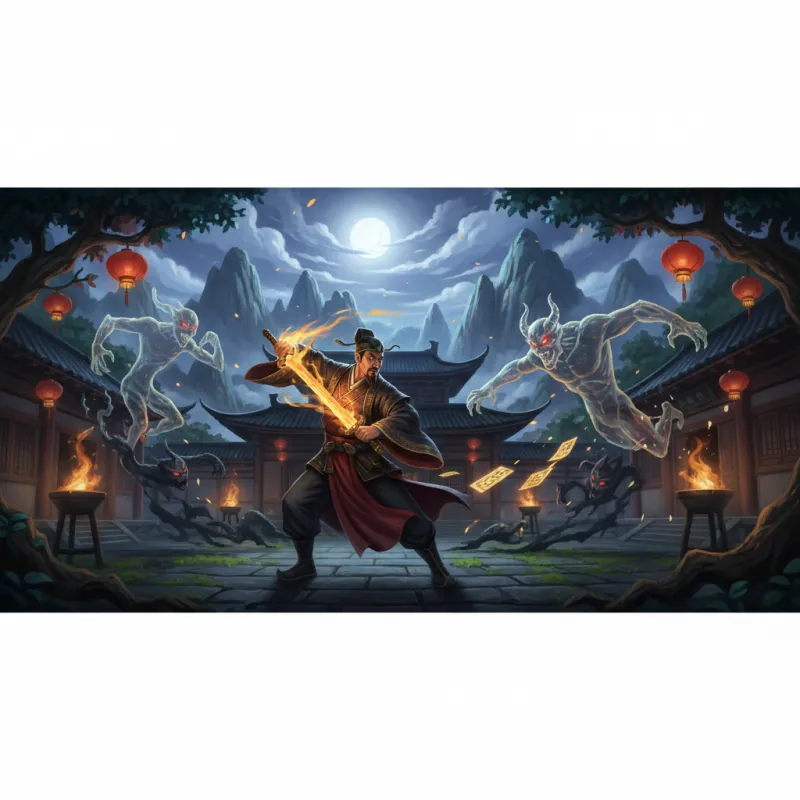
The yellow paper talisman bursts into flame, and the ghost screams. Not from pain—ghosts don't feel pain the way we do—but from the bureaucratic authority encoded in those vermillion brushstrokes. The Daoist priest isn't casting out demons through faith or willpower. He's serving an eviction notice signed by celestial officials, and the ghost has no choice but to comply. This is the reality of Daoist exorcism: less spiritual warfare, more supernatural law enforcement.
The Daoist Priest as Celestial Bureaucrat
Western audiences familiar with The Exorcist expect dramatic confrontations between good and evil, priests sweating through prayers while demons mock them. Daoist exorcism operates on entirely different principles. The dàoshì (道士, Daoist priest) doesn't beg heaven for help—he commands spirits by authority delegated from the celestial bureaucracy itself. Through ordination rituals that can take years to complete, the priest receives official rank in the heavenly administration. When he writes a talisman or recites an incantation, he's not making requests. He's issuing orders that carry the weight of cosmic law.
This bureaucratic framework explains why Daoist exorcism involves so much paperwork. The priest writes petitions (zòuzhāng, 奏章) to celestial officials, files reports on spiritual disturbances, and issues warrants for the arrest of troublesome entities. The famous fúlù (符籙, talismans) aren't magical spells—they're official documents written in a specialized script that spirits can read. A properly executed talisman functions like a court summons or restraining order in the spirit world. Ignore it, and you're in contempt of celestial court.
The Arsenal: Tools of the Trade
Walk into a Daoist exorcism, and you'll see an impressive array of ritual implements. Each serves a specific function in the supernatural bureaucracy. The táomùjiàn (桃木劍, peachwood sword) isn't for stabbing ghosts—it's a symbol of authority, like a judge's gavel. Peachwood has been considered spiritually potent since at least the Han Dynasty, when people hung peachwood charms above their doors during New Year celebrations. The wood itself doesn't harm spirits; the authority it represents does.
The priest's most versatile tool is the fúzhǐ (符紙, talisman paper), typically yellow and inscribed with vermillion ink. These aren't random mystical symbols. Each talisman follows precise templates passed down through lineages, with specific characters and seal scripts that identify which celestial department issued the order. A talisman to expel a èguǐ (惡鬼, malevolent ghost) differs entirely from one used against a yāoguài (妖怪, demon or monster). Use the wrong form, and it's like serving a criminal warrant to a civil court—bureaucratically invalid.
The bāguà jìng (八卦鏡, Eight Trigrams mirror) reflects harmful energy back to its source, functioning as both shield and weapon. The língqí (令旗, command flag) signals orders to spirit generals and celestial soldiers. Even the priest's robes serve a function—the embroidered symbols identify his rank and department, ensuring that spirits know exactly whose authority stands before them. This isn't mysticism for mysticism's sake. Every tool has a job, every ritual has a purpose, every gesture carries meaning in the language of the celestial bureaucracy.
The Ritual Process: Filing Spiritual Paperwork
A proper Daoist exorcism follows a structured sequence that would be familiar to anyone who's dealt with government bureaucracy. First comes the investigation—determining what type of entity is causing trouble and why. Is this a yuānhún (冤魂, wronged spirit) seeking justice? A lìguǐ (厲鬼, fierce ghost) bent on revenge? Or perhaps a húlijīng (狐狸精, fox spirit) playing tricks? The diagnosis determines the treatment.
Once the entity is identified, the priest files the appropriate paperwork with celestial authorities. He burns petitions to inform the relevant departments—typically the Chénghuáng (城隍, City God) for local matters, or higher officials for more serious cases. This isn't symbolic. In the Daoist worldview, these petitions actually reach their intended recipients, who then dispatch spiritual enforcement officers to assist.
The exorcism itself often involves summoning these celestial soldiers—tiānbīng tiānjiàng (天兵天將, heavenly troops and generals)—to arrest or expel the troublesome entity. The priest doesn't fight the ghost personally. He coordinates the operation, issuing commands to spiritual law enforcement while maintaining the ritual space. Think less lone warrior, more dispatcher coordinating a police response.
For particularly stubborn cases, the priest might perform a zhāi (齋, purification ritual) lasting multiple days, with offerings to celestial officials and repeated petitions up the bureaucratic chain. Serious hauntings require serious paperwork. The most powerful exorcisms involve sealing the entity in a container or binding it to a specific location, essentially serving it with a supernatural restraining order backed by the full authority of heaven.
Types of Supernatural Threats
Not all spirits require the same response. Daoist exorcism recognizes a taxonomy of supernatural entities, each with different motivations and vulnerabilities. The guǐ (鬼, ghost) is typically a human soul that hasn't moved on, often because of improper burial rites or unfinished business. These respond well to offerings and proper funeral procedures—essentially, helping them complete their bureaucratic transition to the afterlife. Many "hauntings" resolve once the ghost receives what it needs to file its paperwork and move on.
Yāo (妖, demons or monsters) are different. These entities were never human and don't follow human rules. They might be animals that cultivated spiritual power, like the fox spirits that appear throughout Chinese literature, or nature spirits tied to specific locations. Exorcising a yāo requires different talismans and often involves negotiation—these beings have their own place in the cosmic order and can't simply be dismissed. The priest might need to establish boundaries or broker agreements rather than issue eviction notices.
The most dangerous category is mó (魔, demons in the Buddhist sense), entities of pure malevolence that exist to cause harm. These require the heaviest artillery in the Daoist arsenal—high-level talismans, multiple priests working in concert, and petitions to the most powerful celestial officials. Fighting a mó isn't a one-day affair. It's a campaign that might involve ritual purification of an entire area and ongoing spiritual maintenance to prevent its return.
The Exorcist's Training and Authority
You don't become a Daoist exorcist by reading a manual. The process begins with apprenticeship to an established master, learning the ritual forms, memorizing the talismanic scripts, and studying the celestial bureaucracy's organizational chart. But knowledge alone isn't enough. The priest must undergo ordination rituals that formally register him in the heavenly administration. Without this celestial appointment, his talismans are just pretty calligraphy and his commands carry no weight.
Different Daoist lineages maintain different relationships with celestial departments, which is why some priests specialize in certain types of exorcism. A priest ordained in the Zhèng Yī (正一, Orthodox Unity) tradition might have strong connections to the City God's office, making him particularly effective at handling local hauntings. A Quánzhēn (全真, Complete Reality) practitioner might focus more on internal cultivation and less on dramatic exorcisms, though both traditions maintain the capability.
The priest's authority is real but not unlimited. He can command spirits within his jurisdiction and rank, but overstepping brings consequences. Issue orders beyond your pay grade, and celestial officials might ignore you—or worse, discipline you for bureaucratic overreach. This is why serious cases often require multiple priests or consultation with higher-ranking masters. The celestial bureaucracy has a chain of command, and smart exorcists respect it.
Modern Practice and Cultural Legacy
Daoist exorcism hasn't disappeared into history. Throughout Taiwan, Hong Kong, and overseas Chinese communities, Daoist priests still perform these rituals for clients dealing with hauntings, bad luck, or spiritual disturbances. The practice has adapted to modern contexts—priests might use printed talismans instead of hand-brushed ones, or coordinate rituals via smartphone—but the underlying principles remain unchanged. The celestial bureaucracy, apparently, hasn't updated its filing systems.
The cultural impact extends far beyond actual practice. Chinese horror films and television shows regularly feature Daoist priests as ghost-fighting heroes, from the classic Mr. Vampire series to modern supernatural dramas. These portrayals, while often exaggerated for entertainment, draw on real ritual practices. When you see a movie priest wielding a peachwood sword and yellow talismans, that's not Hollywood invention—it's based on actual Daoist exorcism techniques, even if the special effects are enhanced.
The bureaucratic model of Daoist exorcism also reveals something fundamental about Chinese cosmology. The spirit world isn't a realm of chaos where good and evil battle without rules. It's an ordered system with laws, officials, and procedures. Ghosts and demons aren't outside the cosmic order—they're part of it, subject to the same administrative structures that govern everything else. When a Daoist priest performs an exorcism, he's not fighting supernatural evil so much as enforcing supernatural law.
This explains why Chinese ghost stories often end not with the ghost's destruction but with its proper placement in the cosmic order. The goal isn't annihilation but correction—getting the entity to where it belongs, whether that's the afterlife, a specific location, or simply away from human spaces. The Daoist exorcist serves as mediator between worlds, ensuring that the living and the dead maintain their proper boundaries.
The Philosophy Behind the Practice
The bureaucratic nature of Daoist exorcism reflects deeper Daoist principles about order and harmony. The universe operates according to patterns and principles—the Dào (道, the Way)—and supernatural disturbances represent disruptions to this natural order. The exorcist's job isn't to impose his will on reality but to restore proper flow and balance. He's not a warrior fighting chaos; he's a technician fixing a malfunction in the cosmic machinery.
This philosophical foundation distinguishes Daoist exorcism from Western models of spiritual warfare. There's no absolute evil to be destroyed, no cosmic battle between light and darkness. Instead, there are entities in the wrong place, doing the wrong things, disrupting the natural order. Even malevolent spirits have their place in the system—just not in your house or possessing your relatives. The exorcist's talismans and rituals don't destroy these entities; they redirect them, bind them, or help them transition to where they belong.
The emphasis on bureaucracy and procedure also reflects Confucian influences on Daoist practice. Proper forms matter. Correct procedures matter. Following the established protocols matters. A talisman must be written exactly right, with the proper characters in the proper order, using the proper materials. Deviate from the template, and you're not just being sloppy—you're filing invalid paperwork that celestial officials will reject. The precision required in Daoist ritual reflects a worldview where details matter and proper form has real power.
Understanding Daoist exorcism means understanding this bureaucratic-spiritual framework. The next time you see a Chinese horror film featuring a Daoist priest fighting ghosts, pay attention to the details. Those talismans, that sword, those ritual gestures—they're not random mystical flourishes. They're specific tools and procedures in a sophisticated system of supernatural law enforcement that's been refined over centuries. The priest isn't a lone hero battling evil. He's a celestial bureaucrat doing his job, filing the right paperwork, and making sure the cosmic order stays properly ordered.
Related Reading
- Joss Paper and Spirit Money: Shopping for the Dead
- Paper Offerings: Sending Wealth to the Afterlife
- Feng Shui for Ghost Prevention: Protecting Your Home
- Yin Feng Shui: The Art of Placing Graves for Good Fortune
- How to Make Offerings to Ancestors: A Practical Guide
- Spirit Mediums in Chinese Culture: The Living Who Speak for the Dead
- The Liaozhai Stories That Hollywood Should Adapt (But Probably Won't)
- How to Avoid Punishment in Chinese Hell: Loopholes, Bribes, and Good Behavior
Explore Chinese Culture
- Explore ancient mythical creatures
- Explore Daoist exorcism traditions
- Explore Chinese folk beliefs and superstitions