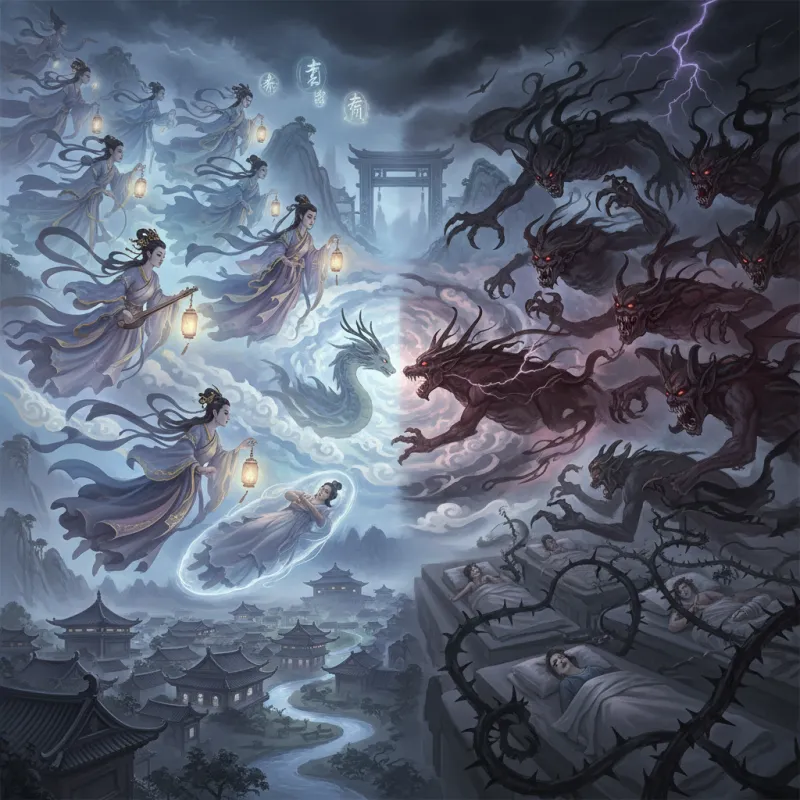
You wake up gasping, heart hammering against your ribs. The dream felt so real — your dead grandmother sitting at the edge of your bed, her hand cold on your wrist, whispering something urgent you can't quite remember. Western psychology would call this your subconscious processing grief. Chinese folk tradition would ask: what did she want?
In the supernatural landscape of Chinese belief, dreams aren't neural fireworks or random memory fragments. They're visitations, invasions, and sometimes battlegrounds. The sleeping mind doesn't retreat into itself — it opens a door to a realm where hungry ghosts prowl, fox spirits seduce, and demons feast on the vulnerable. Understanding this tradition means accepting an uncomfortable premise: when you close your eyes, you're not alone.
The Permeable Boundary
Chinese cosmology has never drawn hard lines between waking and dreaming, living and dead, material and spiritual. The dream realm — sometimes called the mengxiang (梦乡, mèngxiāng, "dream village") — exists as a legitimate space where encounters happen. This isn't metaphor. When a deceased ancestor appears in your dream, folk tradition treats it as an actual visit from their hun (魂, hún) soul, which retains consciousness and agency after death.
The Zhuangzi (庄子), written in the 4th century BCE, famously questions whether Zhuangzi dreamed he was a butterfly or the butterfly is dreaming it's Zhuangzi. But folk religion takes this further: both might be true simultaneously. The dream world and waking world aren't separate realities but overlapping territories with porous borders.
This permeability makes sleep dangerous. During the day, you can see threats coming. You can avoid haunted places, refuse suspicious strangers, keep protective charms visible. But sleep strips away these defenses. Your hun soul loosens from your body — this is why sudden waking can feel so disorienting, as if part of you is still catching up. In that loosened state, you're exposed.
Fox Spirits and Dream Invasion
Of all supernatural entities in Chinese folklore, fox spirits (huli jing, 狐狸精, húli jīng) are most notorious for dream manipulation. They don't just appear in dreams — they architect them, crafting elaborate scenarios to seduce, deceive, or drain their victims. The Liaozhai Zhiyi (聊斋志异, Strange Tales from a Chinese Studio), Pu Songling's 17th-century collection, documents dozens of cases where fox spirits use dreams as hunting grounds.
In one tale, a scholar dreams repeatedly of a beautiful woman who visits his study. The dreams feel more vivid than waking life — he can smell her perfume, feel the silk of her robes. Each morning he wakes exhausted, his yang energy depleted. His family eventually realizes a fox spirit is draining his life force through these dream encounters. The terrifying implication: there's no escape. Locking your door means nothing when the predator enters through your dreams.
Fox spirits choose dreams strategically. In waking life, their illusions might be questioned, their true form glimpsed. But dreams already feel unreal, so victims don't question impossible beauty or strange coincidences. By the time the victim realizes something is wrong, they're already entangled — emotionally attached to a being that's been feeding on them for weeks.
This connects to broader anxieties about fox spirits and possession, where the boundary between self and other becomes dangerously blurred.
The Nightmare Demon: Yan Gui
While fox spirits seduce through dreams, yan gui (魇鬼, yǎn guǐ, "nightmare demons") attack directly. These entities specialize in sleep paralysis — that horrifying state where you're conscious but cannot move, often accompanied by a crushing weight on your chest and a sense of malevolent presence.
Western medicine explains sleep paralysis as a disconnect between consciousness and muscle atonia during REM sleep. Chinese folk tradition identifies it as demonic assault. The yan gui sits on your chest, sometimes described as a small, dark creature with glowing eyes, sometimes as a shadowy mass. It feeds on fear and life energy, growing stronger as you struggle.
Historical records from the Ming Dynasty (1368-1644) describe yan gui attacks as epidemic in certain regions, with entire villages reporting nightly visitations. Taoist priests would be called in to perform exorcisms, placing protective talismans above beds and teaching families specific mantras to recite if attacked. The most effective defense, according to tradition, is to remain calm — panic feeds the demon. Some sources suggest mentally reciting Buddhist sutras or visualizing protective deities.
The physical symptoms match modern sleep paralysis descriptions exactly: inability to move, pressure on chest, difficulty breathing, hallucinations of threatening figures. But the folk interpretation adds a crucial element: intentionality. This isn't a random neurological glitch. Something is doing this to you, and it has reasons.
Dreams of the Dead
When deceased relatives appear in dreams, Chinese tradition treats it as communication requiring interpretation and often action. These aren't comforting memories bubbling up from your subconscious — they're the dead reaching across the boundary to make requests or deliver warnings.
A grandmother appearing in a dream might be indicating she's hungry (her descendants haven't been making proper offerings), cold (she needs more spirit money burned for her), or troubled (there's unfinished business or family conflict disturbing her rest). Ignoring these dream visitations invites misfortune. The dead have limited ways to communicate with the living, and dreams are their primary channel.
But not all dream visitors are benevolent ancestors. Hungry ghosts (egui, 饿鬼, è guǐ) — spirits of those who died violently, without proper burial, or with intense attachments — also use dreams to make contact. These encounters feel different: oppressive, draining, accompanied by feelings of dread. The dreamer might wake with unexplained bruises or scratches, physical evidence of the encounter.
This overlaps with concerns about hungry ghost encounters and the importance of proper funeral rites to prevent the dead from becoming dangerous.
Prophetic Dreams and Divine Messages
Not all supernatural dream encounters are threatening. Chinese tradition also recognizes tuomeng (托梦, tuōmèng, "entrusted dreams") — messages delivered by deities, enlightened beings, or benevolent spirits. These dreams have a distinct quality: crystalline clarity, symbolic imagery that feels significant, and a sense of importance that lingers after waking.
Historical texts record emperors receiving battle strategies from ancestral spirits in dreams, scholars solving problems through dream insights from Confucius, and ordinary people receiving warnings about disasters. The Book of Songs (Shijing, 诗经), compiled around 600 BCE, includes poems describing prophetic dreams that guided major decisions.
The challenge is discernment. How do you distinguish a genuine divine message from a fox spirit's manipulation or a demon's deception? Traditional wisdom suggests several tests: Does the dream leave you feeling energized or drained? Does the message align with moral principles or encourage selfish action? Can the dream's symbols be interpreted through classical texts like the Zhou Gong Jiemeng (周公解梦, Duke of Zhou's Dream Interpretation)?
Protection and Countermeasures
Given the dangers of the dream realm, Chinese folk tradition developed extensive protective practices. Placing a mirror at the foot of the bed reflects malevolent spirits back on themselves. Hanging a bagua (八卦, bāguà) trigram symbol above the headboard creates a protective barrier. Some families keep scissors under the pillow — iron disrupts supernatural influence.
More elaborate protections involve Taoist talismans specifically designed for dream defense, blessed by priests and placed under the mattress or sewn into pillowcases. Buddhist practitioners might recite the Heart Sutra before sleep, creating a protective field of sacred sound. In some regions, people avoid sleeping in certain directions or positions believed to make them more vulnerable to spirit intrusion.
The most powerful protection, according to tradition, is moral cultivation. Entities that prey through dreams are attracted to weakness — moral corruption, excessive desire, unresolved guilt. A person who lives righteously, maintains filial piety, and cultivates inner peace presents a less appealing target. This isn't victim-blaming but rather a belief that spiritual strength creates natural defenses.
The Modern Interpretation
Contemporary Chinese people navigate between traditional beliefs and modern psychology. Many will acknowledge sleep paralysis as a medical phenomenon while still feeling uneasy about its folk interpretation. The dream of a dead relative might be processed as both grief manifestation and potential visitation — both frameworks held simultaneously without contradiction.
This dual consciousness reflects something deeper about Chinese supernatural tradition: it's less about literal belief than about maintaining awareness of possibilities. Whether fox spirits "really" enter dreams matters less than the cultural wisdom encoded in the belief — that sleep makes us vulnerable, that the dead maintain connections with the living, that our inner state affects what we attract.
The dream realm in Chinese folk tradition isn't escapism or fantasy. It's a recognition that consciousness operates in territories we don't fully control, where the boundaries we rely on during waking hours dissolve. When you close your eyes tonight, you're not just resting. You're crossing a threshold into a space where other things are waiting. Whether you call them spirits, demons, or manifestations of the unconscious, the tradition suggests the same wisdom: be careful what you invite in.
Related Reading
- Ghost Press (鬼压床): The Chinese Explanation for Sleep Paralysis
- Dream Interpretation in Chinese Culture: When the Spirit Wanders at Night
- Chinese Dream Interpretation: What Your Dreams Mean in Traditional Culture
- Soul Travel in Chinese Belief: When Your Spirit Leaves Your Body During Sleep
- How to Make Offerings to Ancestors: A Practical Guide
- Painted Skin: The Most Terrifying Story in Chinese Literature
- Campus Ghost Stories in China: The Haunted Dormitories and Cursed Libraries
Explore Chinese Culture
- Explore ancient mythical creatures
- Explore Daoist exorcism traditions
- Explore Chinese folk beliefs and superstitions