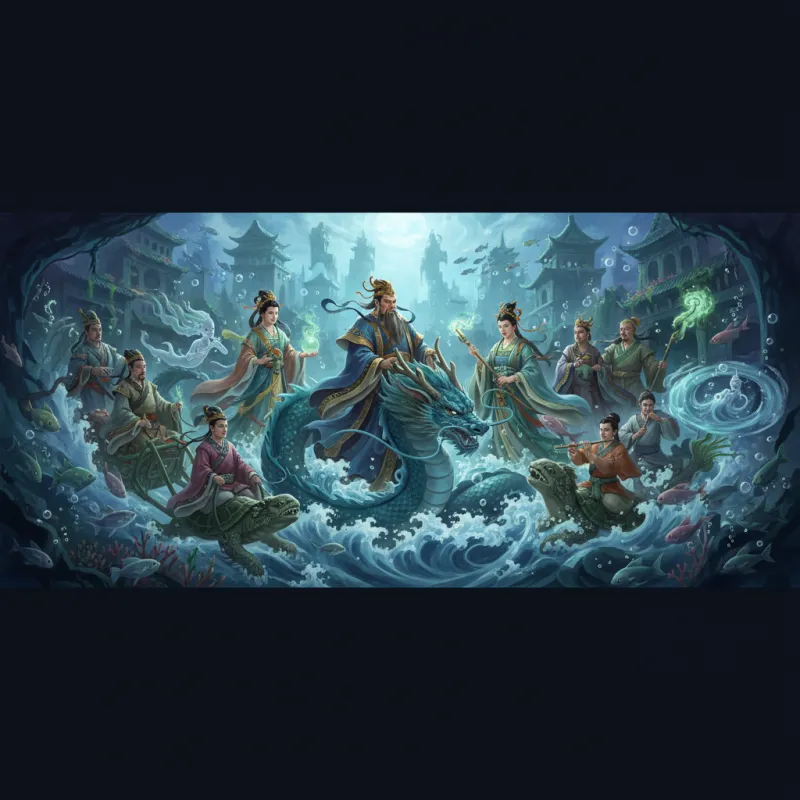
The Dragon King's palace sits at the bottom of the East Sea, its coral pillars wrapped in seaweed banners, its throne room filled with the constant murmur of currents and the clicking of crab courtiers. This isn't poetry — it's bureaucracy. In Chinese mythology, every body of water from the mightiest ocean to the smallest irrigation ditch operates under a management structure more complex than the Tang Dynasty civil service. And like any good bureaucracy, it's staffed by officials who can be bribed, flattered, or occasionally drowned by angry villagers when they fail to deliver rain on schedule.
The Dragon Kings: CEOs of the Aquatic Realm
The Four Dragon Kings (四海龙王, sìhǎi lóngwáng) sit at the top of China's water management hierarchy, each governing one of the cardinal seas. Ao Guang (敖广) rules the East Sea, Ao Qin (敖钦) the South, Ao Run (敖闰) the West, and Ao Shun (敖顺) the North. Their names appear throughout classical literature, most famously in Journey to the West (西游记), where Sun Wukong raids Ao Guang's armory and steals the Ruyi Jingu Bang — the magic staff that becomes his signature weapon.
But the Dragon Kings aren't just mythological set dressing. They received official recognition from actual Chinese emperors. During the Tang Dynasty (618-907 CE), Emperor Xuanzong granted them aristocratic titles. By the Song Dynasty (960-1279 CE), they'd been promoted to kings. This wasn't metaphorical — imperial decrees were issued, temples were built with state funds, and local officials were expected to perform regular sacrifices. When droughts struck, emperors would send envoys to Dragon King temples to beg for rain. When floods devastated provinces, those same temples might be symbolically punished, their statues dragged outside to bake in the sun until the waters receded.
The Dragon Kings commanded vast underwater courts staffed by fish ministers, shrimp soldiers, and crab generals (虾兵蟹将, xiābīng xièjiàng). This phrase has entered modern Chinese as an idiom for incompetent subordinates, which tells you something about how the common people viewed divine bureaucracy. These courts mirrored earthly government so precisely that they even had their own corruption scandals — folk tales frequently feature Dragon King officials accepting bribes of incense and paper money to manipulate weather patterns for wealthy landowners.
River Gods: Middle Management with Attitude
Below the Dragon Kings came the River Gods (河神, héshén), each responsible for a specific waterway. The most important was the Yellow River God, He Bo (河伯), whose mythology stretches back to the Warring States period (475-221 BCE). The Classic of Mountains and Seas (山海经) describes him as originally human — a man named Feng Yi who drowned while trying to cross the river and was posthumously promoted to divine administrator.
He Bo's most notorious practice was demanding virgin brides. Historical records from the Han Dynasty describe how local officials in Ye (邺) would select young women, dress them in wedding finery, and float them downriver on decorated beds as "brides for the River God." This continued until a magistrate named Ximen Bao exposed it as a scam run by corrupt shamans and local officials who pocketed the bride-price money. Ximen Bao's solution was characteristically direct — he threw the shamans into the river to "deliver the message personally" to He Bo, then drowned the officials who protested. The practice stopped immediately.
The Yangtze River had its own deity hierarchy, though less centralized than the Yellow River's. Different sections of the river answered to different gods, creating jurisdictional disputes that folk tales exploited for comedy. One story tells of a merchant whose boat sank at the boundary between two river gods' territories, leading to an underwater court case about which deity was responsible for the salvage operation. The case dragged on so long that the merchant's ghost gave up and reincarnated before receiving a verdict.
River gods could be petty, vain, and surprisingly easy to manipulate. The Strange Tales from a Chinese Studio (聊斋志异) includes multiple stories of scholars outwitting river deities through clever wordplay or by exploiting bureaucratic loopholes in the celestial administration. These weren't all-powerful forces of nature — they were middle managers with quotas to meet and superiors to please.
Well Dragons and Spring Spirits: Local Government
At the most local level, individual wells, springs, and ponds had their own minor deities, usually depicted as small dragons or serpents. Well Dragons (井龙, jǐnglóng) were particularly important in northern China, where water scarcity made every well a matter of life and death. Families would maintain small shrines beside their wells, offering incense and food to keep the Well Dragon content.
These minor water spirits had limited power but intimate knowledge of their territories. Folk belief held that they could predict floods, droughts, and even human affairs within their jurisdiction. Village fortune-tellers would sometimes claim to channel Well Dragons for prophecy, though skeptics noted that these spirits' predictions rarely extended beyond information available through normal gossip networks.
The relationship between humans and these local water deities was transactional and surprisingly casual. A farmer might curse his Well Dragon for running dry, then apologize with extra offerings when the water returned. This stands in stark contrast to the formal, fearful worship directed at higher-ranking deities. You don't negotiate with the Jade Emperor, but you absolutely negotiate with the spirit living in your irrigation ditch.
The Bureaucratic Nightmare of Water Control
The complexity of China's divine water management system created endless opportunities for supernatural dysfunction. Different deities controlled different aspects of water — one might govern rainfall, another river flow, a third groundwater levels. Coordinating these separate jurisdictions required constant communication through the celestial bureaucracy, and like any bureaucracy, it was prone to delays, miscommunications, and paperwork errors.
Folk tales exploit this administrative chaos mercilessly. One story describes a village that received no rain for months because the local Rain God's requisition form was stuck in processing at the Ministry of Thunder. Another tells of a flood caused when two different water deities both approved irrigation requests for the same river, neither checking whether the other had already granted permission.
This bureaucratic view of the supernatural reflects a deeply pragmatic worldview. Chinese folk religion didn't imagine gods as transcendent beings operating on incomprehensible moral principles. They were officials — sometimes competent, sometimes corrupt, always bound by rules and hierarchies. You could appeal their decisions, file complaints with their superiors, or in extreme cases, organize protests at their temples. The supernatural world wasn't mysterious; it was just another layer of government.
Exorcists and Water Spirits
The relationship between water deities and exorcists was complicated. Unlike malevolent ghosts or fox spirits that exorcists routinely banished, water gods held official positions in the celestial bureaucracy. Attacking them was like assaulting a government official — technically possible, but likely to result in serious consequences.
Daoist exorcists developed elaborate protocols for dealing with problematic water deities. Rather than direct confrontation, they would file formal complaints with higher authorities in the spirit world, essentially asking the Dragon Kings or the Jade Emperor to discipline their subordinates. These complaints followed strict formats, written on special paper with specific inks, and burned at designated times to ensure proper delivery through celestial mail systems.
When water spirits stepped outside their authority — possessing humans, causing unscheduled floods, or accepting bribes to drown specific individuals — exorcists could intervene more directly. But even then, the approach was legalistic rather than combative. The exorcist would cite the specific regulations the spirit had violated, invoke the authority of higher-ranking deities, and threaten to escalate the complaint up the chain of command. Most water spirits, faced with potential disciplinary action from their superiors, would back down.
Modern Echoes of Ancient Waters
The Dragon Kings and River Gods have faded from official worship, but they persist in unexpected places. The 2019 animated film Ne Zha featured Ao Bing, son of the Dragon King of the East Sea, as a tragic figure caught between his father's expectations and his own desires. The film became one of China's highest-grossing movies ever, suggesting these ancient deities still resonate with contemporary audiences.
Environmental activists have occasionally invoked water deity mythology in campaigns against pollution. One group in Sichuan erected a shrine to the local River God beside a factory dumping waste into a tributary, with a sign reading: "The River God is watching." The factory's management, despite being Communist Party members theoretically committed to atheism, quietly improved their waste treatment systems. Some superstitions run deeper than ideology.
The bureaucratic model of water management that these deities represented wasn't entirely mythological. Imperial China did develop sophisticated hydraulic engineering systems, with officials responsible for maintaining dikes, dredging channels, and coordinating irrigation schedules. The supernatural hierarchy mirrored and reinforced the earthly one, making water management a cosmic responsibility rather than merely a technical challenge.
Perhaps that's the real legacy of China's water deities — not belief in literal dragon palaces beneath the waves, but the understanding that water requires management, that management requires hierarchy, and that hierarchy requires accountability. Whether you're appealing to the Dragon King for rain or filing a complaint with the local water bureau about contamination, you're participating in the same fundamentally Chinese conviction: every river needs a manager, and every manager can be held responsible.
Related Reading
- Chinese Ghost Beliefs: A Complete Guide to the Spirit World
- Lake Monsters and Sea Creatures in Chinese Folklore
- Your Guide to the Hungry Ghost Festival: What to Do and What to Avoid
- Ghost Marriage: Wedding the Dead
- Exploring Chinese Supernatural Folklore: The Haunting World of Ghosts and Spirits
- Paper Offerings: Sending Wealth to the Afterlife
- Unveiling the Mysteries of Chinese Supernatural Folklore: Ghosts, Spirits, and Afterlife Beliefs
- The Afterlife in Chinese Culture: A Traveler's Guide to the Underworld
Explore Chinese Culture
- Explore ancient mythical creatures
- Explore Daoist exorcism traditions
- Explore Chinese folk beliefs and superstitions