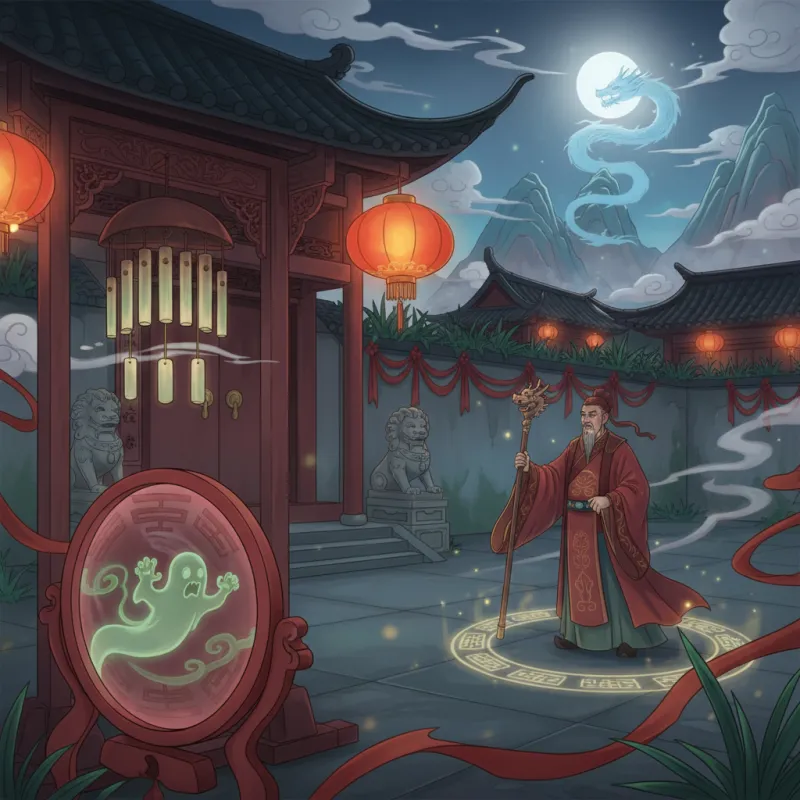
Your grandmother was right about that mirror. The one facing your bedroom door that you thought made the hallway look bigger? In traditional Chinese belief, it's practically rolling out a welcome mat for wandering spirits. Feng Shui (風水, fēng shuǐ)—literally "wind and water"—isn't just about arranging furniture for prosperity. For centuries, it's been the first line of defense against supernatural intrusion, a practical system for keeping the restless dead exactly where they belong: outside.
Why Ghosts Care About Your Floor Plan
Chinese supernatural tradition operates on a simple premise: spirits follow energy flows just like water follows gravity. The concept of qi (氣, qì)—the vital life force that animates all things—doesn't stop being relevant just because something's dead. In fact, ghosts are particularly sensitive to qi pathways because they lack physical bodies to anchor them. They drift along energy currents like leaves in a stream, and if those currents flow straight into your home, you've got a problem.
The Zang Shu (葬書, Burial Book), written by Guo Pu during the Jin Dynasty (266-420 CE), established the foundational principles that govern both the living and the dead. Guo Pu understood that the same environmental forces that bring prosperity to a home can also channel unwanted spiritual visitors. This is why traditional Chinese architecture never places doors in direct alignment—a straight path is an invitation, and not the kind you want to extend to entities from the underworld.
The Mirror Problem: Reflective Surfaces as Spirit Portals
Let's talk about mirrors, because this is where most people unknowingly sabotage their own spiritual security. In Chinese folklore, mirrors don't just reflect light—they reflect and trap spiritual energy. The Liaozhai Zhiyi (聊齋誌異, Strange Tales from a Chinese Studio) by Pu Songling includes multiple stories where mirrors serve as portals between the living world and the realm of ghosts. The scholar Ning Caichen's encounter with Nie Xiaoqian involved a mirror that revealed her true ghostly nature, a detail that wasn't just literary flourish but reflected genuine folk beliefs about mirrors as boundary objects.
The worst placement? A mirror directly facing your bed. You're at your most vulnerable during sleep, when your hun (魂, hún)—your ethereal soul—loosens its connection to your body. A mirror in this position can confuse your hun, trap spiritual energy, or worse, provide an entry point for wandering gui (鬼, guǐ). If you absolutely must have a mirror in the bedroom, cover it at night or position it so it reflects something neutral like a wall, never the bed itself.
Bagua mirrors (八卦鏡, bāguà jìng)—those octagonal mirrors with trigrams around the edge—are a different story entirely. These aren't decorative; they're defensive weapons in the Feng Shui arsenal. Hang one above your front door facing outward, and it deflects negative energy and malevolent spirits before they can enter. But never, and I mean never, hang a bagua mirror inside your home or facing a neighbor's door. That's spiritual warfare, and it will escalate.
Doorways, Thresholds, and the Straight-Line Curse
In Feng Shui, the configuration of doors determines whether your home is a fortress or a highway for spiritual traffic. The most dangerous arrangement is called chuan tang feng (穿堂風, chuān táng fēng)—"piercing wind through the hall"—where the front door aligns directly with the back door or a large window. Qi rushes straight through without circulating, and ghosts can ride that current like a supernatural express lane.
This isn't superstition; it's architectural psychology backed by centuries of observation. The Qing Dynasty manual Yang Zhai San Yao (陽宅三要, Three Essentials of the Yang Dwelling) explicitly warns against through-lines in residential design. The solution is simple: place a screen, a substantial piece of furniture, or even a healthy plant between aligned openings to disrupt the straight path and force energy—both living and dead—to meander.
Bedroom doors facing the front entrance are similarly problematic. You want privacy from the living world; you definitely want privacy from the dead. If your bedroom door has a direct sightline to the main entrance, keep it closed at night or hang a curtain to create a visual barrier. Thresholds themselves hold power in Chinese tradition—that's why you'll see raised thresholds in older homes, forcing everyone (and everything) to step deliberately over the boundary rather than gliding through.
The Corners Where Spirits Congregate
Dead energy accumulates in corners, particularly in rooms that are irregularly shaped or have protruding angles. These sha qi (煞氣, shà qì) or "killing energy" zones become stagnant pools where negative spiritual presence can build up. The northeast corner is especially problematic—it's associated with the "ghost gate" direction in traditional cosmology, the sector through which spirits enter the mortal realm during the Ghost Month.
Walk through your home and identify corners that feel cold, where dust accumulates quickly, or where you instinctively avoid lingering. These are your problem areas. The fix involves activating these spaces with light, sound, or living energy. A small lamp left on, a wind chime that moves air, or a healthy plant can all disrupt stagnation. Salt is also traditional—place small dishes of sea salt in problematic corners and replace monthly, disposing of the old salt by flushing it away or burying it off your property.
Protruding corners that point into living spaces—like the edge of a wall jutting into a room—act like poison arrows, directing sha qi toward whoever sits or sleeps in their path. These aren't just uncomfortable; they're spiritually aggressive. Soften them with fabric, round them with furniture placement, or hang a crystal sphere to diffuse the sharp energy before it reaches you.
Water Features and the Spirit World Connection
Water is the most spiritually conductive element in Feng Shui, which makes its placement critical for ghost prevention. The I Ching (易經, Yì Jīng) associates water with the mysterious, the hidden, and the realm of the dead. This is why traditional Chinese homes never placed wells or water features in certain sectors, and why you should think twice before installing that trendy indoor fountain.
Still water is particularly dangerous—it becomes a mirror, and we've already discussed the mirror problem. Stagnant ponds, unused fountains, or even that decorative bowl of water you forgot about can become spiritual gathering points. If you have water features, keep them moving, clean, and well-maintained. The sound of flowing water is actually protective when properly managed, as it generates active yang energy that discourages yin-heavy spiritual presence.
Bathrooms present a special challenge because they combine water with drainage—a double conduit for energy loss and spiritual entry. Keep bathroom doors closed and toilet lids down when not in use. This isn't just about Feng Shui aesthetics; it's about preventing your home's protective qi from literally going down the drain, taking your spiritual defenses with it. For bathrooms in inauspicious locations (like the center of the home or the northeast sector), add extra protection with plants, salt, or a small mirror on the outside of the door to deflect energy away.
The Protective Power of Living Energy
The most effective ghost prevention isn't passive—it's the active cultivation of vibrant yang energy that makes your home inhospitable to yin-heavy spiritual entities. Ghosts are drawn to decay, darkness, and stagnation. They avoid noise, light, and the chaotic energy of the living. This is why homes that are regularly occupied, well-lit, and full of activity rarely have supernatural problems, while abandoned buildings become haunted almost immediately.
Plants are your allies here, but choose carefully. Healthy, thriving plants with rounded leaves generate protective energy. The money plant (Pachira aquatica), jade plant, and bamboo are all traditional choices. Avoid thorny plants indoors (except for specific protective purposes near windows), and absolutely avoid dried flowers or dead plants—these are yin objects that attract exactly what you're trying to repel. If a plant dies despite your care, remove it immediately and cleanse the area with incense or salt water.
Sound is equally important. Bells, wind chimes, and even regular conversation fill a space with yang energy. This is the real reason behind the Chinese tradition of making noise during festivals—it's not just celebration, it's spiritual maintenance. A home that's too quiet for too long becomes a vacuum that draws in whatever's wandering nearby. Even playing music or leaving a radio on when you're away can help maintain an energetic boundary.
Red, Salt, and Other Practical Defenses
Some Feng Shui protections are so simple they seem almost too obvious, but they work because they're rooted in centuries of trial and error. Red is the most powerful protective color in Chinese tradition—it represents fire, yang energy, and life force. A red door, red curtains in vulnerable areas, or even red envelopes placed in problematic corners can strengthen your home's spiritual boundaries. During Ghost Month, you'll see red paper talismans on doors throughout Chinese communities, and there's a reason this practice has survived for generations.
Salt purifies and creates barriers that spirits cannot easily cross. A line of salt across a threshold, salt in the corners of rooms, or salt water used to clean floors all serve protective functions. This isn't unique to Chinese tradition—salt's protective properties appear in folklore worldwide, suggesting there's something fundamental about its effect on spiritual energy. Replace salt regularly; once it's absorbed negative energy, it needs to be disposed of properly, away from your property.
Incense, particularly sandalwood or agarwood, doesn't just smell pleasant—it transforms the energetic quality of a space. The smoke carries prayers and intentions while simultaneously clearing stagnant energy. Regular smudging or incense burning, especially in corners and doorways, maintains spiritual hygiene. This practice connects directly to Taoist exorcism rituals, where incense serves as both offering and weapon against malevolent forces.
When Feng Shui Isn't Enough
Here's the uncomfortable truth: Feng Shui is preventive medicine, not emergency intervention. If you're already experiencing genuine supernatural activity—objects moving, unexplained sounds, the sensation of being watched—rearranging furniture won't solve the problem. At that point, you need professional spiritual cleansing or the intervention of someone trained in dealing with active hauntings.
That said, proper Feng Shui makes such situations far less likely. A well-protected home with good energy flow, appropriate use of mirrors and water, and regular spiritual maintenance creates an environment where ghosts simply don't want to linger. They're looking for easy targets—dark, stagnant, neglected spaces where they can settle in without resistance. Make your home the opposite of that, and you'll never need to worry about supernatural houseguests.
The principles outlined here aren't superstition; they're the accumulated wisdom of a culture that's been dealing with the supernatural for thousands of years. Your ancestors knew things about the invisible world that modern rationalism has forgotten. That mirror facing your bed? Move it tonight. Those dark corners you've been ignoring? Light them up. The threshold between the living and the dead is thinner than you think, and a little prevention is worth considerably more than any amount of cure.
Related Reading
- Daoist Exorcism: How Chinese Priests Fight Supernatural Evil
- Funeral Rituals in Chinese Culture: A Guide to Sending Off the Dead
- Yin Feng Shui: The Art of Placing Graves for Good Fortune
- Paper Offerings: Sending Wealth to the Afterlife
- The Hungry Ghost Festival: When the Gates of Hell Open
- Hungry Ghost Festival: Traditions and Taboos
- Qingming Festival: When China Visits Its Dead
Explore Chinese Culture
- Explore ancient mythical creatures
- Explore Daoist exorcism traditions
- Explore Chinese folk beliefs and superstitions