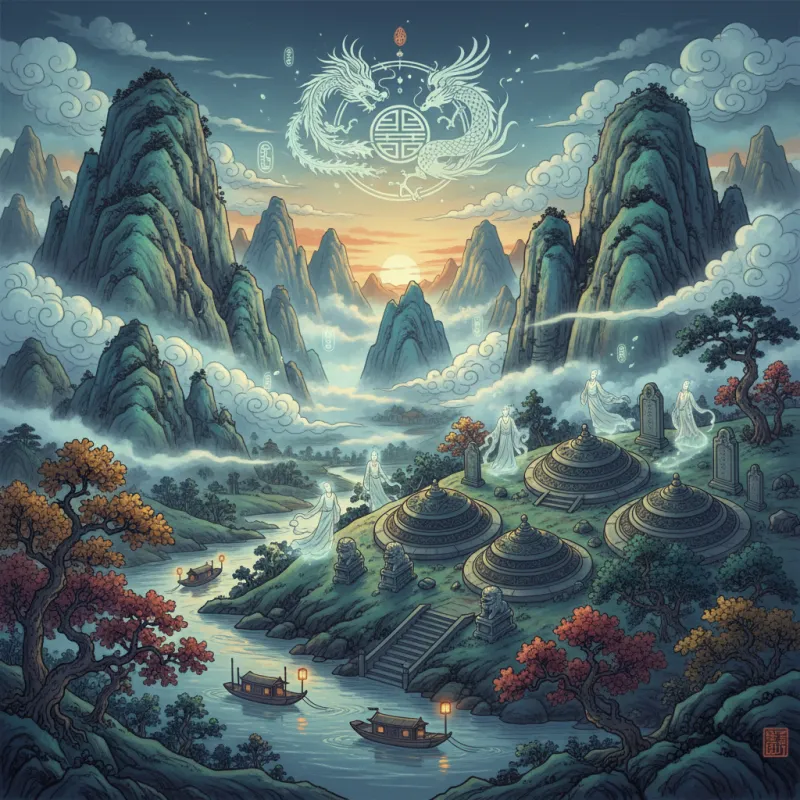
The grave robbers knew something was wrong the moment they broke through the tomb's seal. Not because of traps or curses carved into stone — those they expected. What stopped them cold was the positioning of the coffin itself, angled precisely 23 degrees southeast, aligned with a distant mountain peak they couldn't even see in the darkness. One of them, an old hand who'd looted dozens of Ming dynasty tombs, whispered a single phrase before they fled: "This family paid for a master." He understood what most modern people have forgotten: in Chinese tradition, where you bury your dead matters as much as how you lived your life. Maybe more.
The Logic of Yin Feng Shui
Yin Feng Shui (阴宅风水, yīnzhái fēngshuǐ) — literally "dark house feng shui" — operates on a premise that sounds absurd to modern ears until you examine its internal consistency. The deceased, though no longer living, remain energetically connected to their bloodline. Their bones, resting in earth, interact with the flow of qi (气, qì) through the landscape. Get the positioning right, and beneficial qi flows through the ancestor's remains into the living descendants. Get it wrong, and you've essentially plugged your family into a cosmic drain that siphons fortune, health, and prosperity for generations.
This isn't metaphor. Traditional practitioners speak of specific, measurable outcomes: a grave positioned on a "dragon vein" (龙脉, lóngmài) with proper water flow produces sons who pass imperial examinations. A burial site where qi stagnates creates financial ruin within three generations. The Zangshu (葬书, Zàngshū, "Book of Burial"), attributed to Guo Pu during the Jin dynasty (276-324 CE), established the theoretical framework: "Qi rides the wind and scatters, but is retained when encountering water. The ancients collected it to prevent its dissipation and guided it to ensure its retention. Thus it was called feng shui."
The difference between yang feng shui (阳宅, yángzhái) for the living and yin feng shui is temporal scope. Your house affects you while you live there. Your ancestor's grave affects your entire lineage, potentially forever. This is why wealthy Chinese families historically spent more on tomb site selection than on their own homes.
Reading the Landscape Like a Body
A feng shui master examining potential burial sites doesn't see hills and valleys. They see a living organism. Mountains are the bones and flesh of the earth. Rivers are its blood vessels. The ideal burial location — called a xue (穴, xué, literally "cavity" or "acupoint") — is where these elements converge to create a pocket of concentrated, beneficial qi.
The classic formation is the "armchair" configuration: a main mountain behind (the backrest), smaller hills on either side (the armrests), and open space with water in front (the footrest). The main mountain should ideally be part of a dragon vein, those ridgelines that feng shui practitioners trace across landscapes like acupuncture meridians. Water is crucial — it should approach the site in a meandering curve, not rush straight past. Fast-moving water carries qi away. Gently curving water allows qi to accumulate.
But here's where it gets specific enough to be interesting: the orientation matters down to the degree. The grave must face a direction determined by the deceased's birth date, death date, and the surrounding landforms. A master uses a luopan (罗盘, luópán), the feng shui compass with its concentric rings of cosmological data — the eight trigrams, the 24 mountains, the 28 lunar mansions, the 60-year cycle stems and branches. One degree off, and you've potentially redirected the qi flow from beneficial to harmful.
I've read accounts of Qing dynasty families who, after experiencing a run of bad luck, exhumed their grandfather's bones and repositioned the coffin by just five degrees. Within a year, according to family records, their fortunes reversed. Coincidence? Perhaps. But the practice persisted because enough families believed they saw results.
The Professional Grave Hunters
The term feng shui master (风水师, fēngshuǐ shī) covers a wide range of practitioners, from village amateurs who knew a few basic principles to elite specialists who served imperial families. The truly skilled ones — called kanyu masters (堪舆师, kānyú shī) after an ancient term for heaven and earth — spent decades studying landscape patterns, often traveling thousands of miles to examine famous burial sites and understand why certain locations produced generations of successful descendants.
These masters developed proprietary techniques, closely guarded family secrets passed from teacher to disciple. Some specialized in mountain dragons (山龙, shānlóng), the qi flows through mountainous terrain. Others focused on water dragons (水龙, shuǐlóng), the patterns of rivers and streams. The most sought-after could read both, understanding how they interacted.
Their fees reflected their value. A top-tier master in the Qing dynasty might charge the equivalent of several years' income for a wealthy merchant family. But families paid it, because the alternative — burying an ancestor in a location with bad feng shui — could doom the entire lineage. There are documented cases of families who, unable to afford a master, left a coffin above ground for years while saving money to hire proper expertise.
The profession attracted charlatans, naturally. The Qing Bai Lei Chao (清稗类钞, Qīng Bài Lèi Chāo), a collection of Qing dynasty anecdotes, records numerous stories of fake masters who used impressive-sounding jargon to extract fees while providing useless advice. The real masters, according to these accounts, could be identified by their reluctance to make guarantees and their willingness to walk away from sites they deemed unsuitable, even when offered higher fees.
When Yin Feng Shui Goes Wrong
The flip side of yin feng shui's promise is its threat. A poorly positioned grave doesn't just fail to help — it actively harms. The mechanisms of harm are specific: qi flowing in the wrong direction creates what practitioners call sha qi (煞气, shà qì), harmful or "killing" energy. This manifests in the living descendants as illness, financial loss, family discord, or failure to produce male heirs (historically the greatest catastrophe for a Chinese family).
Certain landscape features are considered particularly dangerous. A grave positioned where two valleys meet in a sharp V-shape creates "scissors sha" that cuts the family's fortune. A site where wind howls constantly scatters qi before it can accumulate. A location where water flows straight toward the grave and then away creates "piercing heart water" that brings sudden disasters.
The Ru Di Yan (入地眼, Rù Dì Yǎn, "Earth-Entering Eye"), a Ming dynasty feng shui text, catalogs dozens of inauspicious formations with wonderfully ominous names: "White Tiger Raising Its Head" (a hill on the right side higher than the left), "Vermillion Bird Weeping" (a depression in the land directly in front), "Black Tortoise Refusing to Bow" (the mountain behind leaning away from the site). Each formation supposedly produces specific types of misfortune.
This belief created a secondary practice: grave relocation. Families experiencing persistent bad luck would hire a master to examine their ancestral graves. If the diagnosis was bad feng shui, they'd exhume the bones and rebury them in a better location. This wasn't done lightly — disturbing ancestors was serious business — but it was considered necessary when the alternative was continued family decline.
Some families went further, engaging in what amounted to feng shui warfare. If you wanted to harm a rival family, you could secretly alter the feng shui of their ancestral graves — digging a ditch to redirect water flow, planting trees to block beneficial qi, or even driving iron stakes into the ground to "nail down" the dragon vein. The Da Qing Lu Li (大清律例, Dà Qīng Lǜ Lì), the Qing legal code, included specific punishments for tampering with graves, recognizing this as a form of attack on the living family.
The Imperial Tombs as Ultimate Expression
If you want to see yin feng shui taken to its logical extreme, look at imperial burial sites. The Ming Tombs (明十三陵, Míng Shísān Líng) outside Beijing occupy a valley selected after three years of searching by the dynasty's best feng shui masters. The site has everything: mountains forming a natural armchair, water flowing in gentle curves, dragon veins converging from multiple directions. The main tomb, for the Yongle Emperor, sits at the precise point where these forces concentrate.
The Qing emperors, being Manchu and thus theoretically outside Han Chinese traditions, nonetheless embraced yin feng shui with equal fervor. The Eastern Qing Tombs (清东陵, Qīng Dōng Líng) in Hebei Province were selected by the Shunzhi Emperor himself, who reportedly spent months traveling through the region before identifying the site. According to court records, he declared: "This mountain has the form of a dragon coiling, the water has the pattern of a phoenix dancing. This is truly an auspicious place for ten thousand generations."
These imperial sites weren't just well-positioned — they were actively maintained. Officials monitored the landscape for changes that might affect qi flow. Trees were planted or removed. Water courses were adjusted. When the Qianlong Emperor noticed that a hill near his father's tomb had eroded, creating what feng shui theory identified as a flaw, he ordered it rebuilt at enormous expense.
Did it work? The Qing dynasty lasted 268 years, longer than most Chinese dynasties. Correlation isn't causation, but within the system's logic, the longevity validated the feng shui masters' expertise.
Modern Practice and Persistent Belief
You might assume yin feng shui died with imperial China, relegated to superstition by modern rationalism. You'd be wrong. In Taiwan, Hong Kong, and overseas Chinese communities, the practice remains robust. Wealthy families still hire feng shui masters to select burial sites. The fees have inflated with the economy — a top master in Hong Kong can charge six figures for a consultation — but the underlying logic remains unchanged.
Mainland China presents a more complex picture. The Communist government officially discouraged feng shui as feudal superstition, and the Cultural Revolution saw many feng shui texts destroyed and practitioners persecuted. But the practice never fully disappeared. It went underground, preserved in rural areas and within families who maintained the knowledge quietly.
Since the 1980s, there's been a resurgence. Cremation is now standard in Chinese cities, which theoretically makes yin feng shui irrelevant — ashes don't interact with landscape qi the same way bones do, according to traditional theory. But practitioners have adapted, applying feng shui principles to the positioning of urns in columbaria or the scattering of ashes in auspicious locations.
The practice has also evolved in interesting ways. Some modern practitioners incorporate geological surveys and environmental assessments into their site evaluations, creating a hybrid approach that maintains traditional principles while acknowledging modern knowledge. Others have gone the opposite direction, emphasizing the spiritual and mystical aspects over the geographical.
What persists across all variations is the core belief: the dead are not truly separate from the living. Where they rest matters. The landscape is not inert but alive with flowing energy. And positioning your ancestors correctly in that landscape is one of the most important things you can do for your family's future.
The Skeptic's Dilemma
Here's what makes yin feng shui intellectually interesting even if you don't believe in qi: it's an unfalsifiable system that nonetheless produces observable behaviors. A family buries their grandfather according to feng shui principles and prospers. The system is validated. The family experiences misfortune. The feng shui must have been wrong, or some other factor interfered, or the misfortune would have been worse without proper positioning. The system remains intact.
This isn't a flaw in the logic — it's a feature. Like many traditional Chinese practices, yin feng shui operates within a cosmological framework where everything is connected, where causation is complex and multidirectional, where outcomes depend on the interaction of countless factors. Within that framework, it's internally consistent and practically useful, providing a methodology for making important decisions about burial sites.
The Western impulse is to dismiss it as superstition, but that misses something important. For centuries, this system shaped how Chinese families thought about death, ancestry, and their connection to the land. It created a relationship with landscape that was intimate and consequential. It made geography matter in deeply personal ways.
Whether the qi is real or not, the effects were real: families carefully selecting burial sites, maintaining ancestral graves, thinking about their actions in terms of multi-generational consequences. That's not nothing. And in a modern world where we increasingly treat death as a problem to be efficiently managed and disposed of, there's something compelling about a tradition that insists: where you put your dead matters, and the consequences echo through time.
The grave robbers who fled that Ming tomb understood this instinctively. They recognized the signs of a burial site positioned by someone who knew what they were doing, someone who understood that death isn't an ending but a transformation, and that the transformed dead still have power over the living. Whether that power flows through dragon veins and accumulated qi, or through the psychological weight of tradition and belief, the practical result is the same: some graves are best left undisturbed.
Related Reading
- Unveiling the Mysteries of Chinese Supernatural Folklore: Ghosts and Afterlife Beliefs
- How to Make Offerings to Ancestors: A Practical Guide
- Funeral Rituals in Chinese Culture: A Guide to Sending Off the Dead
- Taoist Exorcism: Methods of Spirit Removal
- Joss Paper and Spirit Money: Shopping for the Dead
- Chinese Funerals: A Complete Guide to Death Customs and Rituals
- The Enigmatic Spirit-Animals of Chinese Supernatural Folklore and Afterlife Beliefs
- Daoist Exorcism: The Art of Banishing Spirits in Chinese Culture
Explore Chinese Culture
- Explore ancient mythical creatures
- Explore Daoist exorcism traditions
- Explore Chinese folk beliefs and superstitions