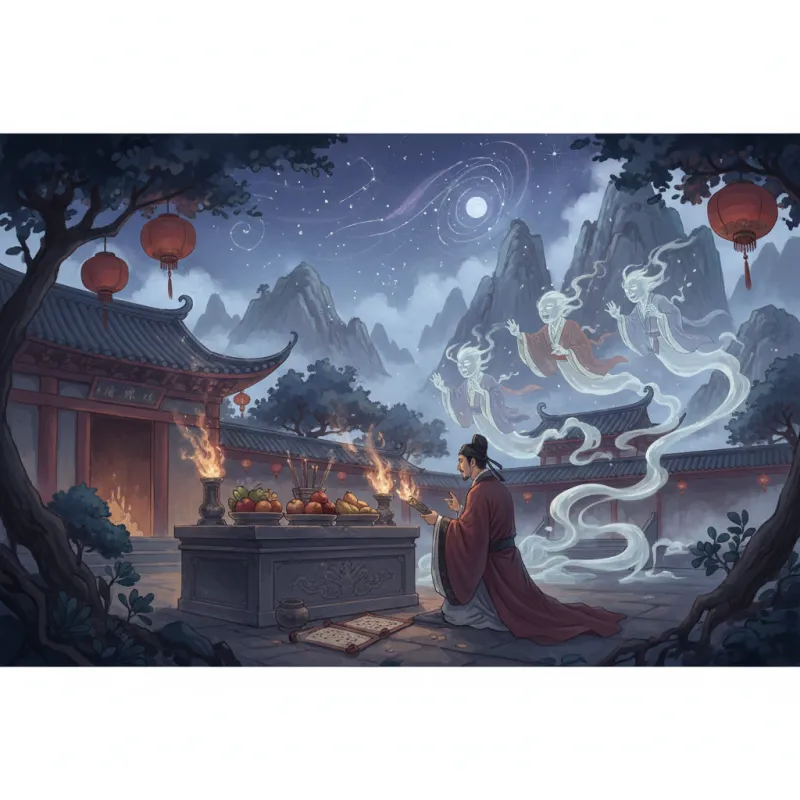
Your grandmother is hungry. Right now, wherever she is in the afterlife, she's waiting for you to remember her. And if you don't? Well, hungry ghosts have a way of making their displeasure known — through nightmares, financial troubles, or that persistent feeling that something in your life is just slightly off.
Ancestor worship (祭祖, jì zǔ) isn't some quaint cultural practice your relatives do out of habit. It's the oldest continuous religious transaction in human civilization, predating every major religion by millennia. Archaeological digs at Yinxu, the Shang dynasty capital, reveal oracle bones from 1600 BCE asking ancestors for help with harvests, battles, and childbirth. The same requests Chinese families make today, just without the turtle shells.
The logic is brutally practical: your dead relatives still exist, they still have needs, and they remember who forgot them. This guide will show you exactly how to maintain that relationship properly — because doing it wrong is worse than not doing it at all.
What You're Actually Doing When You Make Offerings
Let's be clear about the metaphysics here. When you burn incense and paper money for your ancestors, you're not engaging in symbolic remembrance. You're conducting a transaction across the boundary between worlds. The dead need sustenance just like the living, but they can't grow rice or earn money anymore. They depend entirely on what you send them.
Think of it like this: when you die, you don't stop being you. You still have your personality, your preferences, your appetites. Your grandfather who loved cigarettes and baijiu? He still wants cigarettes and baijiu. Your grandmother who was particular about her tea? She's still particular. Death doesn't erase desire — it just removes your ability to satisfy it yourself.
The offerings you make transform in the burning. Physical food becomes spiritual nourishment. Paper money becomes real currency in the underworld. That's why the paper goods industry in China is so elaborate — you can buy paper smartphones, paper cars, even paper servants to send to your ancestors. The Qing dynasty novel Yuewei Caotang Biji (阅微草堂笔记) by Ji Yun records dozens of cases where ghosts complained about receiving insufficient or low-quality offerings. One ghost reportedly haunted his son for burning cheap paper money, saying it was worthless in the afterlife markets.
The Basic Offering Setup
You need an altar. It doesn't have to be elaborate, but it needs to be clean, elevated, and positioned correctly. The traditional placement is against the north wall of your home, facing south — the direction of yang energy and life. If that's impossible, any respectful location away from bathrooms and bedrooms works.
On the altar, you need:
Ancestral tablets (牌位, pái wèi) — wooden plaques inscribed with your ancestors' names and dates. If you don't have these, photographs work. In a pinch, even handwritten names on red paper suffice. The important thing is specificity. "My ancestors" is too vague. Name them. The dead respond to being called by name.
Incense burner (香炉, xiāng lú) — filled with clean sand or rice. Three sticks of incense is standard, representing heaven, earth, and humanity. Light them together, hold them at forehead level, bow three times, then place them in the burner. The smoke carries your prayers and intentions upward.
Offering plates — for food and drink. Use real dishes, not disposable ones. Your ancestors aren't trash. The food should be fresh, properly cooked, and presented as you would serve an honored guest. Because that's what they are.
Tea or wine — in small cups. Tea for regular offerings, wine for special occasions. Pour it fresh each time. Stale offerings are insulting.
Candles — red for celebrations, white for mourning periods. The light guides your ancestors to the offerings and represents the continuation of the family line.
The Offering Ritual Itself
Timing matters. The traditional days are the 1st and 15th of each lunar month, plus major festivals like Qingming (清明节, Qīngmíng Jié) and Zhongyuan Festival (中元节, Zhōngyuán Jié). But honestly? Whenever you think of them is fine. Regular small offerings beat elaborate annual ones.
Here's the basic sequence:
Clean yourself first. Wash your hands and face. Approach the altar with respect — you're entering sacred space. Light the candles, then the incense. Hold the incense sticks in both hands at forehead level and bow three times. As you bow, speak to your ancestors. Out loud. Tell them who you are (they know, but it's polite), what you're offering, and what's happening in your life.
This isn't prayer in the Western sense. It's conversation. "Grandmother, I brought you your favorite dumplings. I got promoted at work. Thank you for watching over me." Or: "Grandfather, I'm struggling with money. Please help if you can." Be specific. Be honest. They were human once — they understand human problems.
Place the food offerings on the altar. Let them sit for at least the time it takes the incense to burn down — about 20-30 minutes. This gives your ancestors time to consume the spiritual essence of the food. The physical food remains, but its qi (气, qì) has been transferred.
After the incense burns out, you can remove the food. Some families eat it themselves — the physical nutrients remain even if the spiritual essence is gone. Others dispose of it respectfully. Never throw offerings in the trash. Bury them, leave them outside for animals, or burn them.
What to Offer and What to Avoid
Your ancestors' preferences matter. If your grandfather was Buddhist and avoided meat, don't offer him pork. If your grandmother loved specific dishes, make those. The more personalized, the better.
Standard offerings include:
Rice and tea — the basics. Never let your ancestors go without these. White rice represents purity and sustenance. Tea represents clarity and respect.
Fruit — oranges, apples, pears. Always in odd numbers (3, 5, 7). Even numbers are for funerals. Avoid pears if offering to a married couple — the word for pear (梨, lí) sounds like separation (离, lí).
Meat and fish — whole chicken, pork, fish. Presented whole when possible, head and tail intact, representing completeness. The fish should face the altar, as if swimming toward your ancestors.
Wine or baijiu — for ancestors who enjoyed drinking. Three small cups, refilled at each offering.
Sweets and snacks — whatever they enjoyed in life. My friend's family offers their grandmother chocolate because she loved it. Tradition adapts.
Paper offerings — hell money (冥币, míng bì), paper clothes, paper goods. Burn these in a metal container outside. The smoke carries them to the afterlife. The paper money industry has gotten creative — you can buy paper credit cards, paper iPhones, even paper luxury cars. Some families burn paper servants or paper houses. The logic is consistent: whatever you burn, they receive.
Avoid:
Beef — many traditional families avoid this because oxen were essential work animals. Offering beef is like offering a tractor.
Bitter or sour foods — these represent hardship. You want your ancestors comfortable, not suffering.
Broken or damaged items — would you serve a guest on a cracked plate? Same principle.
Cheap or fake offerings — your ancestors know the difference. Burning newspaper instead of proper joss paper is like paying someone in Monopoly money.
When Things Go Wrong
Sometimes offerings don't work. You make them regularly, but you still have nightmares, or your business fails, or family members get sick. This usually means one of three things:
You're forgetting someone. Unmarried ancestors, children who died young, relatives who died far from home — these are often neglected. They're the ones most likely to cause trouble. The solution is to expand your offerings to include "all ancestors of the family" to catch anyone you've missed.
The offerings are insufficient. Maybe your ancestors need more than you're giving. Try increasing the frequency or quality. Add their favorite foods. Burn more paper money. One family I know had persistent bad luck until they realized their ancestor had been a heavy smoker — they started burning paper cigarettes and the problems stopped.
You have hungry ghosts, not ancestors. Not every ghost haunting you is related to you. Some are just opportunistic spirits attracted to offerings. This is where protective talismans and proper exorcism rituals become necessary. If problems persist despite proper offerings, consult a Daoist priest or spirit medium.
The Liaozhai Zhiyi (聊斋志异) by Pu Songling contains a story about a man who made offerings to the wrong ancestor for years — he'd confused his grandfather with his great-uncle. His actual grandfather was furious at being neglected and caused the man's business to fail repeatedly. Once the mistake was corrected, prosperity returned immediately.
The Bigger Picture: Why This Still Matters
You might think this is superstition. That burning paper money is absurd. That talking to photographs is pointless. But consider: ancestor worship has survived 3,600 years of dynasties, revolutions, and modernization. It survived the Cultural Revolution's attempt to eradicate it. It's practiced by Chinese families worldwide, from Beijing to San Francisco to Singapore.
Why? Because it works. Not in some vague spiritual sense, but practically. Families that maintain ancestor worship report feeling more connected, more protected, more fortunate. Whether that's because the ancestors actually help or because the ritual creates psychological benefits doesn't matter — the effect is real.
And there's something profound about maintaining a practice your ancestors did exactly the same way 100 generations ago. When you light incense and bow, you're doing what your great-great-great-grandmother did. You're part of an unbroken chain stretching back to the Shang dynasty. That continuity means something.
The dead are not gone. They're just on the other side of a very thin veil, waiting for you to remember them. Feed them. Talk to them. Send them what they need. They'll return the favor.
Your grandmother is still hungry. Now you know what to do about it.
Related Reading
- Yin Feng Shui: The Art of Placing Graves for Good Fortune
- Taoist Exorcism: Methods of Spirit Removal
- Funeral Rituals in Chinese Culture: A Guide to Sending Off the Dead
- Unveiling the Mysteries of Chinese Supernatural Folklore: Ghosts and Afterlife Beliefs
- Daoist Exorcism: How Chinese Priests Fight Supernatural Evil
- Chinese Funerals: A Complete Guide to Death Customs and Rituals
- Exploring Chinese Supernatural Folklore: Ghosts, Spirits, and Afterlife Beliefs
- Liaozhai Zhiyi: The Ghost Stories That Changed Chinese Literature
Explore Chinese Culture
- Explore ancient mythical creatures
- Explore Daoist exorcism traditions
- Explore Chinese folk beliefs and superstitions