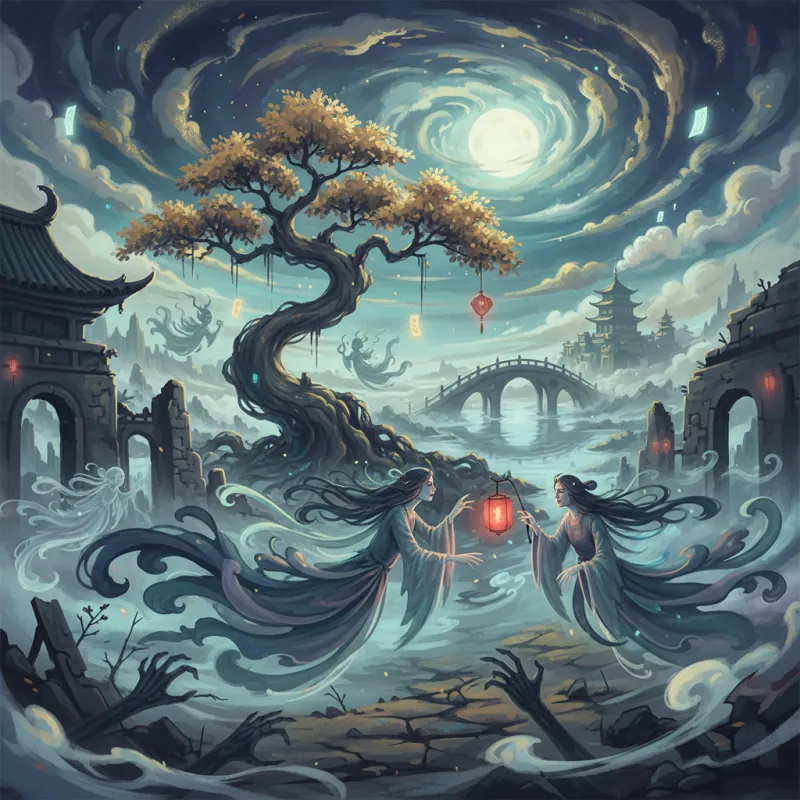
The old woman's hands trembled as she placed three sticks of incense before the ancestral tablet, her whispered prayers barely audible over the crackling of joss paper burning in the bronze vessel. This scene, repeated in countless Chinese households for millennia, represents far more than simple ritual—it's a direct line of communication with the dead, a negotiation with forces that Western minds often struggle to comprehend. Chinese supernatural folklore isn't just a collection of ghost stories; it's an entire cosmology where the boundary between life and death is permeable, negotiable, and terrifyingly real.
The Architecture of the Chinese Afterlife
Unlike the binary heaven-or-hell model familiar to Western audiences, the Chinese afterlife operates more like a celestial bureaucracy—complete with paperwork, bribery, and incompetent officials. The system centers on Diyu (地狱, dìyù), often mistranslated as "hell" but more accurately understood as an underworld processing center where souls are judged, punished, and prepared for reincarnation.
This isn't eternal damnation—it's temporary detention. The Ten Courts of Hell, each presided over by a Yama King (阎罗王, Yánluó Wáng), evaluate different categories of sins. The first court handles those who died prematurely; the fifth specializes in financial crimes; the eighth deals with filial impiety, considered among the gravest offenses. The specificity is remarkable: there's a designated punishment for people who waste food (forced to swallow molten gold), for plagiarists (tongue extraction), for those who mistreat books (crushed by boulders).
What makes this system particularly Chinese is its flexibility. The living can influence the dead's fate through offerings, prayers, and—most importantly—burning paper money and goods. During Qingming Festival (清明节, Qīngmíng Jié) and Ghost Month, families burn elaborate paper houses, cars, even iPhones, ensuring their ancestors live comfortably in the afterlife. It's transactional spirituality: you take care of them, they take care of you.
Gui: The Taxonomy of Chinese Ghosts
The Chinese ghost—gui (鬼, guǐ)—defies simple categorization. These aren't Casper-style friendly spirits or Hollywood's vengeful phantoms, though the latter comes closer. Chinese ghosts are complex entities shaped by the circumstances of their death and their unfinished business in life.
The most dangerous is the yuangui (冤鬼, yuānguǐ), the wronged ghost who died unjustly—murdered, falsely accused, or denied proper burial rites. These spirits possess terrifying power fueled by grievance, and they won't rest until their wrongs are righted. The classic example is Dou E from Guan Hanqing's 13th-century play "The Injustice to Dou E" (窦娥冤, Dòu É Yuān), whose execution for a crime she didn't commit caused blood to flow upward, snow to fall in summer, and drought to plague the region for three years. Her rage literally altered the natural order.
Then there's the hungry ghost—egui (饿鬼, èguǐ)—condemned to eternal starvation because no one performs offerings for them. These pathetic creatures, with needle-thin throats and bloated bellies, roam freely during Ghost Month (the seventh lunar month), when the gates of the underworld swing open. Smart families leave food offerings outside their homes, not from generosity but from self-preservation. An offended hungry ghost makes a vindictive enemy.
The jiangshi (僵尸, jiāngshī), often called "Chinese vampire" or "hopping corpse," represents a different category entirely—the reanimated dead. Unlike Western zombies, jiangshi retain some intelligence and hop because rigor mortis has stiffened their bodies. They're created when a soul fails to leave the body properly, often due to improper burial or violent death. The Qing Dynasty saw numerous reported jiangshi incidents, spawning an entire profession of Taoist corpse herders who transported bodies back to their ancestral homes for proper burial, leading them at night by ringing bells and holding their breath.
The Spirit World's Organizational Chart
Beyond ghosts, Chinese folklore teems with shen (神, shén)—spirits and deities occupying every conceivable niche in the cosmic hierarchy. This isn't monotheism; it's a sprawling supernatural bureaucracy that mirrors earthly government structures.
At the top sits the Jade Emperor (玉皇大帝, Yùhuáng Dàdì), essentially heaven's CEO, managing everything from weather patterns to human destiny. Below him, countless deities handle specialized portfolios: Guanyin (观音, Guānyīn) for mercy and compassion, Guan Yu (关羽, Guān Yǔ) for loyalty and righteousness, Caishen (财神, Cáishén) for wealth. Each deity has specific feast days, preferred offerings, and areas of influence.
Then there are the nature spirits—every mountain, river, and ancient tree potentially houses a spirit. The fox spirit or huli jing (狐狸精, húlijīng) deserves special mention. These shape-shifting creatures, usually appearing as beautiful women, occupy a morally ambiguous space. Some seduce men to steal their yang energy, leading to death or madness. Others, after cultivating themselves for centuries, become benevolent protectors. Pu Songling's 18th-century masterpiece "Strange Tales from a Chinese Studio" (聊斋志异, Liáozhāi Zhìyì) features dozens of fox spirit stories, many surprisingly sympathetic, portraying them as more ethical than the humans they encounter.
The household gods represent the most intimate level of spiritual interaction. The Kitchen God (灶神, Zàoshén) monitors family behavior year-round, then reports to the Jade Emperor before Chinese New Year. Families traditionally smear honey on his image before he ascends, hoping to sweeten his report—or stick his mouth shut. It's spiritual realpolitik at its finest.
Ancestor Worship: The Foundation of Everything
Strip away all the elaborate mythology, and you'll find ancestor worship (祖先崇拜, zǔxiān chóngbài) at the core of Chinese supernatural belief. This isn't worship in the Western religious sense—it's maintaining relationships with deceased family members who remain active participants in family affairs.
The logic is straightforward: death doesn't sever family bonds; it transforms them. Ancestors need sustenance, comfort, and respect in the afterlife. In return, they provide protection, guidance, and blessings to living descendants. Neglect them, and they become hungry ghosts or worse—actively malevolent forces targeting their own bloodline.
This system created powerful social cohesion. Filial piety (孝, xiào) extended beyond the grave, ensuring elderly parents received care because everyone knew they'd become ancestors someday. The ancestral tablet (神位, shénwèi) in the family shrine wasn't decorative—it was a communication device, a spiritual telephone connecting generations.
The practice also explains Chinese attitudes toward death that puzzle Westerners. Death isn't an ending but a transition, a promotion to ancestorhood. The elaborate funeral rites, the specific mourning periods, the ongoing offerings—all serve to ease this transition and establish the proper relationship between living and dead. For deeper insights into these practices, explore Chinese funeral traditions and their spiritual significance.
Exorcism and Spirit Management
Where there are ghosts and spirits, there must be professionals to manage them. Chinese culture developed sophisticated systems for dealing with supernatural threats, primarily through Taoist and Buddhist practitioners.
The Taoist exorcist or daoshi (道士, dàoshì) combines priest, magician, and bureaucrat. Their power comes from mastering talismans (符, fú)—written spells that command spirits through the authority of celestial bureaucracy. These aren't prayers or requests; they're official documents bearing the seals of high-ranking deities, essentially court orders that spirits must obey. A properly executed talisman can trap ghosts, protect buildings, or cure spirit-caused illnesses.
The peachwood sword (桃木剑, táomù jiàn) serves as the exorcist's primary weapon. Peach wood naturally repels evil spirits—a belief so widespread that peach wood charms still hang in doorways across China. Combined with the Eight Trigrams mirror (八卦镜, bāguà jìng) that reflects evil back to its source, these tools form the basic exorcist's kit.
Buddhist monks approach spirit problems differently, emphasizing compassion and release rather than command and control. They perform rituals to help trapped spirits move on, breaking the cycles of attachment that bind them to the mortal world. The Ullambana Festival (盂兰盆节, Yúlánpén Jié), celebrated during Ghost Month, exemplifies this approach—feeding hungry ghosts and performing rites to ease their suffering.
Modern Taiwan and Hong Kong maintain thriving communities of spirit mediums and exorcists. Temple mediums enter trance states, allowing gods to possess them and speak directly to petitioners. It's not historical reenactment—it's living practice, adapting ancient techniques to contemporary problems. Need to know if your new apartment has bad feng shui or hostile spirits? There's a professional for that.
The Living Folklore
Chinese supernatural folklore isn't museum material—it's actively evolving. Modern urban legends blend traditional ghost lore with contemporary settings: haunted MRT stations, cursed apartment buildings, spirits trapped in smartphones. The 2013 film "Rigor Mortis" reimagined jiangshi for Hong Kong's decaying public housing estates, where economic desperation creates new kinds of hungry ghosts.
The persistence of these beliefs, even among educated urbanites, reveals something profound about Chinese cultural psychology. The supernatural framework provides explanations for randomness, injustice, and suffering that purely materialist worldviews struggle to address. When bad things happen to good people, when the wicked prosper, the ghost story offers both explanation and hope for cosmic justice—if not in this life, then in the courts of the afterlife.
This worldview also maintains social bonds across generations. Burning offerings for ancestors isn't superstition to practitioners—it's family obligation, no different from visiting graves or maintaining family records. The ritual connects them to centuries of ancestors and ensures their own descendants will remember them. In a rapidly modernizing society where traditional family structures fracture, these practices preserve continuity with the past.
Understanding Chinese supernatural folklore means recognizing it's not a relic but a living tradition that continues shaping how millions of people interpret their world. The ghosts, spirits, and afterlife beliefs aren't just stories—they're a complete cosmology that addresses fundamental human questions about death, justice, family, and the nature of reality itself. Whether you believe in literal ghosts or view them as cultural metaphors, their influence on Chinese thought, art, and daily life remains undeniable and profound. For those interested in how these beliefs intersect with practical divination methods, consider exploring traditional Chinese fortune-telling techniques that often invoke these same spiritual forces.
Related Reading
- Zhong Kui: The Demon Queller
- Modern Spirit Mediums in Taiwan: Where Gods Still Talk Through People
- Talismans and Fu: The Ancient Art of Paper Magic
Explore Chinese Culture
- Explore ancient mythical creatures
- Explore Daoist exorcism traditions
- Explore Chinese folk beliefs and superstitions