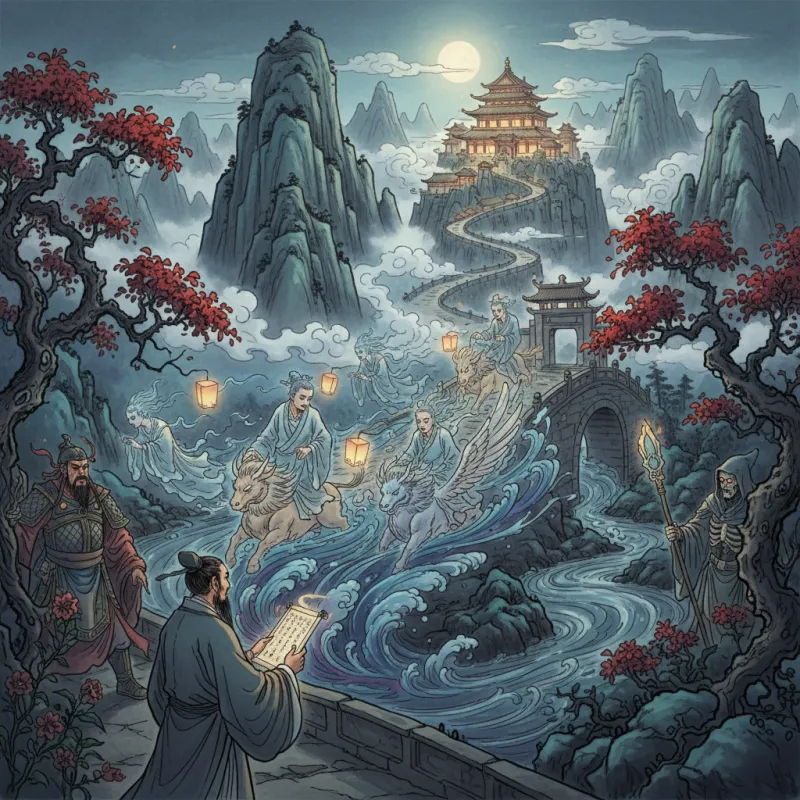
The old woman's hands trembled as she placed three sticks of incense before the ancestral tablet, her whispered prayers barely audible over the crackling of joss paper burning in the courtyard. She wasn't just honoring the dead—she was negotiating with them, appeasing them, ensuring they wouldn't return as hungry ghosts to torment the living. This scene, repeated in countless Chinese households for millennia, reveals a profound truth: in Chinese supernatural folklore, death isn't an ending but a transformation, and the boundary between the living and the dead is far more permeable than Western minds typically imagine.
The Architecture of the Chinese Afterlife
Chinese afterlife beliefs don't offer a simple heaven-or-hell binary. Instead, they present a complex bureaucratic system that mirrors earthly governance—because why would death be any less complicated than life? The underworld, known as Diyu (地狱, dìyù), operates like an imperial administration with ten courts, each presided over by a judge who evaluates specific sins. King Yanluo (阎罗王, Yánluó Wáng), the supreme ruler of this netherworld, borrowed from the Buddhist Yama, determines the fate of souls based on their earthly deeds.
But here's where it gets interesting: souls don't simply arrive at judgment. They must first cross the Yellow Springs (黄泉, huángquán), a subterranean river that separates the world of the living from the realm of the dead. The journey takes seven days, during which the soul remains conscious and aware—which explains why traditional Chinese funerals involve elaborate rituals spanning this exact period. The family burns paper money, provides food offerings, and hires Daoist priests to guide the deceased through this treacherous passage. This isn't superstition; it's spiritual logistics.
When the Dead Won't Stay Dead: The Taxonomy of Chinese Ghosts
Chinese folklore distinguishes between various types of ghosts with the precision of a field guide to supernatural entities. The gui (鬼, guǐ) is the general term for ghost, but the specifics matter enormously. A yuanhun (冤魂, yuānhún) is a wronged spirit seeking justice—think of Dou E from the 13th-century play "The Injustice to Dou E," whose execution caused snow to fall in summer and drought to plague the land for three years. These aren't passive haunters; they're cosmic whistleblowers whose grievances literally alter weather patterns.
Then there are the egui (饿鬼, èguǐ), or hungry ghosts, perhaps the most pitiful category. These are souls of people who died without proper burial rites or whose families neglected ancestral offerings. With throats as thin as needles and bellies as vast as mountains, they wander eternally unsatisfied. The entire Ghost Festival (中元节, Zhōngyuán Jié) in the seventh lunar month exists specifically to feed these desperate spirits, lest they cause mischief or worse. During this month, the gates of the underworld swing open, and the living must be especially careful—no swimming at night (water ghosts will drag you down), no whistling after dark (it attracts wandering spirits), and definitely no picking up money on the street (it's probably ghost currency meant to trap you).
The jiangshi (僵尸, jiāngshī), or hopping vampire, represents another fascinating category. Unlike Western vampires, these reanimated corpses move by hopping because rigor mortis has stiffened their bodies. They're created when a soul fails to leave the body properly—perhaps due to improper burial, violent death, or possession by an evil spirit. The Qing Dynasty saw numerous accounts of jiangshi, and the creature became so embedded in folklore that specific countermeasures evolved: sticky rice to purify, a Taoist talisman on the forehead to immobilize, and holding your breath since jiangshi track victims by detecting their breathing.
The Living's Obligations: Ancestor Worship as Supernatural Contract
Here's what many outsiders miss about Chinese ghost beliefs: they're fundamentally transactional. Ancestor worship isn't merely about respect or remembrance—it's about maintaining a mutually beneficial relationship across the death barrier. The living provide offerings, maintain graves, and perform rituals; in return, ancestors offer protection, guidance, and blessings. Break this contract, and you don't just dishonor the dead—you create potential enemies in the spirit world.
The Qingming Festival (清明节, Qīngmíng Jié) exemplifies this exchange. Families trek to ancestral graves, sweep the tombs, burn incense and paper offerings, and share meals with the deceased. But notice the specificity: you burn paper versions of what the dead might need—money, houses, cars, even smartphones in modern practice. This isn't symbolic; it's believed these items literally transfer to the spirit realm. I've seen paper iPhones and luxury cars at contemporary Chinese funerals, because apparently, the afterlife has kept pace with technological advancement.
The ancestral tablet (神主牌, shénzhǔpái) serves as the physical anchor for this relationship. Kept in homes or ancestral halls, these wooden tablets inscribed with the deceased's name aren't mere memorials—they're portals through which ancestors can receive offerings and communicate with the living. Neglect these tablets, and you're essentially ghosting your ancestors, which is both disrespectful and dangerous. The consequences range from bad luck and illness to full-blown hauntings.
Exorcism and Spirit Management: The Professionals
When things go wrong—when ghosts become aggressive, when hauntings disrupt households, when possession occurs—the Chinese supernatural system has specialists. Daoist priests (道士, dàoshì) serve as the primary ghost-busters, armed with ritual knowledge, talismans, and ceremonial swords. Their methods, documented in texts like the "Daozang" (道藏, Dàozàng), the Daoist canon, involve complex rituals that can last days. These aren't simple exorcisms; they're negotiations, battles, and sometimes even legal proceedings conducted in the spirit realm.
The fangshi (方士, fāngshì), or ritual masters, represent another tradition, blending shamanic practices with Daoist techniques. During the Han Dynasty (206 BCE–220 CE), these practitioners were consulted by emperors themselves for matters of ghosts and spirits. Their methods often involved entering trance states to communicate directly with the supernatural, serving as mediators between worlds. This practice continues in various forms, particularly in rural areas and among certain ethnic minorities where traditional beliefs remain strong.
Buddhist monks also play a role, particularly in helping souls achieve better rebirths or escape the cycle of reincarnation entirely. The practice of releasing burning mouths (放焰口, fàng yànkǒu) involves elaborate rituals to feed hungry ghosts and guide them toward liberation. These ceremonies can involve dozens of monks chanting for hours, creating a sonic environment believed to open pathways for trapped spirits.
The Literary Legacy: How Stories Shape Belief
Chinese supernatural folklore isn't just oral tradition—it's been codified in literature that has, in turn, shaped popular belief. "Strange Tales from a Chinese Studio" (聊斋志异, Liáozhāi Zhìyì) by Pu Songling, completed in 1740, contains 491 tales of ghosts, fox spirits, and supernatural encounters. These aren't children's stories; they're sophisticated narratives exploring themes of justice, desire, and the porousness of reality. The ghost stories often feature female spirits who are more sympathetic, more intelligent, and more moral than their living male counterparts—a subtle critique of Qing Dynasty society wrapped in supernatural packaging.
"Journey to the West" (西游记, Xīyóu Jì), while primarily a Buddhist allegory, is packed with demons, spirits, and underworld bureaucracy. The famous scene where Monkey King crosses out his name from the Book of Life and Death isn't just comic relief—it reflects genuine beliefs about how the afterlife administration functions. Similarly, "Investiture of the Gods" (封神演义, Fēngshén Yǎnyì) details how humans become deities, establishing a cosmology where the boundary between mortal and divine is crossable through merit, sacrifice, or imperial decree.
These texts don't just reflect beliefs; they actively create and modify them. When people encounter ghosts or supernatural phenomena, they interpret their experiences through these literary frameworks. The stories provide a vocabulary, a set of expectations, and a roadmap for understanding the inexplicable.
Modern Manifestations: Ancient Beliefs in Contemporary Life
Walk through any Chinese city today, and you'll find these ancient beliefs alive and adapting. Skyscrapers incorporate feng shui principles to avoid disturbing earth spirits. The fourth floor is often omitted in buildings because "four" (四, sì) sounds like "death" (死, sǐ). During Ghost Month, businesses avoid major transactions, weddings are postponed, and even stock markets show measurably lower activity—ancient supernatural beliefs directly impacting modern economics.
The practice of burning joss paper has evolved to include paper credit cards, passports, and even paper servants. Some shops sell paper mistresses for deceased men, sparking debates about whether such offerings are appropriate—a theological argument about afterlife ethics happening in the 21st century. Online ancestral halls now allow diaspora Chinese to make virtual offerings, suggesting that the spirit realm has internet access.
Horror films from Hong Kong and Taiwan continue mining this rich folklore, but they're not just entertainment—they're modern morality tales using traditional supernatural frameworks. Films like "The Eye" and "Rigor Mortis" don't invent new monsters; they reinterpret classical ghost types for contemporary audiences, keeping these beliefs culturally relevant.
The Philosophical Underpinning: Why These Beliefs Persist
Chinese supernatural folklore persists not despite modernity but because it addresses fundamental human concerns that technology hasn't resolved: What happens after death? How do we maintain relationships with those we've lost? What obligations do we have to previous generations? These aren't superstitious questions; they're existential ones.
The genius of Chinese afterlife beliefs lies in their practicality. They don't promise eternal bliss or threaten eternal damnation; they extend earthly relationships and responsibilities beyond death. Your grandmother still needs money, just in paper form. Your ancestors still care about family honor, just from a different realm. This continuity provides comfort and structure in the face of mortality's chaos.
Moreover, these beliefs create social cohesion. Ancestor worship binds families across generations. Ghost festivals unite communities in shared ritual. The fear of becoming a hungry ghost encourages proper treatment of the dead and maintenance of social bonds. These aren't bugs in the system; they're features that have helped Chinese culture maintain continuity for millennia.
The Western tendency to dismiss these beliefs as superstition misses their sophistication. Chinese supernatural folklore represents a comprehensive system for managing the psychological, social, and spiritual challenges of mortality. It's not about whether ghosts "really" exist—it's about creating meaningful frameworks for confronting death, honoring the past, and maintaining social order. In that sense, these ancient beliefs remain remarkably modern, addressing timeless human needs with practical, if supernatural, solutions.
Related Reading
- Daoist Exorcism: How Chinese Priests Fight Supernatural Evil
- Paper Offerings: Sending Wealth to the Afterlife
- Feng Shui for Ghost Prevention: Protecting Your Home
- Joss Paper and Spirit Money: Shopping for the Dead
- Taoist Exorcism: Methods of Spirit Removal
- Unveiling the Mysteries of Chinese Supernatural Folklore: Ghosts, Spirits, and Afterlife Beliefs
- How Animals Become Demons: The Yaoguai Transformation Process
- Chinese Campus Ghost Stories: The Haunted Universities
Explore Chinese Culture
- Explore ancient mythical creatures
- Explore Daoist exorcism traditions
- Explore Chinese folk beliefs and superstitions