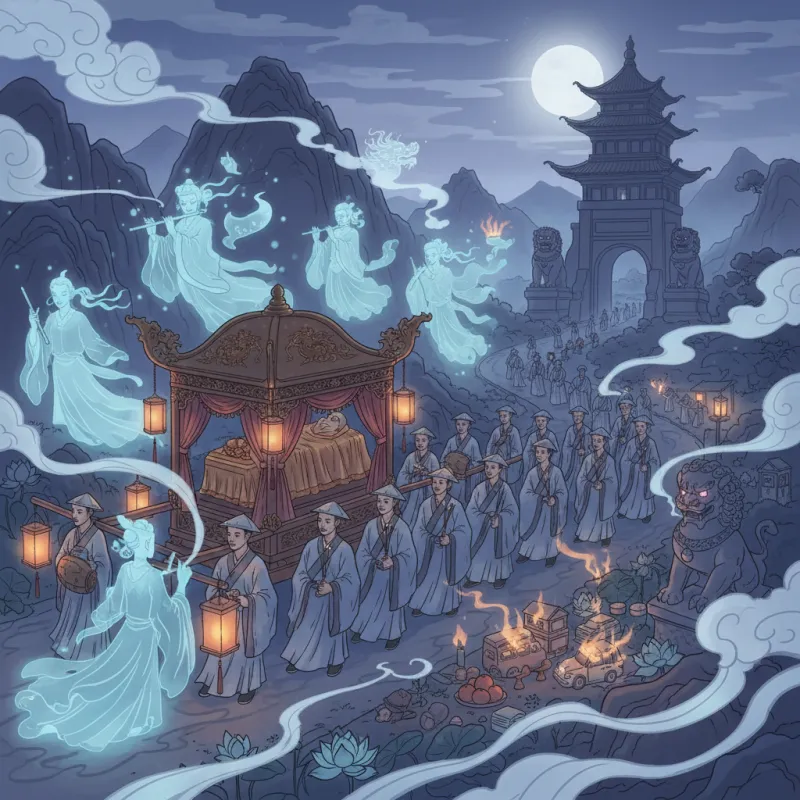
The body lies in the living room for three days. Not in a funeral home — in the house, surrounded by white cloth, incense smoke, and the low hum of Buddhist chants playing on loop. Neighbors bring food. Relatives arrive in waves. And somewhere in the chaos, a ritual master in dark robes is consulting a lunar calendar to determine the exact hour the coffin can leave the building without bringing catastrophe to the family.
This is what a traditional Chinese funeral looks like. Not the sanitized, two-hour chapel service that's become common in modern cities, but the full ceremonial process that still happens in rural areas and among families who take the afterlife seriously. It's exhausting, expensive, and absolutely necessary — because in Chinese folk belief, death is not an ending. It's a transition that requires paperwork, bribes, and very specific instructions.
Why Funerals Matter in Chinese Cosmology
Chinese funeral rituals exist at the intersection of three belief systems: Confucian filial piety, Buddhist karma, and Daoist cosmology. The Confucian part is about duty — honoring your parents in death as you did in life. The Buddhist part is about merit — performing good deeds to improve the deceased's next incarnation. The Daoist part is about bureaucracy — navigating the underworld's administrative system.
Yes, bureaucracy. The Chinese afterlife, as depicted in texts like the Jade Record (玉历, Yùlì) from the Qing Dynasty, operates like an imperial government. There are ten courts, each presided over by a judge who reviews the deceased's life and assigns appropriate punishments or rewards. King Yama (阎罗王, Yánluó Wáng) oversees the first court, where souls are sorted. The process can take years.
This is why funerals include burning paper money (冥币, míngbì), paper houses, paper servants, and even paper iPads in recent years. The deceased needs resources to bribe officials, pay for lodging, and survive the journey. It's not symbolic. In the folk religion framework, these items literally transfer to the spirit world through combustion. Families who skip this step risk leaving their loved one destitute in the afterlife — and a desperate ghost is a dangerous ghost, as anyone familiar with hungry ghost folklore can tell you.
The First Three Days: Preparing the Body
The moment someone dies, the clock starts. The body cannot be moved immediately — doing so might trap the soul in the wrong location. Instead, the deceased is laid out at home, usually in the main room, dressed in burial clothes that must have an odd number of layers (never even, which is associated with the living).
A white cloth covers the face. Incense burns continuously. And here's where it gets specific: the incense must be an odd number of sticks, typically three or five. Family members take turns keeping vigil, ensuring the incense never goes out. If it does, the soul might lose its way.
During these three days, a ritual master — the 司仪 (sīyí) or sometimes a Daoist priest (道士, dàoshì) — arrives to perform the initial rites. This includes:
- Announcing the death to the local earth god (土地公, Tǔdì Gōng) through a formal written notice that's burned
- Setting up an altar with the deceased's photograph, offerings of fruit, and a spirit tablet (牌位, páiwèi) inscribed with their name
- Determining auspicious dates for the funeral and burial using the deceased's birth date and the lunar calendar
The family wears mourning clothes during this period. White is the primary color, though the exact shade and style depend on the mourner's relationship to the deceased. Children wear the roughest white cloth. Grandchildren might wear white with a blue or black border. Spouses have their own specific garments. Getting this wrong is a serious breach of etiquette — it signals either ignorance or disrespect.
The Wake: Feeding the Dead and the Living
The wake (守灵, shǒulíng) is not a quiet affair. There's chanting, sometimes live musicians playing suona horns and drums, and a constant stream of visitors paying respects. Each visitor brings a white envelope with money (白金, báijīn) to help offset funeral costs. The family keeps meticulous records of who gave what — these debts must be repaid at future funerals.
Food plays a central role. The deceased receives daily offerings of their favorite dishes, placed on the altar with chopsticks stuck vertically into a bowl of rice. (This is the only time vertical chopsticks are acceptable in Chinese culture — doing this at a regular meal is deeply taboo because it mimics funeral offerings.)
The living also eat, but the meals follow specific rules. Meat is often avoided, especially by immediate family members, who may observe a vegetarian diet for the entire mourning period. Some families hire caterers to feed the dozens of relatives who've traveled for the funeral. The food is simple, communal, and served in the same space where the body lies — a reminder that death is not separate from life but woven into it.
At night, family members sleep near the coffin. This isn't just about keeping vigil. It's about maintaining a connection, ensuring the deceased doesn't feel abandoned during their first vulnerable days as a spirit. The belief is that the soul lingers near the body for several days before beginning its journey to the underworld, and during this time, it can still perceive the living world.
The Funeral Procession: Sending Off the Soul
On the chosen auspicious day, the coffin leaves the house. This is the 出殡 (chūbìn), the formal funeral procession, and it follows a precise choreography. The coffin cannot exit through the front door — it must leave through a side door or window, sometimes requiring the removal of a window frame. Why? To prevent the deceased's spirit from remembering the way back home and returning as a ghost.
The procession itself is a spectacle. In traditional funerals, it includes:
- A portrait of the deceased carried at the front
- Musicians playing mournful tunes on traditional instruments
- Paper offerings carried on poles — houses, servants, horses, all destined for burning
- The coffin, carried by pallbearers or transported on a decorated vehicle
- Family members following behind, often wailing loudly
The wailing is not just grief — it's ritual performance. Hired mourners (哭丧, kūsāng) sometimes supplement the family, especially if the deceased was elderly and outlived most of their peers. Their job is to cry convincingly, adding emotional weight to the proceedings. This might seem strange to outsiders, but it reflects a practical understanding: grief needs expression, and ritual provides the structure for that expression.
The procession moves slowly through the streets. Bystanders stop and turn away — looking directly at a funeral procession is considered bad luck. Some throw coins or paper money on the ground for the deceased's spirit to collect. The route is predetermined by the ritual master to avoid inauspicious locations like hospitals or police stations.
Burial and Cremation: The Final Disposition
At the burial site or crematorium, the final rites begin. For burial, the coffin is lowered into the grave at a specific time, calculated to the minute based on the lunar calendar and the deceased's birth chart. Family members throw handfuls of earth onto the coffin, a symbolic act of returning the body to the earth.
The grave's location matters enormously. Traditional Chinese geomancy (风水, fēngshuǐ) dictates that a well-positioned grave brings prosperity to descendants, while a poorly positioned one brings misfortune. Wealthy families hire feng shui masters to select burial sites, looking for locations with good "dragon veins" (龙脉, lóngmài) — underground energy flows that connect to cosmic forces. This is why you'll see graves on hillsides facing specific directions, often in clusters that form family burial grounds.
Cremation, though increasingly common in modern China due to land scarcity, requires its own adaptations. The ashes are typically placed in an urn and stored in a columbarium, but families still perform many of the same rituals — burning offerings, making food sacrifices, and maintaining an altar at home with the deceased's photograph and spirit tablet.
After the burial or cremation, family members must not look back as they leave the site. Looking back might encourage the spirit to follow them home. Some families scatter rice or red beans along the path to distract any lingering ghosts, similar to practices described in exorcism rituals for dealing with persistent spirits.
The Mourning Period: 49 Days and Beyond
The funeral is not the end. It's the beginning of a structured mourning period that lasts, in its most intensive form, for 49 days. This number comes from Buddhist belief that the soul undergoes judgment every seven days for seven weeks, with the final judgment on the 49th day determining the next incarnation.
During this period, family members perform rituals every seven days (做七, zuòqī). They burn offerings, make food sacrifices, and sometimes hire monks or priests to chant sutras on behalf of the deceased. The most important of these ceremonies is the seventh seventh-day (七七, qīqī), also called the 49th day, when the soul's fate is sealed.
Immediate family members observe additional restrictions during mourning:
- No weddings, celebrations, or temple visits for 100 days
- No red clothing (the color of joy) for one year
- No haircuts for 49 days
- No participation in New Year celebrations for the first year
These restrictions vary by region and family tradition, but they share a common purpose: marking the mourner as someone in a liminal state, between the world of the living and the obligations to the dead. Breaking these rules isn't just rude — it's believed to disturb the deceased's transition and potentially anger their spirit.
The first anniversary of death (周年, zhōunián) marks another major ritual occasion, with offerings and ceremonies similar to the initial funeral. After three years, the mourning period officially ends, though families continue to honor the deceased during Qingming Festival (清明节, Qīngmíng Jié) and Ghost Month, when they visit graves, burn offerings, and maintain the connection between living and dead.
Modern Adaptations and Persistent Traditions
Walk through any Chinese city today and you'll see funeral practices in flux. Government regulations restrict burning offerings in urban areas due to air pollution concerns. Cremation is mandatory in many cities. Funeral homes have replaced home wakes. The multi-day process has compressed into a single day for many families.
Yet the core logic persists. Even urbanized, educated Chinese families who don't consider themselves religious still burn paper money. They still wear white. They still consult the lunar calendar for auspicious dates. They still hire ritual masters, though now these specialists might arrive in business suits rather than traditional robes.
Why? Because these rituals serve functions that transcend belief. They provide structure for grief. They create community through shared participation. They mark the transition from person to ancestor, from presence to memory. And for those who do believe in the spirit world — and surveys suggest this includes a significant portion of the Chinese population, even among the young — the rituals remain essential technology for managing the dangerous transition of death.
The Western model of death — quick, private, sanitized — has not replaced the Chinese model. Instead, they coexist, with families picking elements from both traditions. A hospital death followed by cremation, but with Buddhist monks chanting. A modern funeral home, but with traditional offerings and mourning clothes. Paper money burned in a designated area rather than at the grave site.
This hybrid approach reflects a pragmatic attitude toward ritual: keep what works, adapt what must change, but never completely abandon the framework that has guided Chinese communities through death for millennia. Because in the end, whether you believe in the ten courts of hell or not, everyone faces the same question: how do we honor the dead while protecting the living? Chinese funeral rituals offer one answer, refined through thousands of years of practice, and still evolving today.
Related Reading
- Paper Offerings: Sending Wealth to the Afterlife
- Joss Paper and Spirit Money: Shopping for the Dead
- Unveiling the Mysteries of Chinese Supernatural Folklore: Ghosts and Afterlife Beliefs
- How to Make Offerings to Ancestors: A Practical Guide
- Yin Feng Shui: The Art of Placing Graves for Good Fortune
- Diyu: The Chinese Underworld and Its Ten Courts of Hell
- Exploring the Multifaceted World of Chinese Supernatural Folklore and Afterlife Beliefs
- Unraveling the Mystique of Chinese Supernatural Folklore and Afterlife Beliefs
Explore Chinese Culture
- Explore ancient mythical creatures
- Explore Daoist exorcism traditions
- Explore Chinese folk beliefs and superstitions