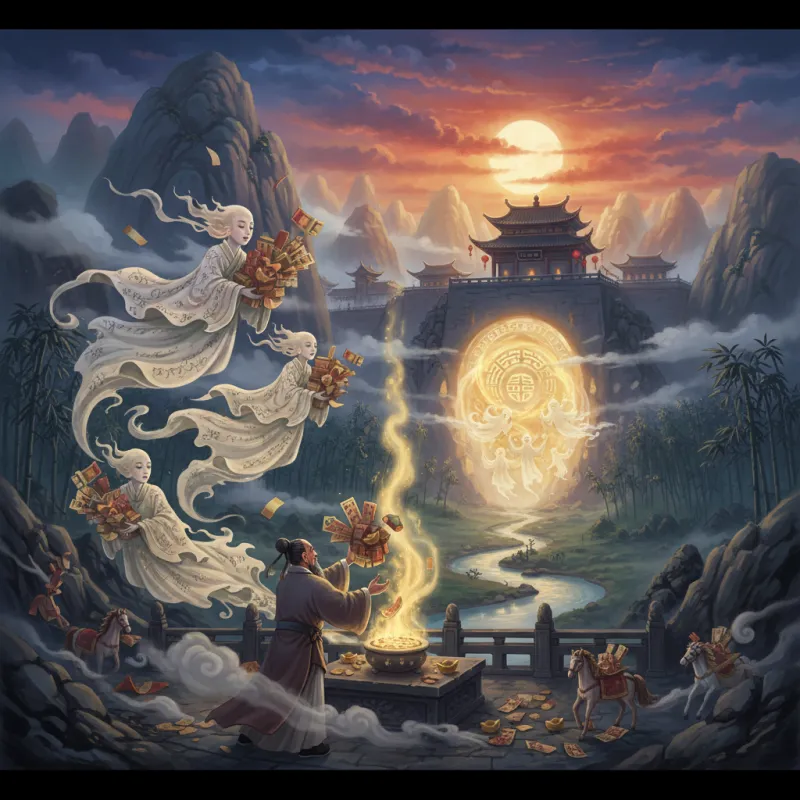
The old woman's hands move with practiced precision, folding golden joss paper into the shape of an ingot. Around her, stacks of hell banknotes—denominations reaching into the billions—wait to be burned. "My husband always complained he never had enough money," she says with a slight smile. "Now I make sure he's the richest man in the underworld." She strikes a match, and the paper fortune goes up in flames, transforming into ethereal wealth that will, according to centuries of belief, materialize in the realm of the dead.
This is the logic of paper offerings (纸钱, zhǐqián)—a practice that treats the afterlife as a mirror economy, one that runs on burned currency and incinerated goods. What began as simple paper money during the Tang Dynasty (618-907 CE) has evolved into an entire industry of afterlife commerce, where you can now purchase paper smartphones, luxury cars, and even mistresses for the deceased. It's capitalism extended beyond death, and it reveals something profound about how Chinese culture conceptualizes the relationship between this world and the next.
The Economics of the Underworld
The Chinese afterlife isn't a place of eternal rest—it's a bureaucracy. The Ten Courts of Hell, as described in texts like the Jade Record (玉历, Yù Lì) and popularized in novels such as Journey to the West, operate like an imperial administration. There are judges, clerks, guards, and endless paperwork. And like any bureaucracy, it runs on money.
Hell money (冥币, míng bì) addresses this practical concern. The earliest versions, appearing during the Tang Dynasty, were simple paper squares stamped with official-looking seals. By the Song Dynasty (960-1279 CE), these had evolved into more elaborate designs mimicking real currency. The logic was straightforward: if the dead needed to navigate an administrative afterlife, they needed funds to pay officials, bribe guards, and purchase necessities.
But the system reveals an interesting theological assumption—the afterlife operates on scarcity. Unlike Western concepts of heaven as a place of infinite abundance, the Chinese underworld requires resources. Your ancestors can go hungry, lack shelter, or suffer poverty unless the living provide for them. This creates an ongoing obligation, a perpetual economic relationship between generations that doesn't end with death.
The practice connects directly to ancestor worship traditions, where maintaining the comfort and status of the deceased ensures their benevolence toward living descendants. A well-funded ancestor is a happy ancestor, and happy ancestors bring fortune rather than misfortune to their families.
From Currency to Commodities
Walk through any Chinese funeral supply shop today, and you'll find an afterlife department store. Paper offerings have expanded far beyond simple money. There are paper houses (complete with furniture), paper servants, paper cars (Mercedes and BMWs are popular), paper electronics, and even paper credit cards. During the Qingming Festival (清明节, Qīngmíng Jié) and Ghost Month, these items are burned by the millions.
This expansion reflects changing values in the living world. In the 1980s, as China began its economic reforms, paper televisions and refrigerators appeared. By the 2000s, paper laptops and mobile phones became common. Now you can buy paper iPads and paper designer handbags. The afterlife, it seems, must keep pace with modern consumer culture.
Some offerings border on the absurd. Paper mistresses and concubines—complete with provocative poses—are sold for deceased men, raising eyebrows and ethical questions. Paper Viagra has been spotted in some shops. These items reveal the earthly, even crude, assumptions about afterlife needs. The dead, apparently, retain all their living desires.
But there's a darker side to this material abundance. The practice of burning elaborate offerings has created environmental concerns—the smoke pollution during major festivals can be severe. Some cities have banned outdoor burning, leading to designated burning facilities or even electronic alternatives where you can "burn" offerings virtually. The tradition is adapting, sometimes awkwardly, to modern environmental consciousness.
The Ritual Mechanics
Burning is the crucial transformation. The act of combustion doesn't destroy the offering—it transmutes it from the material realm to the spiritual realm. Fire serves as a portal, a method of transmission between worlds. This is why the offerings must be completely consumed by flames; partially burned items haven't fully transferred.
The timing matters too. Offerings are burned during specific occasions: funerals, Qingming Festival (the tomb-sweeping day in early April), the Hungry Ghost Festival (中元节, Zhōngyuán Jié) during the seventh lunar month, and death anniversaries. Each occasion has its own protocols. During Ghost Month, offerings aren't just for ancestors—they're for all wandering spirits, a kind of charitable distribution to prevent hungry ghosts from causing trouble.
The burning itself follows certain rules. You must call out the name of the intended recipient, essentially "addressing" the spiritual package. Some families write the deceased's name on the offerings. Without this specification, the goods might go astray, claimed by other spirits or lost in the afterlife's bureaucratic shuffle. It's like mailing a package without an address—it won't reach its destination.
Interestingly, the practice intersects with ghost month traditions, where offerings serve both familial and protective purposes. Feeding your ancestors keeps them strong and benevolent, while feeding wandering ghosts keeps them pacified and less likely to cause mischief.
Regional Variations and Innovations
Not all Chinese communities practice paper offerings identically. In Taiwan, the tradition is particularly robust, with elaborate paper houses sometimes reaching several feet tall. These structures include multiple floors, balconies, and detailed interior furnishings. The craftsmanship is impressive—some are genuine works of folk art.
In Hong Kong, the practice has become more commercialized but remains widespread. Shops sell pre-packaged offering sets for different budgets, from basic money bundles to luxury packages including paper yachts and vacation homes. The city's space constraints mean most burning happens at designated facilities rather than at gravesites.
Overseas Chinese communities have adapted the practice to local contexts. In Southeast Asia, particularly Singapore and Malaysia, paper offerings blend with local customs. In Western countries, Chinese families often face restrictions on outdoor burning, leading to creative solutions like burning in metal drums or using temple facilities.
The most fascinating innovation might be the digital offerings. Several companies now offer apps and websites where you can purchase virtual offerings—digital money, goods, and services—that are "transmitted" to the afterlife through online burning ceremonies. Scan a QR code, make a payment, and the system performs a virtual incineration. It's unclear what the theological implications are, but it represents the tradition's remarkable adaptability.
Theological Debates and Skepticism
Not everyone accepts the practice uncritically. Buddhist purists argue that paper offerings reflect materialistic thinking incompatible with Buddhist teachings about non-attachment. If the goal is to escape the cycle of rebirth, why perpetuate material desires in the afterlife? Some Buddhist monks refuse to participate in paper offering rituals, viewing them as folk superstition rather than genuine dharma.
Confucian scholars have historically been ambivalent. While Confucius emphasized ancestor veneration, he was famously reticent about supernatural matters. "Respect the spirits but keep them at a distance," he advised. The elaborate material provisions for the dead might seem excessive from a Confucian perspective that values sincerity over spectacle.
Modern skeptics point out the obvious: there's no evidence the dead receive these offerings. The practice persists not because of proof but because of tradition, social pressure, and the comfort it provides the living. Burning offerings is perhaps more about the living processing grief and maintaining connection than about actually provisioning the dead.
Yet the practice endures precisely because it serves psychological and social functions. It provides a concrete way to express love and obligation. It creates community through shared ritual. It offers comfort in the face of death's finality. Whether the dead actually receive paper iPhones is almost beside the point—the living need to send them.
The Practice in Contemporary China
Under Communist rule, paper offerings were initially suppressed as feudal superstition. During the Cultural Revolution (1966-1976), the practice was actively persecuted. Shops were closed, offerings were confiscated, and practitioners were criticized. The tradition survived in rural areas and overseas communities, waiting for political winds to shift.
Since the 1980s, paper offerings have made a remarkable comeback. The government's relaxation of religious restrictions, combined with economic prosperity, has fueled a resurgence. The industry is now worth billions of yuan annually. Major cities have dedicated funeral supply districts where dozens of shops compete for customers.
This revival reflects broader trends in Chinese society—a return to traditional practices after decades of suppression, a search for meaning in rapid modernization, and the use of consumption to express identity and values. Burning paper offerings has become a way to assert cultural identity, to maintain connection with the past, and to navigate the uncomfortable reality of death in a society that often avoids discussing it.
The practice also reveals persistent beliefs about the supernatural despite official atheism. Surveys suggest that a significant percentage of Chinese people, even Communist Party members, engage in some form of ancestor veneration or spirit appeasement. The offerings are a visible manifestation of this underground spiritual life, a reminder that official ideology doesn't always match private belief.
The Future of Paper Offerings
Where does this tradition go from here? Environmental concerns are forcing adaptations—some cities now require offerings to be burned at designated facilities with pollution controls. Digital alternatives are growing, though they haven't replaced physical burning. Younger generations show mixed attitudes: some embrace the tradition as cultural heritage, others view it as outdated superstition.
The offerings themselves will likely continue evolving to reflect contemporary life. Paper cryptocurrency? Paper AI assistants? Paper space tourism packages? If the pattern holds, whatever becomes valuable in the living world will eventually appear in paper form for the dead.
What seems certain is that the core impulse—the desire to care for the dead, to maintain connection across the boundary of death—will persist. The form may change, but the fundamental human need to believe that death isn't absolute severance, that we can still provide for those we've lost, remains powerful.
The old woman finishes burning her offerings, watching the last scraps of paper curl into ash. The smoke rises, carrying her husband's fortune upward. Whether it reaches him or not, she's fulfilled her obligation. In that moment, the boundary between living and dead feels permeable, and love finds a way to cross it, even if only through fire and smoke and ancient belief.
Related Reading
- Taoist Exorcism: Methods of Spirit Removal
- Unveiling the Mysteries of Chinese Supernatural Folklore: Ghosts and Afterlife Beliefs
- Daoist Exorcism: How Chinese Priests Fight Supernatural Evil
- Yin Feng Shui: The Art of Placing Graves for Good Fortune
- How to Make Offerings to Ancestors: A Practical Guide
- Ghosts of the Beijing Subway: Urban Legends Underground
- Unveiling the Secrets of Chinese Supernatural Folklore and Afterlife Beliefs
- Exploring Chinese Supernatural Folklore: Ghosts, Spirits, and Afterlife Beliefs
Explore Chinese Culture
- Explore ancient mythical creatures
- Explore Daoist exorcism traditions
- Explore Chinese folk beliefs and superstitions