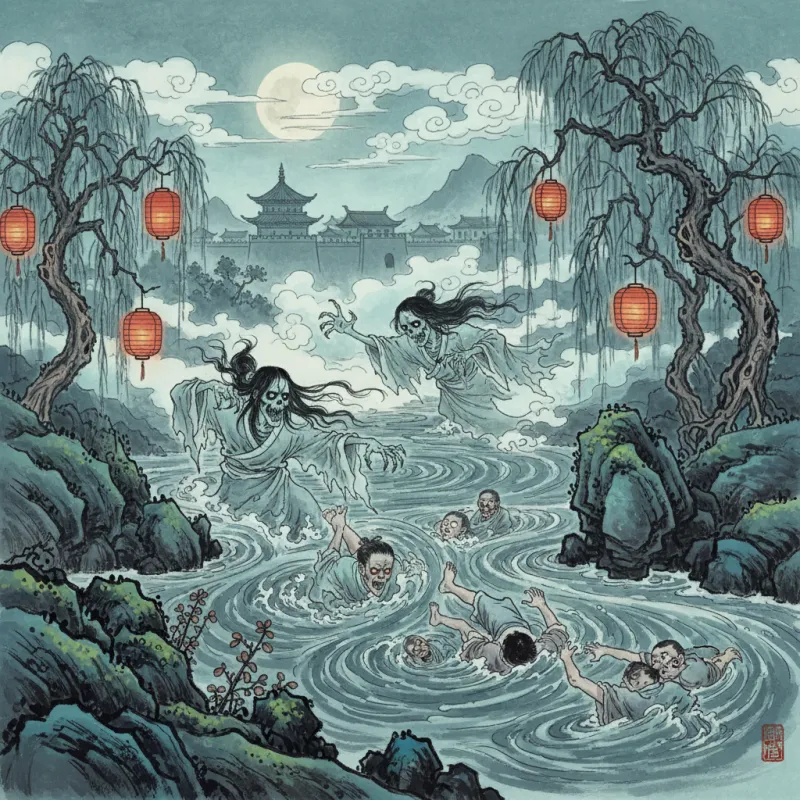
The village children knew better than to swim in the old pond after sunset. Not because their parents forbade it—though they did—but because of what happened to Liu Wei three summers ago. They found his body floating face-down at dawn, his fingers still clutching at nothing, his face frozen in a silent scream. The coroner said drowning. The villagers knew better. They whispered about the pale hand that had grabbed his ankle, the cold grip that wouldn't let go until it had what it wanted: a replacement.
The Curse of the Drowned
Water ghosts, or 水鬼 (shuǐ guǐ), operate on a brutal logic that's been terrifying Chinese communities for millennia. These aren't your garden-variety hungry ghosts wandering the streets looking for offerings. Water ghosts are bound to the exact spot where they drowned, trapped in an aquatic purgatory until they can lure someone else to take their place. Only then can they reincarnate and escape their watery prison.
The mechanics are grimly specific. A water ghost must drown a substitute—called a 替身 (tìshēn) or "replacement body"—before they can move on. This creates a perpetual cycle of death, each drowning victim becoming the next predator. It's supernatural musical chairs where losing means an eternity of cold, dark water pressing against your lungs.
What makes this particularly insidious is that water ghosts retain a twisted form of intelligence. They don't just wait passively for victims. They hunt.
How Water Ghosts Kill
The classical texts describe their methods with unsettling detail. The Taiping Guangji (太平廣記), that massive Song Dynasty collection of supernatural tales, catalogs dozens of water ghost encounters. The most common technique? They appear as drowning victims themselves, thrashing and crying for help. When a good Samaritan jumps in to rescue them, the ghost drags them under with supernatural strength.
Other water ghosts are more subtle. They might manifest as beautiful women bathing at the water's edge, or as valuable objects floating just out of reach—a jade bracelet, a silk purse, a child's toy. The moment you wade in to retrieve it, they strike. Some accounts describe them creating illusions of shallow water where deep pools actually exist, or making solid ground appear where there's only mud that will swallow you whole.
The 17th-century scholar Ji Yun documented a particularly chilling case in his Yuewei Caotang Biji (閱微草堂筆記). A water ghost in Hebei Province would appear as the victim's own reflection, but slightly off—maybe the reflection smiled when the person didn't, or moved a fraction of a second too late. Those who stared too long at their distorted reflection would feel an irresistible compulsion to enter the water, walking in as if in a trance until the water closed over their heads.
The Appearance of Shui Gui
Forget the Hollywood version of waterlogged corpses. Traditional descriptions of water ghosts are far more disturbing because they're so mundane. Most of the time, they look exactly like ordinary people—until you notice the details.
Their skin has a faint greenish tint, like algae growing just beneath the surface. Their hair is perpetually wet, dripping even on the hottest days, leaving no puddles. Their clothes never dry. Some accounts mention that they cast no shadow, or that their shadow moves independently, always pointing toward the water regardless of where the sun is.
The Liaozhai Zhiyi (聊齋誌異), Pu Songling's masterwork of strange tales from the Qing Dynasty, describes water ghosts as having eyes that reflect light like a fish's—a flat, dead gleam that doesn't quite look human. Their body temperature is noticeably cold to the touch, and they smell of river mud and decay, though they try to mask it.
But here's what really sets them apart: water ghosts cannot fully leave the water. They might venture onto the shore, but they must return before dawn, and they can never travel beyond sight of their drowning place. They're prisoners with a very long leash.
Regional Variations and Specific Types
Not all water ghosts are created equal. The Yangtze River ghosts are said to be particularly aggressive, perhaps because of the river's historical death toll. Coastal water ghosts, those who drowned in the sea, are considered more powerful but also more rare—the ocean is too vast for them to effectively hunt for replacements.
In southern China, particularly around the Pearl River Delta, there are stories of 水猴子 (shuǐ hóuzi) or "water monkeys"—a variant that appears as a child-sized creature with greenish fur and webbed hands. These are believed to be the spirits of children who drowned, and they specifically target other children, perhaps seeking playmates in their lonely existence.
The lakes of Yunnan Province have their own subspecies: water ghosts that can possess fish, using them as vessels to scout for victims. Fishermen in the region still perform rituals before casting their nets, and they never eat the first fish caught in a new location—it might be a ghost in disguise.
Northern water ghosts, particularly those in the Yellow River, are associated with the river's frequent floods and course changes. These ghosts are said to travel with the floodwaters, which explains why flood disasters often see a spike in drowning deaths even in areas that weren't previously dangerous. The water brings its ghosts with it.
Protection and Exorcism
The good news—if there is any—is that water ghosts have weaknesses. They're bound by specific rules, and knowing these rules can save your life.
First, they cannot cross running water that isn't their own. A water ghost from a pond cannot follow you across a stream. This is why traditional Chinese villages often built homes with small channels of flowing water around them—a supernatural moat.
Second, they're vulnerable to certain materials. Peach wood, that all-purpose demon repellent, works on water ghosts too. Fishermen would carve peach wood charms and attach them to their boats. Glutinous rice, scattered on the water's surface, is said to confuse and repel them—the rice grains supposedly resemble maggots to the ghost's distorted vision, reminding them of their own decay.
The most effective protection, according to Daoist exorcism practices, is a talisman written in cinnabar ink by a trained priest. These 符 (fú) specifically ward against water spirits and must be renewed annually, preferably during the Ghost Festival in the seventh lunar month.
But what if someone has already been grabbed by a water ghost? The old texts are clear: you have about three breaths to save them. After that, the ghost's grip becomes supernaturally strong, and pulling the victim out becomes nearly impossible. Some accounts suggest that throwing a handful of black dog's blood into the water will force the ghost to release its grip—the blood of a black dog being particularly yang in nature, anathema to yin water spirits.
Professional exorcists can permanently dispel a water ghost, but it requires finding the ghost's original body and giving it a proper burial. Without a body to anchor it, the spirit dissipates. This is why some communities would drag rivers and lakes after drownings, not just to recover the deceased for the family's sake, but to prevent the creation of another water ghost.
The Psychology Behind the Legend
Strip away the supernatural elements, and water ghosts make perfect sense as a cultural adaptation. China's landscape is defined by water—rivers, lakes, canals, rice paddies. Drowning has been a leading cause of death for millennia, particularly among children and farmers.
The water ghost legend serves as a powerful deterrent. Tell a child that a ghost will grab their ankle, and they'll think twice before swimming in dangerous waters. The specific detail that the ghost needs a replacement creates a sense of active malevolence—the water isn't just dangerous, it's hunting you.
There's also a psychological truth embedded in the mythology. Drowning victims often do pull their rescuers under, not out of malice but from panic. The water ghost legend codifies this danger into a memorable narrative. It's easier to remember "don't try to save a drowning person without proper training because water ghosts pull you under" than to remember the actual mechanics of drowning rescue.
The requirement that water ghosts find a replacement before they can reincarnate reflects Buddhist and Daoist beliefs about karma and the cycle of rebirth. It suggests that violent or untimely death creates spiritual debt that must be resolved. The victim becomes victimizer, perpetuating suffering—a neat metaphor for how trauma and violence cycle through communities.
Modern Encounters and Persistence
You might think water ghost beliefs died out with modernization, but you'd be wrong. Rural communities throughout China still take them seriously, and even urban Chinese people often know someone who knows someone who had an encounter.
In 2003, a series of drownings in a Guangdong Province reservoir sparked rumors of a water ghost. Local officials had to bring in a Daoist priest to perform cleansing rituals before people would use the reservoir again. Similar incidents pop up regularly in local news, usually framed as "superstitious beliefs" but reported nonetheless.
The internet age has given water ghosts new life. Chinese social media platforms like Weibo regularly feature threads about water ghost encounters, with users sharing family stories and debating the reality of the phenomenon. Some posts include grainy photos of alleged water ghosts—usually just pareidolia in rippling water, but unsettling nonetheless.
What's interesting is how the legend adapts. Modern water ghosts are said to lure victims by making their phones fall into the water, or by appearing in the background of selfies taken near water. The core mythology remains, but the details update for contemporary life.
Swimming pools present a particular problem for the modern water ghost believer. Can a water ghost exist in chlorinated water? Does the artificial nature of a pool prevent ghost formation? Online discussions suggest that most people believe pools are safe—the water is too controlled, too human-made. But natural bodies of water, even in urban parks, still carry risk.
The persistence of water ghost beliefs points to something deeper than mere superstition. They represent a healthy respect for water's dangers, wrapped in a narrative that's been refined over thousands of years. Whether you believe in literal water ghosts or see them as metaphor, the message is the same: respect the water, or it will take you under.
And on quiet nights, when the water is still and dark, it's hard not to wonder what might be looking back at you from beneath the surface, waiting for its chance at freedom.
Related Reading
- Chinese Ghost Stories for Beginners: Where to Start
- Lake Monsters and Sea Creatures in Chinese Folklore
- River Gods and Water Deities in Chinese Mythology
- Ghost Marriage: Wedding the Dead
- Exploring Chinese Supernatural Folklore: The Haunting World of Ghosts and Spirits
- Demons of Journey to the West: The Most Creative Monsters in Chinese Fiction
- Liaozhai Zhiyi: The Ghost Stories That Changed Chinese Literature
- The Enigmatic Spirit-Animals of Chinese Supernatural Folklore and Afterlife Beliefs
Explore Chinese Culture
- Explore ancient mythical creatures
- Explore Daoist exorcism traditions
- Explore Chinese folk beliefs and superstitions