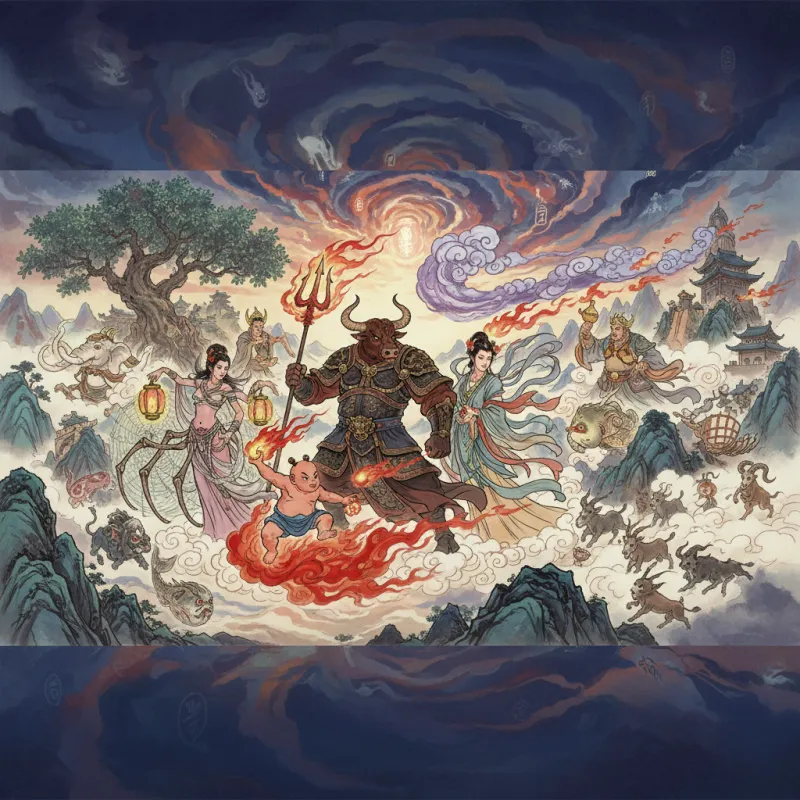
A six-eared macaque who can perfectly impersonate Sun Wukong. A scorpion spirit whose tail sting once made the Buddha himself cry out in pain. A goldfish who escaped from an ornamental pond and became a river-drowning king. If you think Western fantasy has creative monsters, you haven't read Journey to the West (西游记, Xīyóu Jì). Wu Cheng'en's 16th-century masterpiece doesn't just catalog demons — it throws a carnival of the cosmically weird, the tragically flawed, and the hilariously petty across 81 trials that feel less like a religious pilgrimage and more like a supernatural obstacle course designed by someone with an inexhaustible imagination and a dark sense of humor.
The Demon Hierarchy Nobody Asked For
What sets Journey to the West apart from other demon literature is its refusal to follow rules. Chinese folklore typically organizes supernatural beings into neat categories — fox spirits seduce scholars, hungry ghosts haunt the living, celestial beings maintain cosmic order. Wu Cheng'en looked at this system and said "interesting, but what if a goldfish became a king?" The result is a rogues' gallery that includes:
Cultivated animals who've practiced Daoist techniques for centuries until they gained human form and supernatural powers. The White Bone Demon (白骨精, Báigǔ Jīng) transforms three times to deceive Tang Sanzang. The Spider Sisters spin webs that can trap even Sun Wukong. These aren't mindless monsters — they're practitioners who've put in the work, sometimes for thousands of years.
Escaped celestial pets and servants who've gone rogue. The Golden and Silver Horned Kings? They're the boys of Laozi, the founder of Daoism himself. The Nine-Headed Bug served in the celestial bureaucracy before deciding the mortal realm offered better opportunities. It's like if angels kept quitting heaven to become crime lords, and God just sighed and sent someone to deal with it eventually.
Cosmic entities who predate the current world order. The Yellow-Robed Demon was actually a celestial constellation banished for an affair. The Peng Demon King is literally the Buddha's uncle — a golden-winged Garuda of such power that even the Jade Emperor treats him with respect. These aren't creatures you can simply beat into submission; they require diplomatic solutions or calling in favors from the highest levels of heaven.
When Demons Have Better Character Development Than Heroes
Here's what makes Journey to the West genuinely subversive: many demons are more interesting than the pilgrims they're fighting. Take the Red Boy (红孩儿, Hóng Hái'ér), son of the Bull Demon King. He's not evil because he's a demon — he's a spoiled child with godlike powers who's never been told "no." His samadhi fire can burn anything, but his real weapon is his tantrum-throwing entitlement. When Guanyin finally subdues him, it's not a victory of good over evil; it's a cosmic intervention in a parenting failure.
Or consider Princess Iron Fan (铁扇公主, Tiěshàn Gōngzhǔ), who owns a magical fan that can extinguish the Flaming Mountains. She's not blocking the pilgrims because she's evil — she's furious that Sun Wukong got her son Red Boy taken away. Her motivation is maternal rage, and honestly? She has a point. Sun Wukong did get her child forcibly recruited into Guanyin's service. The novel doesn't shy away from this moral complexity; it leans into it.
The Six-Eared Macaque might be the most philosophically disturbing demon in the entire novel. He's identical to Sun Wukong in every way — same powers, same appearance, same memories. When they fight, even the gods can't tell them apart. The Buddha has to intervene to identify the real Wukong, and his solution is to simply eliminate the imposter. But the text leaves us wondering: what if they killed the wrong monkey? What makes one "real" and the other "false" when they're functionally identical? It's an identity crisis wrapped in a kung-fu battle.
The Bureaucracy of Evil
One of the novel's most satirical elements is how many demons are essentially middle managers in supernatural organizations. The Yellow Wind Demon (黄风怪, Huángfēng Guài) was a rat who stole oil from a temple lamp and gained powers. He's not trying to destroy the world — he's carved out a small mountain kingdom where he can be in charge for once. His ambitions are almost touchingly modest.
This reflects Wu Cheng'en's critique of Ming Dynasty bureaucracy, where officials often abused their positions for personal gain. The demons who are former celestial servants mirror corrupt officials who use their government positions to enrich themselves. When Sun Wukong defeats them, they're often just sent back to heaven with a slap on the wrist. The message is clear: the system protects its own, even when they're literally demonic.
The novel's most powerful demons often have 后台 (hòutái, backing) — connections to important celestial figures who protect them from real consequences. The Golden Horned and Silver Horned Kings can terrorize mortals because they belong to Laozi. The Nine-Headed Bug married into a dragon king's family, giving him political protection. It's not enough to be strong in this universe; you need guanxi (connections) even in the supernatural realm.
Monsters as Mirrors
The demons in Journey to the West often reflect the pilgrims' own flaws. The White Bone Demon exploits Tang Sanzang's compassion and naivety. The Spider Sisters prey on Zhu Bajie's lust. The Yellow-Robed Demon uses eloquent speech to deceive, mirroring how words can be weapons. Each demon is a test not just of martial prowess but of character.
Some demons are explicitly described as 心魔 (xīnmó, inner demons) — manifestations of the pilgrims' own psychological struggles. When Sun Wukong fights the Six-Eared Macaque, he's battling his own violent impulses and identity confusion. When Zhu Bajie faces temptation from beautiful spirits, he's confronting his inability to transcend his base nature. The journey west is as much about defeating external monsters as internal ones.
This psychological dimension elevates Journey to the West beyond simple adventure fiction. Wu Cheng'en understood that the scariest demons aren't the ones with the most magical powers — they're the ones that expose our weaknesses and force us to confront who we really are.
The Comedy of Cosmic Horror
What's remarkable is how the novel balances genuine horror with slapstick comedy. The same demon who eats human flesh might also be outwitted by Sun Wukong disguising himself as a pill or hiding inside someone's stomach. The Bull Demon King, a fearsome warrior, gets into an argument with his wife about their son that feels like any domestic dispute — except it's between two immortal beings who can level mountains.
This tonal flexibility is quintessentially Chinese. Unlike Western traditions that often separate horror from comedy, Journey to the West understands they're two sides of the same coin. The universe is vast, ancient, and full of beings who can erase you from existence — but they're also petty, foolish, and prone to the same mistakes as mortals. It's cosmic horror with a laugh track.
The demons' deaths are often anticlimactic in ways that feel intentional. After chapters of buildup, a powerful demon might be defeated because Sun Wukong called in a favor from a celestial being who just... takes their pet back. No epic final battle, no dramatic sacrifice — just "oh, that's where my goldfish went." It deflates the tension in a way that's both frustrating and hilarious, reminding us that from heaven's perspective, these earth-shaking conflicts are minor administrative issues.
Why These Demons Still Matter
Journey to the West's demons have influenced Chinese popular culture for over 400 years. Every modern Chinese fantasy — from films to video games to web novels — draws from Wu Cheng'en's monster manual. The idea that demons can be sympathetic, that they have complex motivations, that they're not purely evil but products of circumstance and choice — this was revolutionary for its time and remains compelling today.
These aren't the demons of Christian tradition, purely evil beings to be destroyed. They're not the yaoguai of earlier Chinese folklore, simple spirits to be appeased or exorcised. They're individuals with histories, relationships, ambitions, and flaws. Some deserve their fate; others are tragic figures caught in circumstances beyond their control. A few are just trying to make a living in a universe where the powerful prey on the weak.
The novel suggests that the line between demon and deity is thinner than we'd like to believe. Many celestial beings were once demons who reformed or gained enough power to be legitimized. Many demons are fallen celestial beings who made mistakes. The difference isn't always moral — sometimes it's just political. In Wu Cheng'en's universe, heaven and hell aren't opposites; they're different departments in the same cosmic bureaucracy, and transfers happen more often than you'd think.
Related Reading
- Chinese Demons: A Taxonomy of Evil in Chinese Mythology
- Unveiling the Shadows: A Journey Through Chinese Supernatural Folklore of Ghosts and Spirits
- Daoist Exorcism: The Art of Banishing Spirits in Chinese Culture
- Jiangshi: The Hopping Vampires of Chinese Horror
- Yaoguai: A Classification of Chinese Monsters
- Exploring Chinese Supernatural Folklore: The Haunting World of Ghosts and Spirits
- Qingming Festival: When China Visits Its Dead
- How to Avoid Punishment in Chinese Hell: Loopholes, Bribes, and Good Behavior
Explore Chinese Culture
- Explore ancient mythical creatures
- Explore Daoist exorcism traditions
- Explore Chinese folk beliefs and superstitions