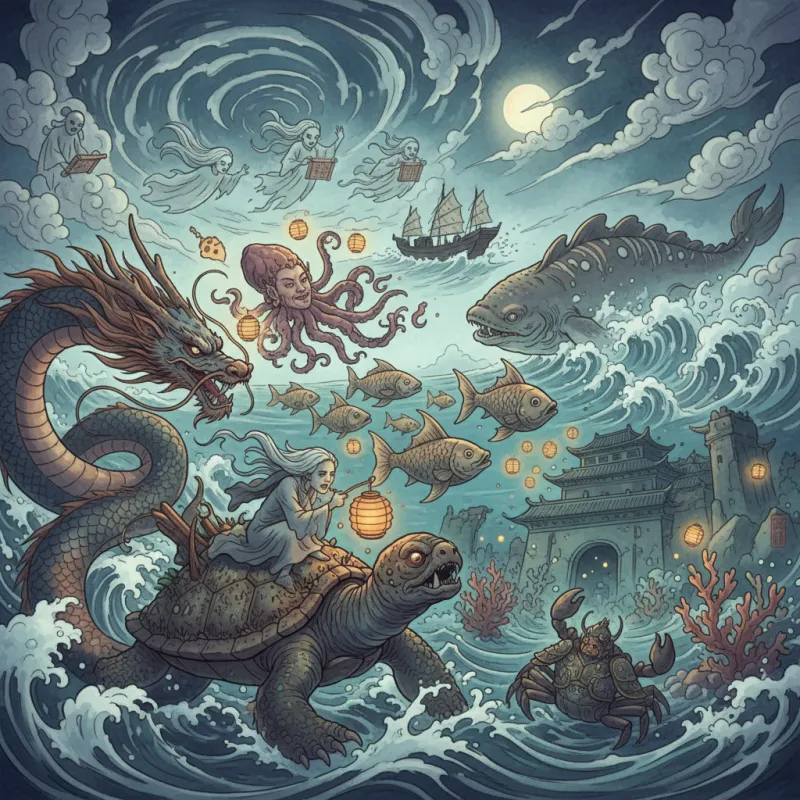
The fishermen of Tianchi Lake tell a story that makes cryptozoologists nervous: in 1962, a group of workers spotted something massive breaking the surface of the volcanic crater lake, its body dark and serpentine, moving with deliberate purpose through water that shouldn't support anything larger than a trout. What unsettles researchers isn't the sighting itself — it's that local villagers weren't surprised. They'd been leaving offerings at the water's edge for generations, not to an undiscovered species, but to something they called 水怪 (shuǐguài, water monster), a term that sits uncomfortably between zoology and demonology.
The Cosmological Problem with Chinese Lake Monsters
Western cryptozoology operates on a simple premise: unknown animals exist, we just haven't catalogued them yet. Chinese water monster traditions reject this framework entirely. When the 山海经 (Shānhǎi Jīng, Classic of Mountains and Seas) describes the 鱼妇 (yúfù, fish woman) — a creature with a human face and fish body that makes sounds like a mandarin duck — it's not documenting wildlife. It's mapping the supernatural geography of the world, placing entities that exist in the liminal space between animal, spirit, and demon.
This creates a classification nightmare. The 蛟 (jiāo), often translated as "flood dragon," appears in texts from the Han Dynasty onward as both a physical creature that capsizes boats and a spiritual entity that can transform into human form. The 鼋 (yuán), a massive turtle-like being recorded in the Yangtze River, is simultaneously described as having a shell "large enough to serve as a boat" and possessing the ability to understand human speech and hold grudges across decades. Are these animals with supernatural properties, or spirits that manifest in animal form? Chinese tradition doesn't particularly care about the distinction.
Tianchi: China's Most Documented Water Anomaly
Tianchi (天池, Heavenly Lake), the volcanic crater lake straddling the China-North Korea border, has generated more documented sightings than any other Chinese body of water. The modern record begins in 1903, when a local official reported seeing "a creature with a buffalo-sized head" surface near the center of the lake. But the sightings that captured national attention came in the 1970s and 80s, when multiple groups — including forestry workers, tourists, and a team of scientists — reported observing large, dark shapes moving through the water.
The 1980 incident involved six witnesses who watched a creature for forty minutes through binoculars. Their descriptions were consistent: dark coloration, approximately six meters long, moving with vertical undulations rather than horizontal (suggesting a mammalian rather than reptilian locomotion). Photographs were taken, though predictably inconclusive — dark shapes on dark water, the eternal frustration of cryptozoology.
What makes Tianchi particularly interesting is its isolation. The lake sits at 2,189 meters elevation, formed by a volcanic eruption in 946 CE. It's frozen seven months of the year, with water temperatures that rarely exceed 10°C even in summer. The lake has no surface connection to other water systems. If something large lives there, it either survived the volcanic formation (unlikely), was introduced by humans (possible but unrecorded), or isn't bound by conventional biological constraints (the local explanation).
The Yanbian Korean Autonomous Prefecture government, which administers the Chinese side of the lake, has taken an ambiguous position. They don't officially endorse the monster's existence, but they don't discourage tourism driven by it either. A research station was established in the 1980s, though its findings have never been conclusive. The North Korean side maintains silence, which tells you nothing — they maintain silence about everything.
The Yangtze's Forgotten Leviathans
Before the Three Gorges Dam transformed the Yangtze into a managed waterway, the river system supported a mythology of aquatic giants that made Tianchi's creature look modest. The 鼍 (tuó), often called the Chinese alligator but described in classical texts as reaching lengths of three to four meters, was said to produce a sound like thunder that could be heard for miles. The 白鱀豚 (báijìtún, baiji dolphin) — now functionally extinct — was considered a reincarnation of a princess who drowned herself rather than marry against her will, blurring the line between animal and vengeful ghost.
But the most persistent Yangtze legend involves the 江豚 (jiāngtún, finless porpoise) and its alleged larger relative, sometimes called 江猪 (jiāngzhū, river pig). Fishermen from Wuhan to Shanghai have reported encounters with something significantly larger than the known porpoise species — estimates range from three to six meters — with a more aggressive temperament. These accounts increased during the 1950s and 60s, when industrial development along the river was accelerating, leading some researchers to speculate that habitat disruption was forcing deeper-dwelling creatures into shallower waters.
The problem with Yangtze monster accounts is separating folklore from observation. The river has been central to Chinese civilization for millennia, accumulating layers of supernatural attribution that make objective analysis nearly impossible. When a fisherman reports seeing a "river pig" capsize his boat, is he describing an encounter with an unknown species, a misidentified known animal, or invoking traditional language to explain an accident? The answer often depends on who's asking and why.
Kanas Lake and the Ethnic Dimension
Kanas Lake (喀纳斯湖) in Xinjiang presents a different dynamic. The lake sits in Kazakh and Mongol territory, and the monster tradition — locally called 湖怪 (húguài, lake monster) — predates Han Chinese documentation. Kazakh herders have stories of horses and cattle being dragged into the water by something large enough to create significant disturbance. When Han researchers arrived in the 1980s to investigate, they were documenting a tradition that had existed independently of Chinese textual culture.
The scientific explanation offered for Kanas sightings is Hucho taimen, a species of giant salmon that can reach two meters in length and weigh over 100 kilograms. Schools of these fish, moving together, could create the impression of a single large creature. This explanation satisfies no one — it's too prosaic for believers, too speculative for skeptics, and ignores the cultural context entirely.
What's notable about Kanas is how the monster tradition has been commercialized. The local tourism bureau actively promotes the lake monster, complete with a research center and annual "monster watching" events. This has created a feedback loop where economic incentives encourage sightings, which in turn generate more tourism revenue. It's cryptozoology as economic development strategy, and it's remarkably effective.
The Dragon King Problem
Any discussion of Chinese water monsters must address the 龙王 (lóngwáng, dragon king) tradition, which complicates everything. Dragon kings are not cryptids — they're established figures in Chinese religious and literary tradition, governing bodies of water and controlling weather. But the line between dragon king mythology and water monster sightings is porous.
When villagers near Qinghai Lake report seeing a "dragon" in the water, are they describing an unknown animal or invoking the dragon king framework to interpret an anomalous experience? The language itself creates ambiguity. 龙 (lóng, dragon) can refer to the mythological creature, a metaphorical description of something serpentine, or a respectful term for any powerful water-dwelling entity. Context determines meaning, and context is often lost in translation.
This linguistic flexibility means that historical accounts of water monsters are nearly impossible to evaluate objectively. When the 太平广记 (Tàipíng Guǎngjì, Extensive Records of the Taiping Era), compiled in 978 CE, describes a "dragon" emerging from a well in Sichuan and causing floods, is this a water monster sighting, a dragon king manifestation, or a metaphorical description of a natural disaster? The text doesn't distinguish because the categories weren't separate in the compiler's worldview.
Modern Sightings and Smartphone Skepticism
The smartphone era has been unkind to cryptozoology globally, and Chinese water monsters are no exception. Despite millions of people carrying high-resolution cameras, the quality of monster evidence hasn't improved — it's arguably gotten worse, with obvious hoaxes and misidentified debris flooding social media. Douyin (Chinese TikTok) is full of "lake monster" videos that are clearly logs, waves, or deliberate fabrications.
But the smartphone era has also democratized documentation. In 2020, multiple tourists at Tianchi posted videos of something large moving through the water, creating enough disturbance to be visible from the shore. The videos are inconclusive — they always are — but the volume of simultaneous reports from unconnected sources is harder to dismiss than a single witness account.
The Chinese government's position on lake monsters remains strategically ambiguous. They don't officially endorse cryptozoology, but they don't actively suppress it either. Local governments promote monster tourism, while national scientific institutions maintain polite skepticism. It's a pragmatic approach: let the believers believe, let the skeptics doubt, and let the tourism revenue flow.
What the Water Hides
The persistence of Chinese water monster traditions, despite modernization and scientific skepticism, suggests something more complex than simple misidentification or hoaxing. These stories serve functions beyond explaining anomalous sightings — they maintain connections to pre-industrial relationships with water, preserve ethnic and regional identities, and provide frameworks for understanding the unknown that scientific materialism doesn't satisfy.
Whether Tianchi actually contains a large unidentified creature is, in some ways, beside the point. The tradition exists, it shapes behavior, it generates meaning. Fishermen still leave offerings at certain lakes, not because they've seen monsters, but because their grandfathers did, and their grandfathers' grandfathers before them. The water remains mysterious, dangerous, worthy of respect — qualities that don't disappear just because we've mapped the depths and catalogued the species.
The 山海经 understood something that modern cryptozoology often misses: the map is not the territory, and the catalogue is not the world. There are things in deep water that resist classification, not because they're undiscovered animals, but because they occupy spaces in human consciousness that taxonomy can't reach. Call them monsters, call them spirits, call them cultural constructs — the water keeps its secrets regardless.
Related Reading
- Chinese Ghosts: A Field Guide to the Dead Who Will Not Leave
- River Gods and Water Deities in Chinese Mythology
- Exploring Chinese Supernatural Folklore: Ghosts, Spirits, and Afterlife Beliefs
- The Drowning Ghost (水鬼): China's Most Feared Water Spirit
- Water Ghosts: The Spirits That Pull You Under
- Supernatural Animals in Chinese Culture: Not Just Foxes
- The Tongji: Spirit Mediums of Southeast Asia's Chinese Communities
- Campus Ghost Stories in China: The Haunted Dormitories and Cursed Libraries
Explore Chinese Culture
- Explore ancient mythical creatures
- Explore Daoist exorcism traditions
- Explore Chinese folk beliefs and superstitions