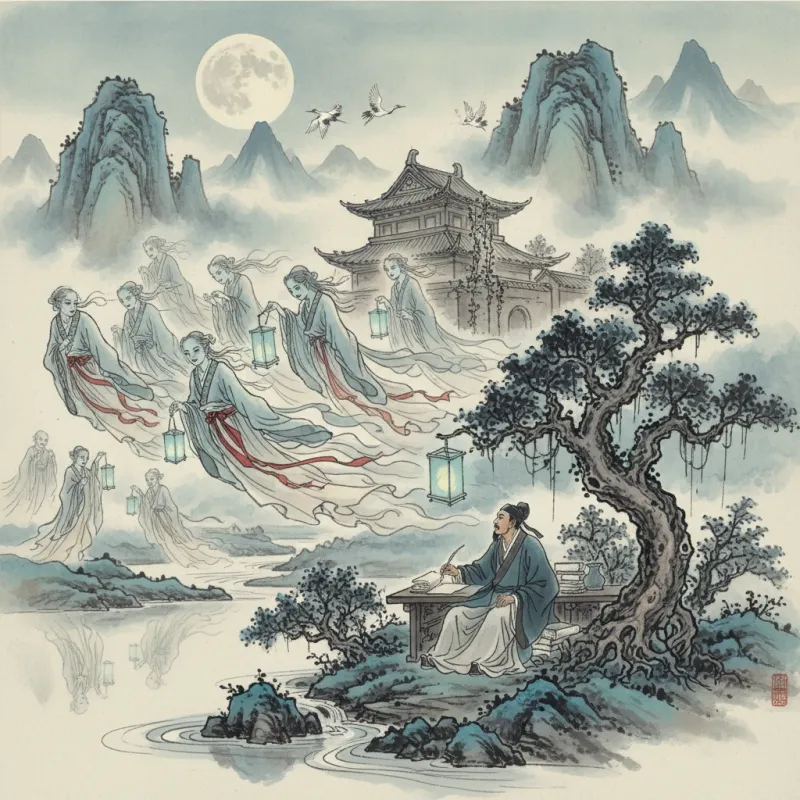
A scholar walks alone at night. He meets a beautiful woman by the roadside. She invites him to her home. They drink wine, recite poetry, make love. At dawn, he wakes in a graveyard, embracing a corpse. This is not a cautionary tale about lust—it's a love story. And that inversion, that refusal to moralize in the expected way, is what makes Liaozhai Zhiyi (聊斋志异, "Strange Tales from a Chinese Studio") the most subversive work in Chinese literature.
The Angry Genius Who Failed Everything
Pu Songling (蒲松龄, 1640-1715) took the imperial examination at age nineteen and passed the first level easily. Then he failed. And failed again. And kept failing for the next forty years. He died at seventy-five, still a provincial scholar, never achieving the government position that defined success in Qing Dynasty China. While his peers became magistrates and ministers, Pu Songling tutored other people's children and collected ghost stories.
This wasn't writer's romanticism—it was humiliation. The examination system was supposed to identify merit, to elevate the talented regardless of birth. Pu Songling had the talent. He had the education. What he didn't have was luck, connections, or the particular kind of formulaic brilliance that impressed examiners. So he spent four decades writing stories where the examination system is revealed as corrupt, where ghosts are more honorable than officials, and where fox spirits show more integrity than Confucian scholars.
The bitterness is the point. Liaozhai isn't escapist fantasy—it's a 500-story indictment of Qing society, wrapped in supernatural entertainment.
Why Ghosts and Fox Spirits?
Pu Songling couldn't directly criticize corrupt officials or the emperor. That would get him executed. But he could write about a ghost who exposes a crooked magistrate, or a fox spirit who reveals a scholar's hypocrisy. The supernatural provided cover for social criticism that would otherwise be impossible.
This tradition goes back centuries in Chinese literature. The Soushen Ji (搜神记, "In Search of the Supernatural") from the 4th century established the pattern: strange tales that comment on human society. But Pu Songling perfected it. His ghosts aren't just scary—they're morally superior to the living. His fox spirits (狐狸精, húlijīng) aren't evil seductresses—they're often the most loyal, honest characters in the story.
Take "Nie Xiaoqian" (聂小倩), one of the most famous tales. A ghost woman is forced by a demon to seduce and kill travelers. She falls in love with a scholar and warns him instead, risking her own destruction to save him. The real monster isn't the ghost—it's the demon who enslaves her, a clear metaphor for corrupt officials who force good people into evil acts. When you understand that Pu Songling saw himself as trapped in a corrupt system, the story reads differently.
The Fox Spirit as Feminist Icon
Here's what's radical: in Liaozhai, fox spirits are better wives than human women. They're educated, witty, sexually confident, and fiercely loyal. They choose their own husbands. They leave bad relationships. They're everything that actual Qing Dynasty women, bound by Confucian propriety and foot-binding, could never be.
"Ying Ning" (婴宁, "Infant Ning") features a fox spirit who laughs constantly—inappropriate, uncontrolled laughter that horrifies proper society. She's criticized for it, but she doesn't stop. Her laughter is freedom. It's a rejection of the suffocating decorum that governed women's lives. Pu Songling clearly admires her.
In "Xiao Xie" (小谢), a fox spirit wife helps her scholar husband pass the examination that Pu Songling himself could never pass. She's smarter than him, more capable, and when he succeeds, she quietly disappears—because society has no place for a woman that competent. The tragedy isn't supernatural; it's social.
This is why Liaozhai remained popular for three centuries. Women readers saw themselves in these fox spirits—intelligent, constrained, dreaming of autonomy. The supernatural wasn't fantasy; it was the only space where female agency could exist.
The Examination System's Body Count
At least fifty stories in Liaozhai directly address the imperial examination system, and none are flattering. Scholars go mad from study. They're driven to suicide by failure. They're corrupted by desperation. Examiners are bribed, incompetent, or both. The system that's supposed to identify merit instead destroys it.
In "Sima Lang" (司马郎), a scholar dies from examination stress, becomes a ghost, and continues taking the exam in the underworld—where he finally passes, because the ghost examiners are more fair than the living ones. It's darkly funny until you remember this is Pu Songling's autobiography, barely disguised.
"Ye Sheng" (叶生) is even more bitter. A brilliant scholar fails repeatedly, dies of grief, and his ghost takes the examination for a friend—who passes. The ghost's talent was real; the system's judgment was wrong. When the friend discovers the truth, he builds a shrine to honor the ghost. It's Pu Songling imagining the recognition he'll never receive in life.
These aren't just stories about examinations—they're about a society that claims to value merit but actually values conformity, connections, and luck. The supernatural elements let Pu Songling say what he couldn't say directly: the system is broken, and it's killing the people it claims to serve.
Literary Influence and Modern Adaptations
Liaozhai Zhiyi didn't just influence Chinese literature—it defined an entire genre. Every ghost story, every fox spirit tale, every supernatural romance in Chinese culture traces back to Pu Songling. Lu Xun (鲁迅), the father of modern Chinese literature, called Liaozhai "the pinnacle of classical Chinese fiction." That's not hyperbole.
The stories have been adapted countless times: operas, films, television series, comics, video games. "Nie Xiaoqian" alone has been filmed dozens of times, most famously as A Chinese Ghost Story (1987), which turned the tale into a wire-fu romance. Modern adaptations often miss the social criticism—they keep the romance and horror but lose the anger. That's a mistake. The anger is what makes Liaozhai matter.
Contemporary Chinese writers still use Pu Songling's technique: supernatural stories that comment on social problems. When you can't directly criticize the government, you write about ghosts. The tradition continues because the need continues. For more on how these tales influenced later Chinese supernatural fiction, see The Evolution of Chinese Ghost Stories.
Why These Stories Still Matter
Liaozhai Zhiyi endures because it's about more than ghosts. It's about what happens when society fails its talented people. It's about women trapped in impossible situations. It's about corruption disguised as merit. It's about the gap between what a culture claims to value and what it actually rewards.
Pu Songling died believing he was a failure. He never knew that his ghost stories would outlive every official who passed the examination he failed. His fox spirits would be more famous than any Qing Dynasty minister. His angry, beautiful, subversive tales would be read for centuries.
The scholar who meets a ghost by the roadside and falls in love—that's not a story about the supernatural. It's a story about finding genuine connection in a society built on false pretenses. The ghost is more real than the living world around her. That's the point. That's always been the point.
For readers interested in specific supernatural beings from these tales, explore Fox Spirits in Chinese Folklore or learn about Chinese Exorcism Traditions that developed alongside these stories.
Related Reading
- Pu Songling: The Failed Scholar Who Wrote China's Greatest Ghost Stories
- The Liaozhai Stories That Hollywood Should Adapt (But Probably Won't)
- What is Liaozhai Zhiyi? A Guide to China's Greatest Ghost Stories
- Nie Xiaoqian: The Ghost Romance That Conquered Cinema
- Painted Skin: The Most Terrifying Story in Chinese Literature
- Chinese Horror Novels and Web Fiction: A Reading Guide
- The Enigmatic Spirit-Animals of Chinese Supernatural Folklore and Afterlife Beliefs
- Chinese Ghost Beliefs: A Complete Guide to the Spirit World
Explore Chinese Culture
- Explore ancient mythical creatures
- Explore Daoist exorcism traditions
- Explore Chinese folk beliefs and superstitions