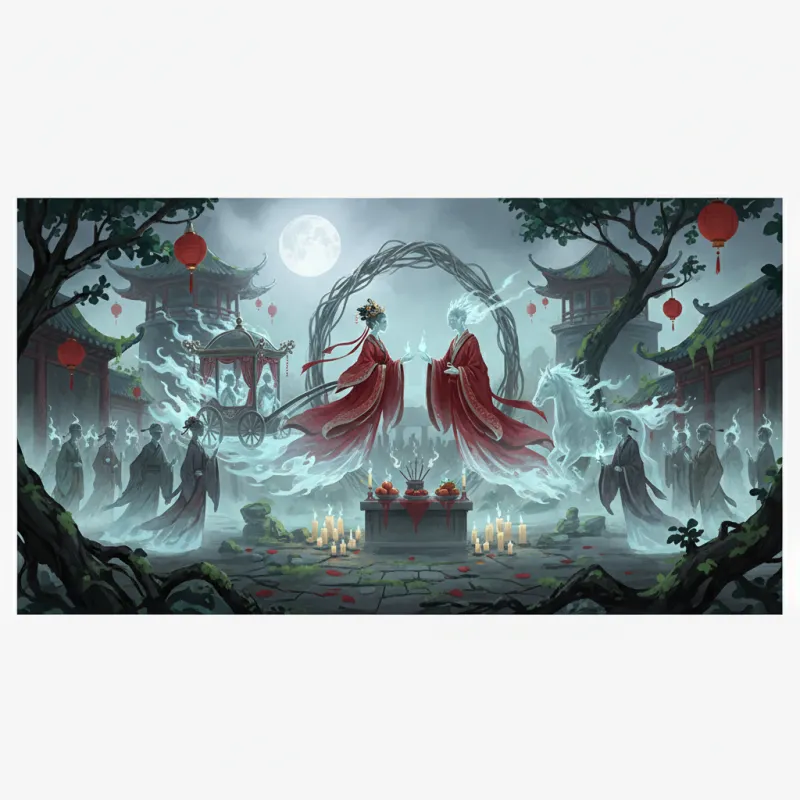
The corpse bride wore red silk, her face painted white as porcelain, lips rouged crimson. She sat propped in the wedding sedan chair, dead for three months but dressed as if she'd walk down the aisle tomorrow. Across from her, a living groom—or sometimes another corpse—waited to complete a ceremony that would bind them across the boundary between worlds. This is minghun (冥婚), "ghost marriage," and it's still happening in China today.
When the Dead Need Spouses
Ghost marriage isn't some dusty relic from China's imperial past. In 2016, police in Shaanxi Province busted a ring selling female corpses for up to 50,000 yuan each—bodies destined to become ghost brides. The demand was real, the prices were climbing, and families were willing to pay. Why? Because in Chinese cosmology, an unmarried death is an incomplete death, and incomplete deaths create restless, potentially vengeful spirits.
The logic runs deep. A person who dies unwed has no descendants to worship them, no place in the ancestral tablets, no one to burn offerings during Qingming Festival. They're stuck in liminal space—not quite family, not quite forgotten. Worse, unmarried female ghosts might become hungry ghosts or vengeful spirits who torment the living. The solution? Marry them off posthumously, give them the social completion they were denied in life, and everyone—living and dead—can rest easier.
The Han Dynasty Precedent
Ghost marriage traces back at least to the Han Dynasty (206 BCE – 220 CE), though it likely existed in some form even earlier. The Book of Han mentions cases where families arranged posthumous marriages to maintain proper ritual order. But the practice really crystallized during the Song Dynasty (960-1279 CE), when Neo-Confucian emphasis on family continuity and proper ritual made an unmarried death not just sad but cosmically problematic.
The wealthy practiced it most visibly. When a son or daughter of a prominent family died before marriage, the family's reputation demanded a proper wedding—even if the bride or groom was already in the ground. These weren't quiet affairs. Families hired matchmakers, exchanged betrothal gifts, held elaborate ceremonies complete with musicians and mourners. The Qing Dynasty scholar Yuan Mei documented cases in his Zi Bu Yu (子不语, "What the Master Would Not Discuss"), describing ghost weddings with all the pomp of living ones, except the bride never stood up.
The Mechanics of Marrying Ghosts
How do you arrange a marriage when one or both parties are dead? Very carefully, and with specific rituals that vary by region. In northern China, particularly Shanxi and Shaanxi provinces, families hire spirit matchmakers—specialists who know the protocols for negotiating between the living and dead.
First comes the match. Families consult fortune tellers to ensure the deceased's birth and death dates align favorably with the potential spouse. Sometimes both parties are dead—a double ghost marriage, joining two corpses in eternal union. Other times, a living person (usually male) marries a deceased woman, often to fulfill a deathbed promise or family obligation.
The ceremony itself mirrors a traditional wedding but inverted. Red becomes white, joy becomes solemnity. The deceased's spirit tablet or photograph takes the place of the living body. In some regions, families exhume the body, dress it in wedding clothes, and conduct the ceremony with the corpse present. The couple is then buried together, or their ashes are interred in the same tomb.
Paper offerings play a crucial role—paper houses, servants, money, even paper smartphones in modern versions. These burn to ash, transmitting to the spirit world where the newlyweds will need them. The living family gains a new ancestor to worship; the dead gain the social status they lacked.
The Dark Side: Corpse Theft and Murder
Where there's demand for dead brides, there's a black market. The corpse trade in rural China has spawned genuine horror stories. In 2007, a man in Shaanxi Province murdered six women to sell their bodies as ghost brides. In 2013, grave robbers in Henan Province stole dozens of female corpses, selling them for 20,000 to 80,000 yuan depending on age and condition. Young, recently deceased women fetch the highest prices.
The economics are grim but logical. Families desperate to marry off a dead son will pay premium prices for a suitable corpse. Middlemen coordinate between sellers (sometimes the deceased woman's own impoverished family) and buyers. The bodies are transported in coffins or body bags, paperwork is forged, and the ghost wedding proceeds as if everything were legitimate.
Police crackdowns have pushed the trade underground but haven't eliminated it. The practice persists because the belief persists—that unmarried dead are dangerous, that family honor demands proper ritual, that the living owe the dead this final service.
Regional Variations and Modern Adaptations
Ghost marriage isn't monolithic. In Taiwan, the practice takes a different form. Families of deceased unmarried women sometimes place the woman's details on a red envelope and leave it on the street. A man who picks it up is considered to have accepted the marriage proposal—though modern Taiwanese men have learned to avoid mysterious red envelopes.
In Hong Kong and southern China, some families arrange "spirit marriages" without physical bodies, using only photographs and spirit tablets. The ceremony is symbolic, the union spiritual, and no corpses change hands. This version sidesteps the legal and ethical problems while still fulfilling the ritual obligation.
Younger generations increasingly reject the practice as superstitious and macabre. But in rural areas where traditional beliefs run deep, ghost marriage endures. Some families have adapted, holding simplified ceremonies or even virtual ghost weddings, but the core impulse remains—to complete what death interrupted, to give the dead what they were denied in life.
The Psychology of Posthumous Completion
What drives families to marry off their dead? Grief, certainly, but also guilt and fear. Parents who lost a child before marriage often feel they failed in their fundamental duty—to see their children properly settled. A ghost marriage offers closure, a way to fulfill that obligation even after death.
There's also genuine fear of supernatural consequences. Stories abound of unmarried ghosts haunting their families, causing illness, accidents, or infertility among the living. A ghost marriage appeases the restless spirit, transforms it from a potential threat into a protected ancestor. The ceremony doesn't just serve the dead; it protects the living.
This intersects with broader Chinese concepts of ancestor worship and filial piety. The living and dead aren't separate realms but interconnected ones. What happens in one affects the other. A ghost marriage maintains that connection, ensures the dead remain integrated into the family structure rather than drifting into dangerous isolation.
The Legal and Ethical Quagmire
Modern Chinese law doesn't explicitly address ghost marriage, creating a legal gray zone. The ceremonies themselves aren't illegal, but corpse theft, grave robbery, and murder certainly are. Authorities struggle to balance respect for traditional practices with the need to prevent criminal exploitation.
Some legal scholars argue for explicit bans, pointing to the corpse trade's violence and the practice's reinforcement of patriarchal values—after all, it's usually female corpses being bought and sold. Others advocate for regulation rather than prohibition, arguing that driving the practice completely underground makes it more dangerous, not less.
The ethical questions cut deeper. Is it wrong to fulfill a dead person's presumed wishes if they can't consent? Does family honor justify disturbing the dead? When does tradition become exploitation? These aren't easy questions, and Chinese society remains divided on the answers.
The Persistence of Ancient Beliefs
Ghost marriage survives because it addresses something fundamental—the human need to complete unfinished business, to impose order on death's chaos. In a rapidly modernizing China where skyscrapers dwarf ancient temples and smartphones outnumber incense burners, the practice seems anachronistic. Yet it persists precisely because modernization hasn't eliminated the fear of death or the desire to honor the dead.
The practice also reveals how Chinese supernatural beliefs differ from Western ones. There's no sharp division between natural and supernatural, living and dead. The spirit world isn't elsewhere; it's here, interpenetrating the physical world, requiring constant negotiation and ritual maintenance. Ghost marriage is one tool in that negotiation, a way to manage the boundary between worlds.
Whether ghost marriage will survive another generation remains uncertain. Urban Chinese increasingly view it as embarrassing superstition, rural practice rates are declining, and legal pressure is mounting. But as long as people die unmarried and families feel the weight of that incompletion, some version of minghun will likely endure—perhaps transformed, perhaps hidden, but not entirely gone. The dead, after all, have always been patient.
Related Reading
- Female Ghosts in Chinese Literature: Beauty and Tragedy
- River Gods and Water Deities in Chinese Mythology
- Chinese Ghosts: A Field Guide to the Dead Who Will Not Leave
- Chinese Ghost Beliefs: A Complete Guide to the Spirit World
- Lake Monsters and Sea Creatures in Chinese Folklore
- The Hungry Ghost Festival: When the Gates of Hell Open
- Temple Guardian Spirits: The Supernatural Protectors of Sacred Spaces
- Door Gods and Protective Spirits: China's Supernatural Security System
Explore Chinese Culture
- Explore ancient mythical creatures
- Explore Daoist exorcism traditions
- Explore Chinese folk beliefs and superstitions