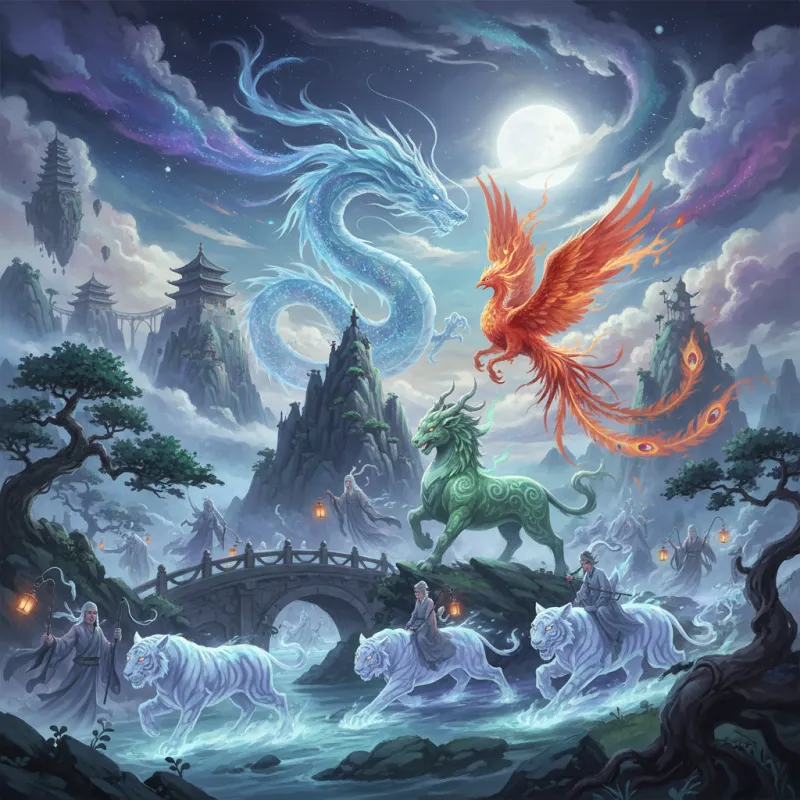
A white fox appears at the edge of a moonlit cemetery, its nine tails swaying like silk ribbons in the wind. The gravedigger drops his shovel—he knows what this means. By morning, someone in the village will be dead, or worse, possessed. In Chinese supernatural folklore, animals aren't just animals. They're messengers between worlds, shape-shifters wearing human skin, and sometimes, they're the restless dead themselves, clawing their way back into the realm of the living.
The Taxonomy of Transformation: What Makes a Spirit-Animal
The term "spirit-animal" in Western discourse has been watered down to personality quizzes and Instagram bios, but in Chinese folklore, these beings—called yāo guài (妖怪) or jīng guài (精怪)—are far more sinister and complex. They're not symbolic representations of your inner self. They're actual entities that have cultivated spiritual power through centuries of practice, often through absorbing moonlight, consuming human essence, or feeding on the energy of graveyards.
The Soushen Ji (搜神记, "In Search of the Supernatural"), compiled by Gan Bao during the Eastern Jin Dynasty (317-420 CE), catalogs hundreds of these transformations. What distinguishes a spirit-animal from an ordinary creature is its ability to transcend its natural form through cultivation—a process called xiū liàn (修炼). A fox that lives for fifty years might develop a single tail of spiritual power. At a hundred years, it can assume human form. By the time it grows nine tails, it has achieved near-immortality and can topple kingdoms with its seductive powers.
Foxes, Snakes, and the Geometry of Seduction
The húli jīng (狐狸精, fox spirit) dominates Chinese supernatural literature with an almost monopolistic grip on the cultural imagination. But why foxes? The answer lies in their liminal nature—they're neither fully wild nor domesticated, neither purely predator nor prey. They inhabit the boundaries, just as spirits inhabit the boundary between life and death.
Liaozhai Zhiyi (聊斋志异, "Strange Tales from a Chinese Studio"), Pu Songling's 17th-century masterwork, features dozens of fox spirit tales. In "Xiao Cui," a fox spirit actually helps a young scholar pass his imperial examinations, challenging the simplistic notion that all spirit-animals are malevolent. Yet in "Painted Skin," a fox demon literally wears the flayed skin of a beautiful woman to seduce and devour men—one of the most viscerally horrifying images in Chinese literature.
Snake spirits, or shé jīng (蛇精), run a close second in the supernatural hierarchy. The Legend of the White Snake (白蛇传, Bái Shé Zhuàn) tells of Bai Suzhen, a white snake who cultivates for a thousand years to achieve human form and falls genuinely in love with a mortal man. The story's tragedy lies in its impossibility—the Buddhist monk Fahai cannot tolerate this transgression of cosmic boundaries and imprisons her beneath Leifeng Pagoda. The tale asks uncomfortable questions: Is a love that crosses species boundaries monstrous, or is the real monster the rigid enforcement of categorical purity?
The Afterlife's Menagerie: Animals as Psychopomps
Chinese afterlife beliefs, heavily influenced by Buddhist and Daoist cosmology, position certain animals as guides or guardians of the dead. The ox-headed and horse-faced demons, Niú Tóu (牛头) and Mǎ Miàn (马面), serve as bailiffs in the underworld bureaucracy, dragging souls before the Ten Courts of Hell for judgment. These aren't spirit-animals in the cultivated sense—they're functionaries, cosmic civil servants with animal heads and human bodies.
More intriguing are the animals that appear as omens of death. The owl, called māo tóu yīng (猫头鹰), is universally feared in Chinese culture as a harbinger of mortality. Unlike Western associations with wisdom, Chinese folklore positions owls as creatures that feed on souls, their nocturnal hunting a metaphor for death's predatory nature. When an owl perches on your roof and calls three times, traditional belief holds that someone in the household will die within three days.
Black dogs, or hēi gǒu (黑狗), occupy a paradoxical position. They can see ghosts and spirits invisible to human eyes, making them both protectors against supernatural threats and potential channels for possession. The Yuewei Caotang Biji (阅微草堂笔记, "Notes from the Yuewei Hermitage") by Ji Yun records numerous accounts of dogs barking at empty corners, only for the family to later discover a suicide or murder had occurred in that exact spot years before.
Hungry Ghosts in Fur: When Humans Become Animals
The Buddhist concept of the Hungry Ghost Realm (è guǐ dào, 饿鬼道) intersects with animal transformation in disturbing ways. Souls who committed particular sins—greed, gluttony, cruelty to animals—might be reborn as animals in their next life, or worse, as hybrid creatures trapped between human consciousness and animal form. These aren't spirit-animals who cultivated power; they're humans who devolved, their karma dragging them down the cosmic hierarchy.
The Jade Record (玉历宝钞, Yù Lì Bǎo Chāo), a Ming Dynasty text describing the underworld's bureaucracy, details specific punishments where sinners are transformed into animals while retaining human awareness. A butcher might become a pig, fully conscious as he's led to slaughter. A corrupt official might become a rat, forced to scavenge and hide. This isn't metaphorical—these texts present it as literal cosmic justice.
The concept of yuān hún (冤魂, wronged souls) adds another layer. A person who dies unjustly—murdered, falsely accused, denied proper burial—might return as an animal to seek vengeance. The Taiping Guangji (太平广记, "Extensive Records of the Taiping Era") includes a story of a woman wrongly executed for adultery who returns as a white tiger, systematically hunting down everyone involved in her conviction. The tiger is both herself and not herself—her rage given fang and claw.
The Exorcist's Bestiary: Combating Animal Spirits
Daoist exorcists and Buddhist monks developed elaborate protocols for dealing with spirit-animals, recognizing that different creatures required different approaches. Fox spirits, being highly intelligent and often sympathetic, might be reasoned with or offered alternative arrangements—a shrine in exchange for leaving the family alone. Snake spirits could sometimes be appeased through offerings at their original cultivation site.
But some spirit-animals were considered irredeemably dangerous. The weasel spirit, or huáng shǔ láng jīng (黄鼠狼精), was notorious for possession that caused madness and speaking in tongues. The standard exorcism involved peach wood swords, cinnabar talismans, and the invocation of specific deities—often Zhong Kui (钟馗), the demon-queller, or Erlang Shen (二郎神), who commanded a celestial dog capable of devouring evil spirits.
The Maoshan (茅山) tradition of Daoism specialized in spirit-animal exorcism, developing a classification system that ranked creatures by danger level and prescribed specific countermeasures. Their texts, many still secret, allegedly contain the true names of powerful spirit-animals—knowledge that grants power over them. This echoes the broader Chinese magical principle that knowing something's true name gives you authority over it, whether it's a demon, a spirit, or a god.
Modern Hauntings: Spirit-Animals in Contemporary Chinese Horror
Contemporary Chinese horror cinema and literature have revitalized spirit-animal folklore for modern audiences, though often with significant reinterpretation. Films like Painted Skin (2008) and its sequel update fox spirit tales with CGI spectacle while preserving the core themes of forbidden love and identity. The question "What makes us human?" resonates differently in an age of artificial intelligence and genetic engineering, but the fox spirit's dilemma—am I the mask I wear or the creature beneath?—remains potent.
Online forums and social media have created new spaces for spirit-animal encounters. Chinese Reddit equivalents like Tieba feature thousands of posts claiming modern sightings—a fox with too-intelligent eyes watching from an apartment balcony, a snake that appeared in a locked room after someone died. Skeptics dismiss these as urban legends, but they follow the same narrative patterns as stories from the Tang Dynasty. The settings change; the archetypes endure.
The resurgence of interest in traditional culture among young Chinese people has also revived serious engagement with these beliefs. Temples dedicated to fox spirits, once dismissed as superstition, now receive offerings from tech workers seeking luck in love or business. Whether this represents genuine belief or performative tradition is beside the point—the rituals continue, and the stories multiply.
The Boundary Keepers
Spirit-animals in Chinese folklore serve as boundary markers between categories we prefer to keep separate: human and animal, living and dead, natural and supernatural. They're unsettling precisely because they refuse to stay in their assigned boxes. A fox that becomes a woman, a human who becomes a hungry ghost in animal form, a snake that achieves enlightenment—these transformations challenge the stability of identity itself.
Perhaps that's why these stories persist across millennia and continue to evolve. In a culture that values harmony and proper order, spirit-animals represent the chaos that lurks at the edges of civilization—the wilderness that can never be fully tamed, the dead who won't stay buried, the animal nature within the human form. They remind us that the boundaries we draw are more fragile than we'd like to believe, and that something with nine tails and ancient eyes might be watching from just beyond the firelight, waiting for us to step across.
For more on the bureaucratic structure of the Chinese afterlife, see The Ten Courts of Hell. Those interested in specific exorcism practices should explore Daoist Talismans and Ghost-Sealing Rituals.
Related Reading
- Unveiling the Secrets of Chinese Supernatural Folklore and Afterlife Beliefs
- Unraveling the Mystique of Chinese Supernatural Folklore and Afterlife Beliefs
- Chinese Ghost Stories for Beginners: Where to Start
Explore Chinese Culture
- Explore ancient mythical creatures
- Explore Daoist exorcism traditions
- Explore Chinese folk beliefs and superstitions