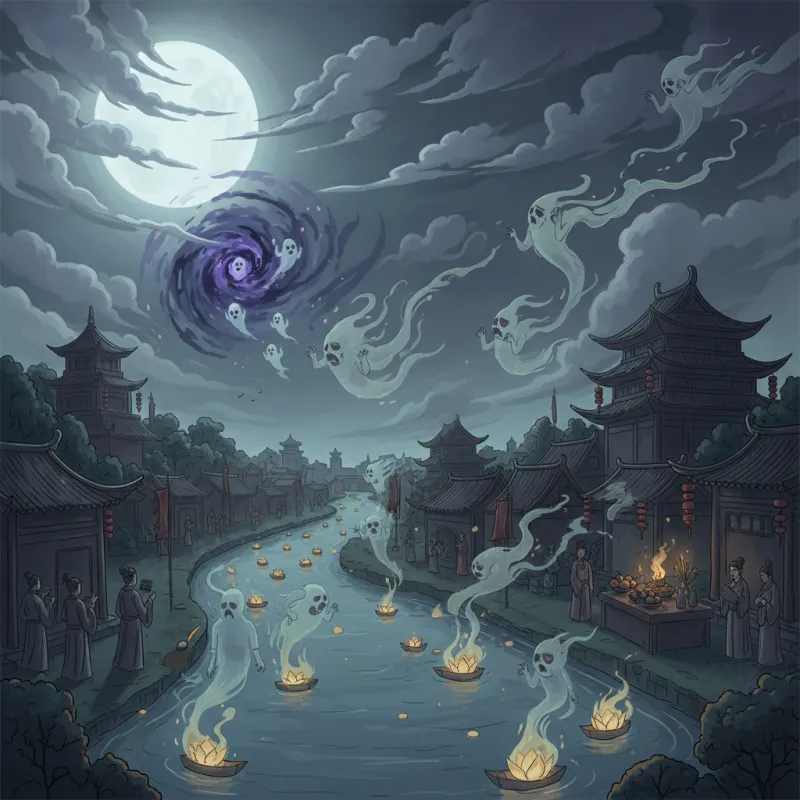
The incense smoke curls upward from the sidewalk offering, and you step around it without thinking. Your friend grabs your arm. "Don't walk through that," she hisses. "It's for them." You've just encountered your first Ghost Month taboo, and you're lucky someone warned you. For one lunar month each year, the boundary between the living and dead dissolves, and the rules change. What's harmless in the sixth month can invite disaster in the seventh.
When the Gates Open
Ghost Month (鬼月, guǐyuè) occupies the seventh month of the lunar calendar, typically falling between mid-August and mid-September in the Western calendar. The exact dates shift annually—in 2024, it runs from August 4 to September 2; in 2025, from July 25 to August 22. Mark your calendar accordingly, because the supernatural doesn't care if you forgot to check.
The fifteenth day marks the peak: Hungry Ghost Festival (中元节, Zhōngyuán Jié), also called Ghost Festival or Zhongyuan Festival. This is when offerings reach their maximum, when temples hold elaborate ceremonies, and when the 鬼 (guǐ, ghosts) are most active. If you're going to participate in any Ghost Month observances, this is the day to do it.
The mythology is straightforward. The gates of 阴间 (yīnjiān, the underworld) open on the first day of the seventh month. Spirits flood into the living world—some to visit family, others to search for food and entertainment, still others with less benign intentions. The gates close on the last day. For thirty days, two worlds occupy the same space.
What You Should Do
Feed them. This is the core practice, the non-negotiable element that gives the festival its name. Hungry ghosts (饿鬼, èguǐ) are spirits with enormous appetites and tiny throats—a punishment for greed or attachment in life. But during Ghost Month, all spirits are hungry, and all deserve offerings.
Set out food on the fifteenth day at minimum. Fruit, rice, meat, sweets, tea—arrange them on a table or even on the ground outside your home. Add incense and joss paper (冥纸, míngzhǐ), the currency of the dead. Burn the paper money so spirits can spend it in the afterworld. Some families offer entire meals, complete with chopsticks and rice wine. The food isn't meant to be eaten by humans afterward; leave it until the incense burns down, then dispose of it respectfully.
Participate in community ceremonies if you can. Many Chinese communities hold large-scale Ghost Month events: opera performances (戏曲, xìqǔ) staged for spirit audiences, with the front rows left empty for ghostly attendees; auction ceremonies where participants bid on blessed items; floating water lanterns to guide lost souls. These aren't tourist attractions—they're genuine religious observances—but respectful observers are typically welcome.
Honor your ancestors specifically. Ghost Month isn't only about appeasing hungry strangers; it's about remembering your own dead. Visit graves, clean tombstones, leave offerings at family altars. The seventh month is when your ancestors can most easily receive what you give them. This is ancestor veneration at its most potent.
Light the way. Lanterns serve a practical purpose during Ghost Month—they help spirits navigate. Some families hang red lanterns outside their homes to guide ancestral spirits to the right address. Others float lanterns on water to illuminate the path for lost souls. The symbolism is ancient: light represents guidance, safety, the possibility of finding one's way home.
What You Should Avoid
Swimming tops every Ghost Month prohibition list, and for good reason. Water is the domain of 水鬼 (shuǐguǐ, water ghosts)—spirits of drowning victims who must claim a substitute before they can reincarnate. During Ghost Month, when spirits roam freely, water ghosts actively hunt for replacements. They grab swimmers' legs, pull them under, hold them down. Every year, drowning deaths spike during the seventh month. Believers attribute this to supernatural causes; skeptics point to increased risk-taking or statistical clustering. Either way: stay out of pools, lakes, rivers, and oceans.
Don't whistle or call out names at night. Whistling attracts ghostly attention—it's like ringing a dinner bell for spirits. Calling someone's name after dark is worse, because if a ghost responds instead of your friend, you've just invited it to follow you. If you must get someone's attention at night during Ghost Month, tap their shoulder. And if someone calls your name from behind, don't turn around immediately. Look over your shoulder first to verify it's actually a living person.
Avoid moving house, starting businesses, getting married, or scheduling surgery. Ghost Month is inauspicious for major life events. The spiritual turbulence makes everything riskier. Moving house might mean bringing unwanted spirits into your new home. Starting a business invites financial misfortune. Weddings held during Ghost Month are considered doomed—some believe the marriage will end in death or divorce. Elective surgery can wait until the eighth month; emergency surgery is obviously exempt from supernatural scheduling concerns.
Don't stay out late or wander at night. The hours after midnight belong to ghosts during the seventh month. If you must be out, stay in well-lit areas, travel in groups, and keep your head down. Don't investigate strange sounds or follow mysterious figures. The ghost encounters that happen during Ghost Month tend to be more intense than those during the rest of the year, precisely because the barrier between worlds is thinner.
Leave the front row empty. If you attend a Ghost Month opera or performance, never sit in the front row. Those seats are reserved for spirit attendees. Sitting there is not only disrespectful—it's dangerous. You're taking a ghost's seat, and they might take offense. They might also decide you're interesting enough to follow home.
Don't pick up money you find on the street. That coin or bill might be an offering meant for ghosts. Taking it means stealing from the dead, which invites retribution. Even if it's not an offering, it might be bait—some spirits allegedly drop money to lure victims. During Ghost Month, leave found money where it lies.
The Skeptic's Participation
You don't have to believe in ghosts to participate in Ghost Month observances. Many Chinese people treat the seventh month as cultural practice rather than literal supernatural danger. They make offerings because their parents did, because it maintains tradition, because it's a way of remembering the dead that doesn't require religious conviction.
Think of it as Pascal's Wager for folk religion. If ghosts exist, you've protected yourself and shown respect. If they don't, you've participated in a cultural tradition that connects you to centuries of Chinese history. The cost is minimal—some fruit, some incense, some minor behavioral adjustments for thirty days.
The psychological benefits are real regardless of supernatural reality. Ghost Month rituals provide structure for processing grief and mortality. They create community through shared observance. They offer a designated time for remembering the dead, which is healthier than suppressing those thoughts year-round. The Chinese approach to death and spirits acknowledges mortality in ways that Western culture often avoids.
Regional Variations
Ghost Month practices vary significantly across Chinese communities. In Taiwan, the observances are particularly elaborate—entire streets shut down for massive ceremonies, and businesses close for the fifteenth day. Taiwanese Ghost Month includes the "Robbing the Orphans" (抢孤, qiǎnggū) ritual, where participants climb tall, greased poles to grab offerings at the top, symbolically competing with ghosts for resources.
In Hong Kong and southern China, the focus is more on opera performances and community feasts. In Singapore and Malaysia, Chinese communities hold auctions where blessed items are sold, with proceeds going to charity. The underlying principles remain consistent—feed the hungry, honor the dead, avoid supernatural danger—but the specific practices reflect local history and community preferences.
Mainland China's Ghost Month observances were suppressed during the Cultural Revolution and have only partially recovered. Urban areas tend toward minimal observance, while rural communities maintain more traditional practices. The revival of Ghost Month traditions in China over the past few decades reflects broader trends in religious and cultural restoration.
The Modern Seventh Month
Ghost Month persists in the 21st century, even as Chinese communities modernize and secularize. Real estate agents in Chinese-majority areas still report difficulty selling properties during the seventh month. Wedding venues offer discounts because demand plummets. Some businesses see revenue drop as people avoid major purchases.
But the festival is also adapting. Digital offerings have emerged—websites where you can burn virtual joss paper for deceased relatives. Some families make offerings of modern items: paper smartphones, paper credit cards, paper luxury cars. The logic is consistent with traditional practice: if the dead need money in the afterlife, they probably also need technology.
Environmental concerns are reshaping some practices. The massive amounts of joss paper burned during Ghost Month create air pollution, leading some communities to establish centralized burning locations or encourage reduced paper offerings. Some temples now offer "green" alternatives—digital burning, or symbolic offerings that don't require actual combustion.
Why It Matters
Ghost Month reveals something fundamental about Chinese cosmology: the dead are not gone. They exist in a parallel realm that occasionally intersects with ours, and the seventh month is when that intersection is most pronounced. This isn't metaphorical. For believers, ghosts are as real as living people, with needs and agency and the capacity to affect the living world.
Even for non-believers, Ghost Month serves a purpose. It's a designated time for confronting mortality, for remembering those who've died, for acknowledging that death is not an ending but a transition. Western culture tends to segregate death—we put it in hospitals and funeral homes, we avoid discussing it, we treat it as an aberration rather than an inevitability. Ghost Month does the opposite. For thirty days, death walks alongside life, and everyone adjusts accordingly.
The taboos and offerings might seem superstitious, but they're also practical psychology. Don't swim during Ghost Month? That's also: be more cautious during a period when you're thinking about death and might take unnecessary risks. Make offerings to the dead? That's also: take time to remember and honor those who came before you. The supernatural framework provides motivation for behaviors that have value independent of literal ghost belief.
Whether you approach Ghost Month as religious observance, cultural tradition, or anthropological curiosity, the core message remains: respect the dead, feed the hungry, and remember that the boundary between worlds is thinner than you think. At least for one month a year, act accordingly.
Related Reading
- Lake Monsters and Sea Creatures in Chinese Folklore
- Female Ghosts in Chinese Literature: Beauty and Tragedy
- River Gods and Water Deities in Chinese Mythology
- The Drowning Ghost (水鬼): China's Most Feared Water Spirit
- Water Ghosts: The Spirits That Pull You Under
- The Cowherd and the Weaver Girl: China's Greatest Love Story
- Mengpo Soup: The Drink That Erases Memory
- Chinese Death Customs That Surprise Westerners
Explore Chinese Culture
- Explore ancient mythical creatures
- Explore Daoist exorcism traditions
- Explore Chinese folk beliefs and superstitions