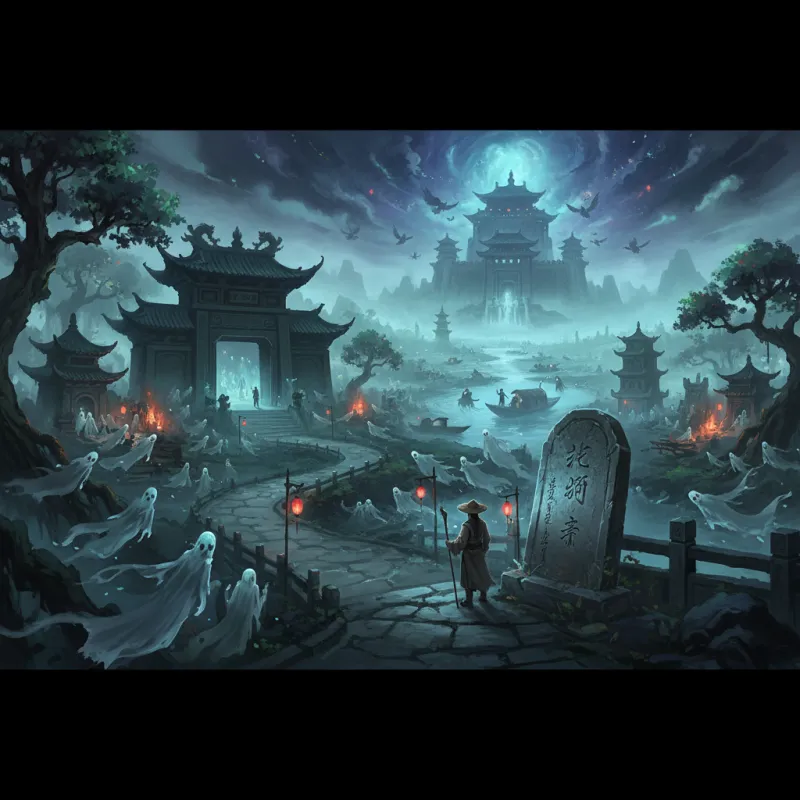
You die. Your soul separates from your body like steam rising from rice. Before you can orient yourself, two figures appear: one with the head of an ox, one with the head of a horse. They're not here to negotiate. 牛头马面 (Niútóu Mǎmiàn, "Ox-Head and Horse-Face") are underworld bailiffs, and you're coming with them whether you like it or not. Welcome to Diyu — the Chinese underworld — where death is just the beginning of a very long, very bureaucratic journey.
The Underworld Is a Government Office
Forget Dante's circles or the Greek river Styx. The Chinese afterlife operates like an imperial ministry. Diyu (地狱, Dìyù) is structured as a vast bureaucracy with ten courts, each presided over by a judge-king who reviews specific categories of sin. This isn't metaphor — Ming and Qing dynasty texts describe the underworld with the same administrative precision they used for earthly governance.
The first court is run by 秦广王 (Qínguǎng Wáng, King Qinguang), who conducts the initial review. He's essentially intake processing. If you lived a balanced life — neither exceptionally virtuous nor criminally wicked — you might pass through quickly. But most souls get referred to the subsequent courts for detailed judgment. Each king specializes: the second court handles corruption and medical malpractice, the fifth court deals with murder and robbery, the eighth court judges filial impiety. It's like being transferred between government departments, except the penalties involve boiling oil and mountains of knives.
The Bridge of Helplessness and Other Checkpoints
Between courts, souls encounter specific landmarks that appear repeatedly in Chinese ghost stories and folklore. The most famous is 奈何桥 (Nàihé Qiáo, the Bridge of Helplessness), a narrow crossing over a blood-red river. According to the Jade Record (玉历, Yùlì), a Qing dynasty text that became the definitive guide to the underworld, the bridge has three paths: the virtuous cross on a wide, safe walkway; ordinary people navigate a narrow beam; sinners fall into the river below, where they're attacked by copper snakes and iron dogs.
On the far side of the bridge sits 孟婆 (Mèng Pó, Old Lady Meng), who ladles out a tea that erases all memory of your previous life. This is mandatory. You cannot refuse. The tea — 孟婆汤 (Mèng Pó tāng) — ensures you enter your next incarnation with a blank slate, carrying no grudges, no attachments, no knowledge of who you once were. Some stories claim the tea is brewed from tears collected from the living world. Others say it contains herbs from the banks of the Forgetting River. Either way, you drink it, and your past dissolves.
The Eighteen Levels of Hell
If you've committed serious offenses, you're sent down to the eighteen levels of hell (十八层地狱, Shíbā Céng Dìyù) for punishment before reincarnation. These aren't permanent damnation — they're corrective sentences. The duration depends on the severity of your crimes, but eventually, everyone gets out.
Each level specializes in particular torments matched to specific sins. Liars have their tongues pulled out by iron hooks. Those who wasted food are forced to eat molten iron pellets. People who disrespected their parents are frozen in ice or sawed in half. The Journey to the West briefly depicts these hells when the Monkey King causes havoc in the underworld, and the descriptions are visceral: grinding stones, forests of swords, pools of blood.
The logic is both karmic and rehabilitative. You experience suffering proportional to the suffering you caused. A butcher who killed excessively might spend centuries in the hell of dismemberment. A corrupt official who starved peasants might endure the hell of hunger. The punishment fits the crime with bureaucratic precision.
The Book of Life and Death
Every soul's fate is recorded in the 生死簿 (Shēngsǐ Bù, Book of Life and Death), a ledger maintained by underworld clerks that lists your allotted lifespan and karmic balance. This book appears throughout Chinese literature as both plot device and philosophical concept. In Journey to the West, Sun Wukong famously breaks into the underworld and crosses out his name and the names of all monkeys, making them immortal. In Strange Tales from a Chinese Studio (聊斋志异, Liáozhāi Zhìyì), multiple stories feature people who discover their death date has been recorded incorrectly, leading to bureaucratic mix-ups.
The book's existence raises interesting questions about fate versus free will. If your death date is already written, can you change it? Some stories say yes — through exceptional virtue or intervention by deities. Others suggest the book records probability, not certainty. Either way, the underworld clerks take their record-keeping seriously. They're accountants of karma, and the books must balance.
Reincarnation: The Six Paths
After judgment and punishment, souls proceed to reincarnation through one of six paths (六道, Liù Dào): gods, humans, asuras (demigods), animals, hungry ghosts, or hell beings. Your next incarnation depends entirely on your karmic balance sheet. This is borrowed from Buddhist cosmology but adapted into Chinese folk belief with characteristic practicality.
The best outcome is rebirth as a human or, better yet, a deity. The worst is rebirth as a hungry ghost (饿鬼, È Guǐ) — a creature with a throat like a needle and a stomach like a mountain, eternally starving but unable to eat. Animal rebirth is considered unfortunate but not catastrophic; you'll work off your karma and eventually return to human form. The system is cyclical, not linear. You can move up or down the ladder depending on your actions in each life.
Interestingly, being reborn as a human is considered fortunate because only humans can accumulate the merit needed to escape the cycle entirely and achieve enlightenment. Gods live too comfortably to seek liberation; hell beings suffer too much to practice virtue. Humans occupy the sweet spot of just enough suffering to motivate spiritual practice and just enough comfort to pursue it.
Exceptions and Loopholes
Like any bureaucracy, the underworld has exceptions. Virtuous individuals might bypass judgment entirely and ascend directly to heaven. Children who die young are sometimes spared punishment and reincarnated quickly. Those who die violently or unjustly might become wandering ghosts if their cases aren't properly resolved — which is why proper funeral rites and offerings are essential.
There are also ways to influence the process from the living world. Descendants can burn paper money and offerings to ease a soul's passage. Monks can perform rituals to reduce sentences or transfer merit. The Jade Record explicitly describes how living relatives can petition underworld officials on behalf of the dead, like filing an appeal in court. This is why ancestor veneration remains central to Chinese culture — you're not just honoring the dead, you're actively helping them navigate the afterlife bureaucracy.
Why This Matters
The Chinese underworld isn't about eternal reward or punishment — it's about accountability and transformation. Everyone faces judgment. Everyone pays for their actions. Everyone gets another chance. This creates a moral framework that's both strict and forgiving: your choices matter immensely, but no single life defines you forever.
Understanding Diyu also explains countless elements of Chinese ghost stories, from why spirits need paper money to why exorcists can negotiate with demons. The underworld isn't a distant abstraction — it's a parallel realm with rules, officials, and procedures. When you read about a ghost seeking justice or a demon collecting souls, you're seeing the underworld's bureaucracy in action.
So when Ox-Head and Horse-Face come for you, don't panic. Bring your paperwork, be honest with the judges, and remember: this is just processing. Your next life is already waiting on the other side of Meng Po's bridge.
Related Reading
- Diyu: The Chinese Underworld and Its Ten Courts of Hell
- Exploring Chinese Beliefs in the Afterlife: Ghosts, Spirits, and Folklore
- The Wheel of Reincarnation: How the Chinese Afterlife Recycles Souls
- Exploring the Mystical Realm of Chinese Ghosts and Afterlife Beliefs
- The Chinese Afterlife Is a Bureaucracy (And That Tells You Everything)
- The Best Chinese Horror Films: A Genre Guide — Cnspirit Perspective
- Chinese Death Customs That Surprise Westerners
- Funeral Rituals in Chinese Culture: A Guide to Sending Off the Dead
Explore Chinese Culture
- Explore ancient mythical creatures
- Explore Daoist exorcism traditions
- Explore Chinese folk beliefs and superstitions