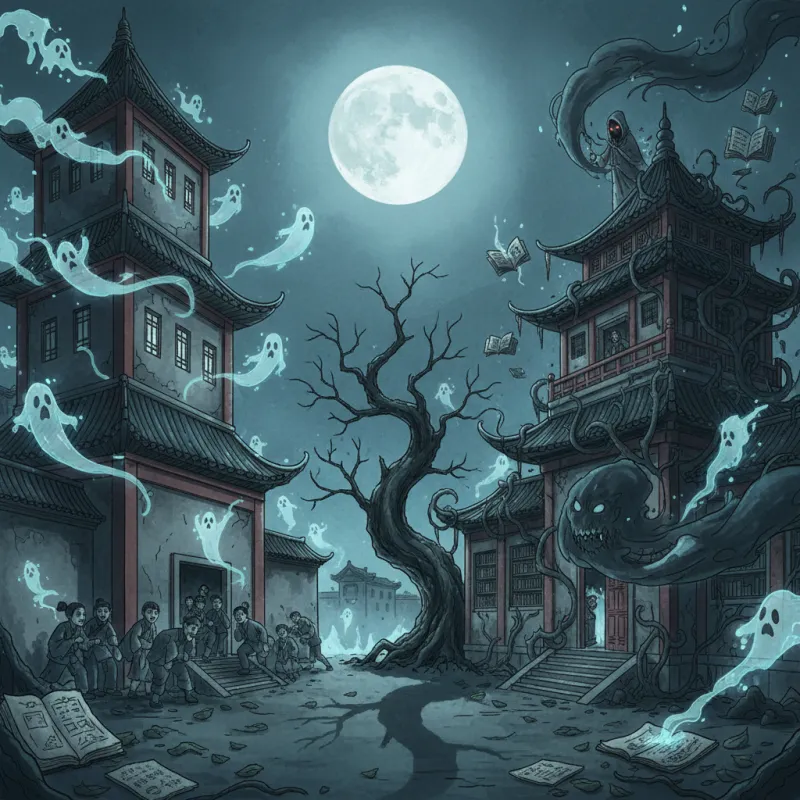
The mirror in Room 404 of Peking University's Building 28 doesn't reflect quite right. Students who've lived there report seeing movement in the glass when they're standing still, or catching glimpses of a figure standing behind them that vanishes when they turn around. The university officially attributes the room's persistent vacancy to "structural issues," but maintenance records show nothing wrong with the plumbing, electrical, or foundation. What they don't mention in those records is that Room 404 was sealed for three years after a graduate student hanged herself there in 1989, or that the number itself — 四零四 (sì líng sì) — sounds uncomfortably close to "death zero death" in Mandarin.
The Architecture of Fear
Chinese university campuses weren't designed with ghost stories in mind, but their layout practically guarantees them. Most major universities expanded rapidly during the 1980s and 1990s, constructing massive dormitory complexes to accommodate the flood of students entering higher education. These buildings went up fast and cheap, with little attention to the feng shui principles that traditionally governed Chinese architecture. The result? Structures that violate every rule in the book: buildings facing the wrong direction, rooms with no natural light, corridors that dead-end in ways that trap qi (气, qì) — life energy — and create pockets of stagnant spiritual atmosphere.
Tsinghua University's infamous Building 6 exemplifies this architectural negligence. Built in 1987, it's a brutalist concrete block with a central courtyard that never sees direct sunlight. Students call it the "ghost well" because sounds echo strangely there, and the temperature drops noticeably even in summer. The building's designer, who remained anonymous, apparently ignored the traditional prohibition against creating enclosed spaces that can't "breathe." In Chinese supernatural belief, such spaces become magnets for gui (鬼, guǐ) — ghosts — who are drawn to places where energy stagnates.
The Midnight Scholar
Every campus has a variation of this story, but Fudan University's version has enough specific details to make you wonder. According to the tale, a student in the 1970s was so obsessed with passing the gaokao (高考, gāokǎo) — China's notoriously difficult college entrance exam — that he studied in the library until he literally died at his desk. The librarians found him the next morning, slumped over a copy of the Analects, his notes still wet with ink.
Now students report seeing him in the library's third floor reading room, always at the same desk by the northeast window. He appears between 2 and 4 AM, wearing a faded Mao suit, writing furiously in a notebook that looks decades old. Those who've approached him say he never looks up, never acknowledges their presence. One student claimed she tried to read over his shoulder and saw he was writing the same sentence over and over: "I must not fail, I must not fail, I must not fail."
What makes this story particularly unsettling is that Fudan's library records do show an unexplained death in 1976 — a student found deceased in the reading room, cause of death listed as "exhaustion." The university moved the desk afterward, but students swear the ghost simply moved with it.
The Bathroom Suicides
Chinese university bathrooms are communal, institutional, and deeply unpleasant — exactly the kind of liminal space where ghost stories thrive. They're also, tragically, common sites for student suicides. The combination of privacy, accessibility, and the symbolic act of "washing away" one's existence makes them attractive to desperate students. And once a bathroom has a suicide, it tends to collect ghost stories like mold.
Nanjing University's East Campus has a women's bathroom on the fourth floor that's been the site of three suicides since 1995. Students avoid it after dark, claiming they hear crying from the stalls, see wet footprints appearing on dry floors, and smell jasmine perfume — the scent one of the victims was wearing when she died. The university installed brighter lights and painted the walls cheerful colors, but the stories persist. Some students perform small rituals before entering: knocking three times, announcing their presence, leaving offerings of fruit or incense in the corner.
These bathroom ghosts are typically classified as yuangui (冤鬼, yuānguǐ) — wronged ghosts — spirits who died with unresolved grievances and can't move on. In traditional Chinese belief, suicide is particularly problematic because it's considered an unnatural death that disrupts the cosmic order. The ghost becomes trapped, endlessly replaying their final moments, unable to proceed to the underworld for judgment.
The Cursed Thesis
Academic pressure in Chinese universities is crushing, and ghost stories often reflect this anxiety. The "cursed thesis" legend appears at multiple campuses with slight variations, but the core remains consistent: a graduate student working on their dissertation discovers research that shouldn't exist — forbidden knowledge, suppressed history, or occult practices. They become obsessed, stop sleeping, stop eating. Their advisor grows concerned but can't reach them. Eventually, they're found dead in their dorm room, their thesis incomplete, their computer files corrupted beyond recovery.
At Wuhan University, students whisper about a history PhD candidate in 2003 who was researching the Cultural Revolution's impact on local folk religion. She supposedly uncovered evidence of mass executions at a temple site, complete with photographs and witness testimonies that contradicted official records. Her roommate reported that she became paranoid in her final weeks, claiming she was being followed, that her research was being stolen, that "they" wouldn't let her finish. She died of an apparent heart attack at age 27, with no prior cardiac issues. Her thesis files were seized by university officials and never released.
Whether this story is true is almost beside the point. It captures a real fear among Chinese graduate students: that pursuing certain truths will have consequences, that some knowledge is genuinely dangerous. The ghost in these stories isn't just a supernatural entity — it's the manifestation of institutional pressure, censorship, and the very real risks of academic inquiry in a controlled environment.
The Dormitory Rules
Some campus ghost stories have evolved into elaborate rule systems that students follow with surprising seriousness. These rules supposedly protect you from supernatural encounters, but they also function as a form of collective anxiety management — a way to feel some control in an environment where students have very little.
At Zhejiang University, students in certain older dormitories follow the "midnight rules": don't look in mirrors after midnight, don't respond if someone calls your name three times, don't open your door if you hear scratching, and never, ever count the number of people in your room when you wake up in the dark. Break these rules, the story goes, and you invite attention from the building's resident gui.
These rules bear striking similarity to the taboos found in Chinese horror fiction, particularly the "rules-based horror" subgenre that's become popular in recent years. But they also echo genuine folk practices — the kind of protective rituals rural Chinese families have followed for generations. Students are essentially creating their own folk religion, adapting traditional supernatural beliefs to their modern institutional environment.
The Library's Forbidden Section
University libraries in China often house rare books and historical documents, some dating back centuries. These collections are typically restricted, accessible only to faculty and advanced researchers. Naturally, students have created elaborate ghost stories about what's really in those forbidden sections.
Beijing Normal University's library supposedly contains a collection of Qing Dynasty texts on necromancy and spirit communication, confiscated from a Daoist temple during the Cultural Revolution. Students claim that anyone who reads these texts without proper spiritual protection will be haunted by the spirits described within. One particularly persistent story involves a literature student who snuck into the restricted section in 2008, photographed several pages from a text called the "Manual of Hungry Ghosts" (饿鬼手册, èguǐ shǒucè), and posted them online. Within a week, she withdrew from school, claiming she was being followed by something that only appeared in her peripheral vision.
The truth is probably more mundane — the restricted sections do contain sensitive historical materials, but they're politically sensitive, not supernaturally dangerous. Still, the ghost stories serve a purpose: they add mystique to academic knowledge, transforming dry historical texts into forbidden grimoires. They make scholarship feel dangerous and exciting, which isn't entirely inaccurate in the Chinese context.
Why Campus Ghost Stories Matter
These stories aren't just entertainment. They're how Chinese students process the very real pressures and traumas of university life: the isolation, the academic stress, the suicides that happen with disturbing regularity, the sense that institutional forces beyond their control are shaping their lives. Ghost stories provide a language for discussing these issues indirectly, safely.
They also preserve a connection to traditional Chinese supernatural beliefs in an environment that's officially atheist and materialist. The Communist Party may have spent decades trying to eliminate "feudal superstition," but students still knock on wood, avoid the number four, and leave offerings for bathroom ghosts. These practices persist because they fulfill genuine psychological needs — they provide ritual, meaning, and a sense of agency in an uncertain world.
The campus ghost story is a uniquely modern Chinese folk form, blending ancient beliefs about gui and yuanhun (冤魂, yuānhún) — wronged souls — with contemporary anxieties about education, success, and survival. Every retelling adds new details, adapts to new circumstances, keeps the tradition alive. As long as Chinese universities remain pressure cookers of ambition and anxiety, students will keep telling these stories, keep following the rules, keep leaving offerings in bathroom corners.
And somewhere, in a library reading room at 3 AM, a student in a Mao suit is still writing the same sentence, over and over, unable to stop, unable to rest, unable to fail.
Related Reading
- Ghost Month: Surviving the Seventh Month
- Ghost Stories from Chinese Folklore: Tales That Will Keep You Awake
- The Most Famous Chinese Ghost Stories: Tales That Have Haunted a Civilization
- Ghost Stories from the Three Kingdoms: When Heroes Became Haunters
- Chinese Folklore: The Stories That Grandmothers Tell
- Unraveling the Mystique of Chinese Supernatural Folklore and Afterlife Beliefs
- Chinese Horror Literature: From Liaozhai to Modern Thrillers
Explore Chinese Culture
- Explore ancient mythical creatures
- Explore Daoist exorcism traditions
- Explore Chinese folk beliefs and superstitions