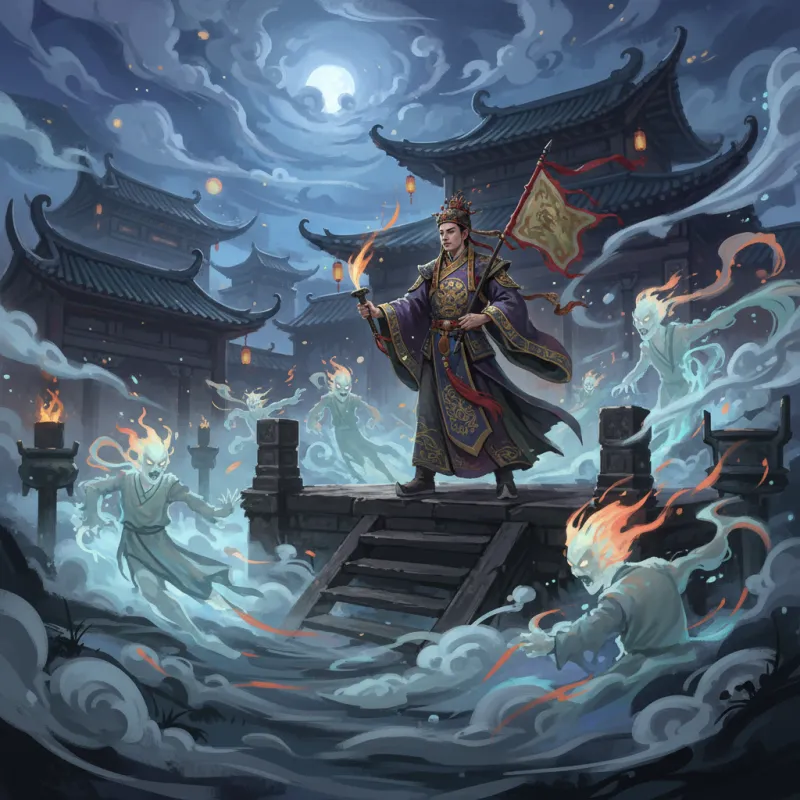
The spiked ball crashes into flesh with a wet thud. Blood streams down the medium's bare back, but his face shows no pain — only the fierce, otherworldly expression of a deity who has temporarily evicted the human soul from its own body. In temples across Singapore, Malaysia, Thailand, and Indonesia, this scene repeats thousands of times each year. The tongji (童乩, tóngjī) — spirit mediums who channel gods into their bodies — represent one of Chinese folk religion's most extreme and misunderstood practices, a tradition that survived the journey across the South China Sea when it couldn't survive in China itself.
The Medium and the Message
A tongji is not a priest. He's not a monk. He's not even necessarily religious in his daily life. He's a human vessel — what the Hokkien-speaking communities of Southeast Asia call a tangki (乩童, jītóng in Mandarin). The term literally means "divination youth," though many mediums are middle-aged or older. Their job is simple in concept, terrifying in execution: to empty themselves completely so a deity can occupy their body and interact directly with worshippers.
The process is called jiangsheng (降神, jiàngshén) — "descending of the spirit." It begins with ritual preparation: incense, drumming, chanting, sometimes the burning of spirit money. The medium enters a trance state, his consciousness supposedly departing to make room for the god. What happens next varies by deity and tradition, but often includes self-mortification that would hospitalize an ordinary person: striking the body with spiked clubs, cutting the tongue with a sword, walking on hot coals, piercing the cheeks with metal skewers.
The blood is the proof. In Chinese folk religion, gods don't bleed — but they can make a human body bleed without that body feeling pain. The medium's wounds, inflicted while channeling divine presence, are considered sacred. Some temples collect the blood on yellow paper talismans (符, fú) that worshippers take home for protection.
Gods Who Prefer Violence
Not every deity works through tongji. Guanyin (觀音, Guānyīn), the Goddess of Mercy, rarely possesses mediums — her compassionate nature doesn't align with violent trance practices. But martial deities love a good possession session. The Monkey King, Sun Wukong (孫悟空, Sūn Wùkōng), is a frequent visitor, as is the Third Prince, Nezha (哪吒, Nézhā), that bratty child-god who rides on flaming wheels. The Jade Emperor himself occasionally descends, though he's considered too dignified for the more extreme displays.
The most popular deity for tongji possession is Jigong (濟公, Jìgōng), the "Mad Monk" — a historical Chan Buddhist monk from the Song Dynasty who achieved enlightenment while drinking wine, eating meat, and generally violating every monastic rule. When Jigong possesses a medium, the performance is part spiritual counseling, part comedy routine. The possessed medium might demand alcohol, crack jokes, speak in crude language, and dispense advice that's simultaneously profound and absurd. I've watched a Jigong-possessed medium in Penang tell a worried mother that her son's business would fail unless he "stopped being such a cheapskate with the temple donations" — then immediately turn to another worshipper and deliver a genuinely moving speech about accepting death.
The deity's personality completely overrides the medium's. A soft-spoken accountant becomes a roaring warrior god. A young man speaks with the voice of an ancient general. This isn't the subtle "channeling" of New Age spiritualism — it's full-body possession, complete with different vocal patterns, facial expressions, and physical capabilities.
The Southeast Asian Exception
Here's what's fascinating: this practice barely exists in mainland China anymore. The Communist government suppressed it as feudal superstition. Even in Taiwan, where traditional religion survived better, tongji sessions are less common and less extreme than in Southeast Asia. The practice found its truest home among the Chinese diaspora communities of Malaysia, Singapore, Thailand, and Indonesia.
Why? Partly because these communities, isolated from mainland China, preserved older forms of folk religion that evolved or disappeared in the homeland. But also because the tongji served a crucial social function for immigrant communities. In the 19th and early 20th centuries, Chinese migrants in Southeast Asia faced discrimination, violence, and legal systems that didn't serve them. The tongji became an alternative authority — a way to resolve disputes, diagnose illnesses, find lost items, and receive guidance without relying on colonial or local institutions.
The temples where tongji operate are called shentan (神壇, shéntán) — "god altars" — and they function as community centers. During major festivals like the Nine Emperor Gods Festival (九皇爺, Jiǔ Huáng Yé), multiple mediums might go into trance simultaneously, creating a chaotic scene of possessed bodies, drumming, and crowds seeking blessings. The mediums don't charge for their services — they're considered servants of the gods, not professionals. Many hold regular day jobs and only perform medium duties during festivals or when the temple calls.
The Training of a Human Vessel
You don't choose to become a tongji. The gods choose you. The typical story involves unexplained illness, strange dreams, or sudden behavioral changes. A person might start speaking in tongues, experiencing seizures, or feeling compelled to visit a particular temple. Temple elders recognize these as signs of divine calling. If the person resists, the symptoms supposedly worsen.
Once accepted, the training is intense. The apprentice medium must learn to enter trance states reliably, to recognize which deity is attempting possession (different gods have different "signatures"), and to perform the physical feats required. Some temples have senior mediums who teach techniques for pain management and trance induction. There's also spiritual preparation: vegetarian diets before sessions, sexual abstinence, ritual purification.
The most controversial aspect is the self-mortification. Critics — both within and outside Chinese communities — argue it's barbaric, dangerous, or psychologically damaging. Defenders insist the medium feels no pain while possessed, and that wounds heal with supernatural speed. I've seen mediums with dozens of scars from spiked balls and blades, yet they claim no lasting injury. Medical explanations range from endorphin release to dissociative states, but these don't fully account for the lack of infection or the rapid healing that practitioners report.
The practice shares some similarities with Daoist exorcism rituals, particularly in the use of talismans and the belief that spiritual authority can override physical limitations. However, tongji operate within folk religion rather than formal Daoist lineages, and their possession is considered more complete — the human consciousness fully departs rather than coexisting with divine power.
What the Gods Actually Say
So what do these possessed mediums actually do? Mostly, they give advice. Worshippers approach with questions about health, business, relationships, family disputes. The deity, speaking through the medium, provides guidance. Sometimes it's practical: "See a doctor about that cough." Sometimes it's spiritual: "Your ancestor is angry because you haven't maintained the grave." Sometimes it's cryptic: "The metal element is weak in your life; wear more white."
The medium might also write talismans — protective charms in Chinese characters that the deity "writes" through the medium's hand. These are burned and the ashes mixed with water for the worshipper to drink, or kept as protective amulets. The calligraphy is often wild and barely legible, which is taken as proof of divine rather than human authorship.
During major crises — epidemics, natural disasters, community conflicts — the tongji's role expands. In 2020, during the COVID-19 pandemic, temples across Southeast Asia held special sessions where mediums channeled deities to provide guidance on safety measures and spiritual protection. Some temples reported that their deities had predicted the pandemic months earlier, though these claims are, of course, impossible to verify.
The relationship between worshipper and deity-through-medium is surprisingly informal. People argue with the gods, negotiate with them, even complain about previous advice that didn't work out. The gods, in turn, can be stern, compassionate, angry, or playful depending on their nature and the situation. This directness — the ability to literally talk to a god face-to-face — is what makes the tongji tradition so compelling for believers.
The Modern Medium
Today's tongji exist in a strange space between ancient tradition and modern skepticism. Younger Chinese in Southeast Asia are less likely to believe in literal divine possession, viewing it as cultural performance or psychological phenomenon. Yet the temples remain crowded during festivals, and new mediums continue to emerge.
Some temples have adapted to modernity. They livestream possession sessions on Facebook. They maintain websites with schedules of when specific deities will be available for consultation. A few mediums have become minor celebrities, with worshippers traveling from other countries to consult them. This commercialization troubles traditionalists, who worry that the practice is becoming entertainment rather than genuine religious expression.
The question of authenticity haunts the tradition. How do you distinguish a genuine possession from a performance? Temple communities rely on reputation and results — a medium whose advice consistently proves accurate, whose wounds heal quickly, whose trance states seem genuinely altered, earns trust. Frauds exist, certainly, but the community policing is surprisingly effective. A medium caught faking possession faces social ostracism and is banned from temples.
The practice also faces legal challenges. Singapore has regulations about public performances and blood exposure. Malaysia's Islamic authorities occasionally clash with Chinese temples over noise and public displays. Insurance companies don't know how to classify tongji activities. Yet the tradition persists, adapting to each new constraint while maintaining its essential character.
The Skeptic's Dilemma
I've watched dozens of tongji sessions across Malaysia and Singapore. I've seen mediums pierce their cheeks with metal rods, strike themselves with spiked clubs until blood flows freely, walk barefoot across beds of nails. I've watched their wounds heal within days, leaving minimal scarring. I've heard them speak in dialects they supposedly don't know, provide information they shouldn't have access to, and offer advice that worshippers swear proved accurate.
I don't know what to make of it.
The rationalist explanation is straightforward: trance states, endorphin release, cold reading, community collusion, confirmation bias. The wounds aren't as severe as they look. The healing isn't as miraculous as claimed. The accurate predictions are remembered while the failures are forgotten. The changed voices and personalities are theatrical performance or dissociative states.
But I've also seen things that don't fit neatly into skeptical frameworks. The medium who provided specific details about a worshipper's deceased father that no one else could have known. The wounds that should have required stitches but healed cleanly within three days. The elderly medium who, while possessed by a warrior god, performed acrobatic feats he couldn't replicate in his normal state.
The tongji tradition doesn't ask for your belief. It simply continues, generation after generation, a living link to forms of Chinese spirituality that predate Buddhism, that survived the journey across dangerous seas, that adapted to new lands while maintaining their essential strangeness. Whether you see gods or psychology, the practice remains one of the most visceral expressions of religious devotion in the Chinese diaspora — a tradition where the divine doesn't speak through scripture or priests, but through the bleeding, trembling, transformed bodies of ordinary people who become, for a few hours, something decidedly not ordinary.
For those interested in how these practices relate to broader Chinese spiritual traditions, the connections to Chinese shamanic practices are worth exploring, as are the parallels with spirit possession in Chinese opera, where theatrical performance and genuine trance states sometimes blur in fascinating ways.
Related Reading
- Shamanism in Chinese Folk Religion: The Original Spirit Workers
- Spirit Writing: Fuji Divination and Messages from the Gods
- Modern Spirit Mediums in Taiwan: Where Gods Still Talk Through People
- Spirit Mediums in Chinese Culture: The Living Who Speak for the Dead
- Temple Legends: The Ghost Stories That Live in China's Sacred Spaces
- Yaoguai: A Classification of Chinese Monsters
- The Most Famous Chinese Ghost Stories: Tales That Have Haunted a Civilization
Explore Chinese Culture
- Explore ancient mythical creatures
- Explore Daoist exorcism traditions
- Explore Chinese folk beliefs and superstitions