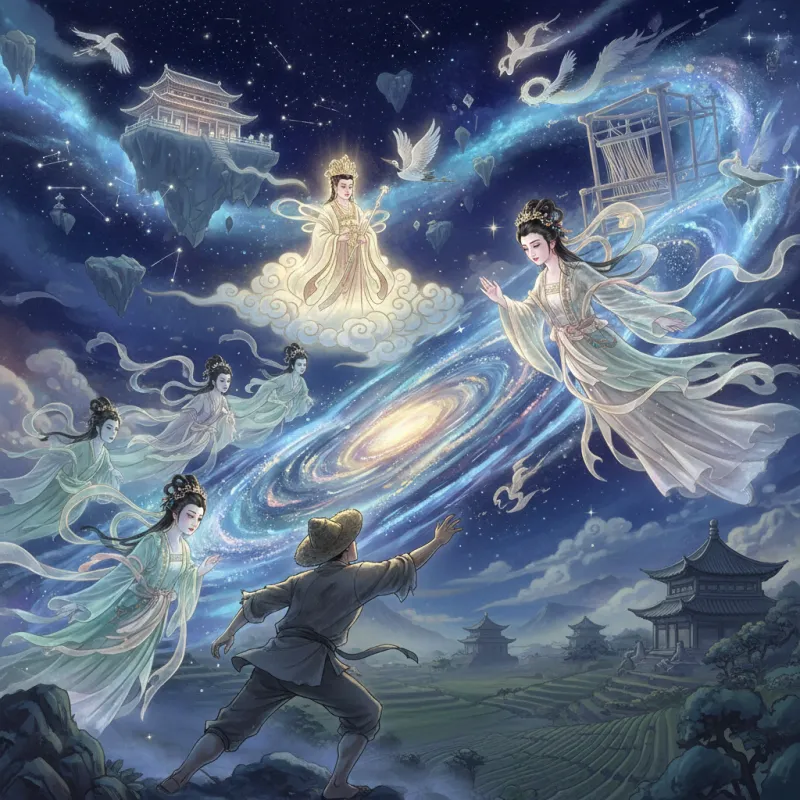
Every year on the seventh day of the seventh lunar month, millions across East Asia gaze upward, searching for two stars separated by the luminous river of the Milky Way. They're not just stargazing—they're witnessing the universe's cruelest love story, one that makes Romeo and Juliet look like they got off easy. At least those two died together. Niulang and Zhinu have been forced apart for over two millennia, allowed to meet just once a year, and their separation wasn't caused by feuding families or bad timing. It was divine punishment for the crime of falling in love.
The Cowherd Who Stole a Goddess
Niulang 牛郎 (Niúláng, literally "Cow Boy") wasn't born into tragedy—he was born into poverty, which in ancient China often amounted to the same thing. Orphaned young and left with nothing but an aging ox, he worked the fields while his elder brother and sister-in-law treated him like an unpaid servant. When they finally kicked him out, all he had was that ox and a plot of land too poor to grow anything but regret.
But this ox was no ordinary beast. It was, in fact, a fallen star—the Taurus constellation itself, banished to earth for some celestial transgression. One day, the ox spoke (because apparently that's just what happens when you're kind to magical cattle) and told Niulang about seven fairy sisters who would descend to bathe in a nearby lake. "Hide the youngest one's robe," the ox advised, "and she won't be able to return to heaven."
Let's pause here. By modern standards, this is deeply problematic—essentially trapping someone by stealing their clothes. But in the logic of Chinese folklore, where fox spirits seduce scholars and dragons demand virgin sacrifices, this counted as a legitimate courtship strategy. The tale reflects its origins in a patriarchal society where marriages were arranged and women had little agency, yet paradoxically, it became one of China's most celebrated love stories.
When Heaven and Earth Collide
The youngest fairy was Zhinü 织女 (Zhīnǚ, "Weaving Girl"), granddaughter of the Queen Mother of the West and heaven's most skilled weaver. Her celestial looms produced the clouds themselves, and her tapestries could capture the essence of seasons. When she emerged from the lake to find her robe missing and Niulang waiting with an awkward smile, she could have called down lightning. Instead, she saw something in this dirt-poor cowherd—perhaps his gentleness, perhaps his loneliness that mirrored her own isolation in heaven's bureaucratic courts.
They married. Not in a grand ceremony, but in the simple way of common folk, with the ox as their only witness. And here's where the story reveals its radical heart: Zhinü chose to stay. She could have demanded her robe back, could have returned to her celestial palace and endless bolts of cloud-silk. Instead, she picked up a mortal hoe and worked the fields beside her husband. They had two children—a boy and a girl—and for a few precious years, they were happy.
The historical context matters here. This tale likely originated during the Han Dynasty (206 BCE – 220 CE), when the stars Vega and Altair were first associated with these lovers. It was a time when Confucian values emphasized duty and hierarchy, yet this story celebrated a woman who abandoned her divine status for love. No wonder it resonated across centuries.
The Queen Mother's Wrath
But heaven keeps meticulous records, and eventually, the Queen Mother of the West—Xiwangmu 西王母 (Xīwángmǔ)—discovered her granddaughter's desertion. The goddess who controlled immortality and cosmic order couldn't tolerate such disorder. She descended in fury, ripped Zhinü from her children's arms, and dragged her back to heaven.
Niulang, desperate and grieving, remembered the ox's final gift. The old beast, knowing its time had come, told Niulang to skin it after death and wear its hide—it would grant him the power to ascend to heaven. So Niulang did something that would horrify modern readers: he skinned his only friend, fashioned the hide into a crude flying apparatus, grabbed his two children in baskets on a shoulder pole, and launched himself into the sky.
He almost made it. He was within reach of Zhinü, their fingers nearly touching, when the Queen Mother pulled out her hairpin and slashed it across the sky. The wound she carved became the Milky Way—the Tianhe 天河 (Tiānhé, "Sky River")—an impassable torrent of stars separating the lovers forever.
The Magpies' Bridge
Here's where the story could have ended in pure tragedy, but Chinese folklore has a soft spot for persistence. The lovers' grief was so profound that it moved even the magpies—those clever, chattering birds that in Chinese culture symbolize joy and good fortune. Every year on the seventh day of the seventh lunar month, magpies from across the world fly up to heaven and form a bridge with their bodies, allowing Niulang and Zhinü to meet for a single night.
This is why the Qixi Festival 七夕节 (Qīxì Jié, "Double Seventh Festival") is celebrated as Chinese Valentine's Day. Young women would pray to Zhinü for skill in weaving and embroidery, while lovers would look to the stars and promise eternal devotion. If it rained on Qixi, people said those were the lovers' tears of joy at reunion—or tears of sorrow at parting, depending on who you asked.
The Story's Many Lives
What makes this tale endure isn't just its romance but its adaptability. During the Tang Dynasty (618-907 CE), poets like Bai Juyi wrote heartrending verses about the separated lovers. The Song Dynasty (960-1279 CE) saw it transformed into opera, with elaborate costumes and acrobatic performances. By the Ming (1368-1644 CE) and Qing (1644-1912 CE) dynasties, it had become so embedded in culture that even illiterate peasants knew every detail.
The story also evolved regionally. In some versions, Niulang is a kind-hearted scholar rather than a cowherd. In others, Zhinü willingly descends to earth, no robe-stealing required. Some tellings emphasize the Queen Mother's cruelty; others suggest she was enforcing necessary cosmic order—after all, what happens when immortals abandon their duties for mortal pleasures?
Modern retellings have tried to "fix" the problematic elements, making the initial meeting more consensual or giving Zhinü more agency. But something gets lost in these sanitized versions. The original tale's power lies partly in its unfairness, in the way it captures how love often means choosing between impossible options, how happiness can be snatched away by forces beyond our control.
What the Stars Still Tell Us
Stand outside on a clear summer night and look up. Vega shines brilliant and blue-white in the constellation Lyra—that's Zhinü at her celestial loom. Across the Milky Way, Altair glows in Aquila, flanked by two smaller stars—Niulang with his children in their baskets. They're 16 light-years apart, which means the light you see from each star left when the other's light was still traveling. Even their starlight can't meet in real-time.
Chinese astronomers identified these stars over 2,000 years ago, weaving mythology and astronomy together in ways that Western science tried to separate. But maybe they understood something we've forgotten: that stories help us navigate not just moral landscapes but literal ones. Sailors used these stars for navigation. Farmers used them to mark seasons. The tale gave cosmic geography human meaning.
The story also reveals deep truths about Chinese cosmology. Heaven isn't a distant paradise but a bureaucratic mirror of earthly dynasties, complete with hierarchies, rules, and punishments. Immortals aren't all-powerful—they're bound by duty and cosmic order. And love, even divine love, must negotiate with authority. This isn't the Christian heaven of eternal bliss; it's a complex realm where even goddesses can be unhappy.
A Bridge of Birds and Hope
What strikes me most about this tale isn't the separation but the bridge. Those magpies didn't have to help. They gained nothing from forming that living span across the stars. Yet they did it anyway, year after year, because they witnessed love that refused to accept impossibility.
Maybe that's the real lesson. Not that love conquers all—clearly it doesn't, or Niulang and Zhinü would be together—but that love inspires others to build bridges. The magpies represent community, compassion, the human impulse to help lovers reunite even when heaven itself says no.
Today, the Qixi Festival has been commercialized, turned into another excuse for flowers and chocolates. But on clear nights, people still look up. They still tell their children about the cowherd and the weaver girl. They still believe, just a little, that somewhere in the vast darkness between stars, two lovers are walking across a bridge of wings, stealing a few precious hours before dawn forces them apart again.
And every year, without fail, the magpies return. That's not just mythology—that's faith in love's endurance, even when the universe itself conspires against it.
Related Reading
- The Legend of the White Snake: A Complete Retelling
- Zhong Kui: The Demon Queller
- Unraveling the Mystique of Chinese Supernatural Folklore and Afterlife Beliefs
- Daoist Exorcism Rituals Explained: How to Kick Out a Demon the Chinese Way
- The Most Famous Chinese Ghost Stories: Tales That Have Haunted a Civilization
Explore Chinese Culture
- Explore ancient mythical creatures
- Explore Daoist exorcism traditions
- Explore Chinese folk beliefs and superstitions