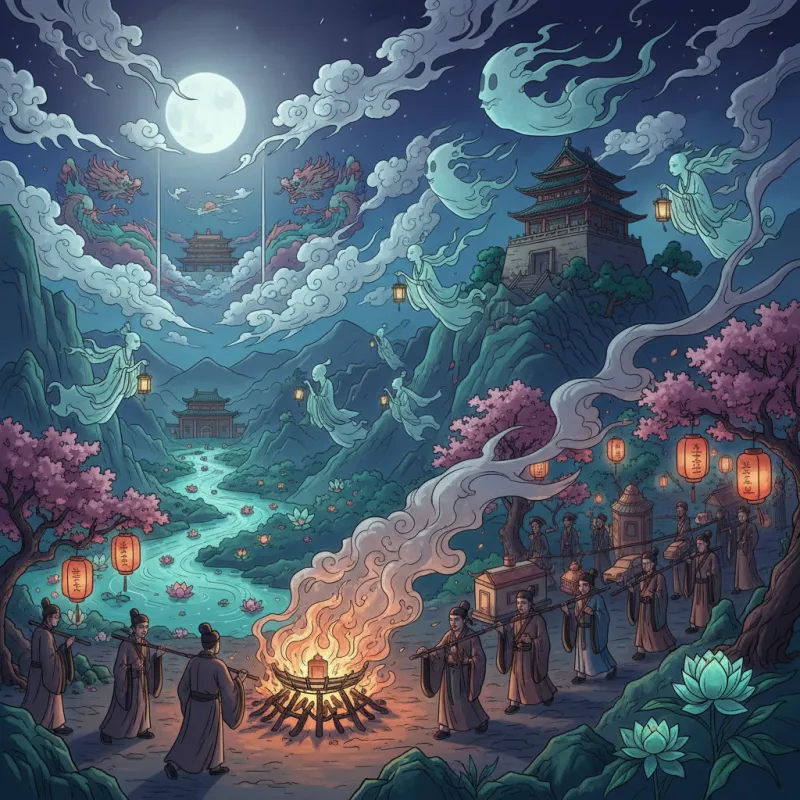
The first time I watched someone burn a paper iPhone for their deceased grandfather, I thought it was a joke. It wasn't. The mourner carefully lit the edges of the meticulously crafted replica, complete with a printed "screen" showing app icons, and explained that grandpa had always wanted to try one. As the flames consumed the offering, I realized I was witnessing something far stranger than any ghost story: the collision of ancient Chinese afterlife economics with modern consumer culture.
Hell Money Runs on Hyperinflation
Chinese funeral customs operate on a premise that would make any Western economist's head spin: the dead need cash, and lots of it. Joss paper (纸钱, zhǐqián) — also called "ghost money" or "spirit money" — gets burned at funerals, during Qingming Festival, and on death anniversaries to ensure the deceased has spending money in the afterlife. But we're not talking about modest sums here.
Modern Hell Bank Notes come printed with denominations that make Zimbabwe's currency crisis look reasonable. Ten billion dollars. Fifty billion. Some notes simply say "unlimited" in the amount field. The Bank of Heaven and Earth, a fictional institution that appears on most joss paper, apparently has no concept of monetary policy. The logic is brutally practical: if you're going to burn money for the dead, why be stingy? Your ancestors need to bribe underworld officials, pay for housing, and maintain their lifestyle. Inflation in the afterlife must be astronomical.
This isn't some modern invention either. The practice dates back to at least the Han Dynasty (206 BCE – 220 CE), though early versions used actual coins or clay replicas. Paper money for the dead became widespread during the Tang Dynasty (618-907 CE), when paper currency itself was still a novelty. The Chinese were burning paper money for ghosts before most of the world even understood the concept of paper money for the living.
Your Afterlife Needs a Smartphone
Walk through any Chinese funeral supply shop today and you'll find yourself in the world's strangest shopping mall. Paper replicas of everything: Mercedes-Benz cars, three-story mansions, Gucci handbags, air conditioners, washing machines, laptops, and yes, the latest iPhone models. All designed to be burned and transmitted to the afterlife.
The evolution of these offerings tells you everything about how Chinese death customs adapt to modernity while maintaining their core logic. In the 1980s, paper televisions and refrigerators became popular. By the 2000s, paper computers and mobile phones. Now you can buy paper credit cards (with high limits, naturally), paper passports for afterlife travel, and even paper servants — though the latter has become controversial for obvious reasons.
Some families go all out. I've heard of funerals where mourners burned paper replicas of the deceased's actual house, complete with furniture. One family in Guangdong made headlines for burning a paper yacht. The message is clear: death shouldn't mean downward mobility.
Western observers often find this practice bizarre or even comical, but it reveals something profound about Chinese attitudes toward death. The afterlife isn't some ethereal spiritual realm divorced from material concerns — it's a continuation of life with its own bureaucracy, economy, and social hierarchy. Your dead grandmother still needs to eat, still wants nice things, and definitely still needs to keep up appearances with the neighbors.
The Underworld Has More Bureaucracy Than the DMV
If you think dealing with government paperwork is bad while alive, Chinese tradition suggests death makes it worse. The afterlife in Chinese belief isn't heaven or hell in the Western sense — it's a vast bureaucratic underworld (地府, dìfǔ) run by officials who make the IRS look friendly.
This is why joss paper money isn't just for spending — it's primarily for bribes. When you die, you face judgment from Yanluo Wang (阎罗王), the King of Hell, and his subordinate judges. These officials review your life's deeds and determine your fate. Having money to smooth things over is considered essential. Think of it as afterlife lobbying.
The bureaucratic nature of the Chinese underworld appears throughout classical literature. In Journey to the West (西游记), the Monkey King famously breaks into the underworld's record office and erases his name from the Book of Life and Death. The scene is played for comedy, but it reveals the underlying assumption: death is an administrative process, and like all administrative processes, it can theoretically be manipulated.
This bureaucratic model also explains why Chinese funerals involve so much paperwork. The deceased receives a "passport" for the afterlife journey, complete with official-looking stamps. Some families burn paper documents showing property deeds, bank statements, and credentials — essentially building a paper trail for the afterlife audit.
Red Envelopes at Funerals (But Don't You Dare Keep Them)
Here's something that shocks Western funeral-goers: guests at Chinese funerals often receive red envelopes (红包, hóngbāo) containing money. In most cultures, money flows toward the bereaved family to help with funeral costs. In Chinese tradition, it flows both ways — and the money you receive comes with strings attached.
The red envelope you get at a funeral typically contains a small, odd amount — maybe $3 or $5. You're expected to spend this money immediately on something trivial, never to save it or bring it home. The purpose is to transfer any bad luck or death energy away from you. Some people buy candy and give it away to strangers. Others buy a cheap meal and throw away the leftovers. The point is to circulate the money away from yourself as quickly as possible.
This practice connects to broader Chinese beliefs about death pollution (丧气, sàngqì). Contact with death, even attending a funeral, temporarily makes you unlucky. The red envelope ritual is one of many cleansing practices. Others include washing your hands with pomelo leaves before entering your home, or avoiding visiting friends' houses for a period after attending a funeral.
The concept of death pollution also explains why Chinese funerals traditionally involve so many color restrictions. White is the color of mourning, and wearing white to a wedding would be a horrific insult — you'd essentially be wishing death on the couple. Red, the color of life and celebration, is forbidden at funerals. These aren't just aesthetic choices; they're part of a complex system of symbolic boundaries between the living and the dead.
The Dead Get Hungry (And Picky About Food)
Food offerings at Chinese funerals and ancestral altars aren't symbolic — they're actual meals for the dead. Families prepare the deceased's favorite dishes, arrange them on the altar, and leave them for a period to allow the spirit to consume the "essence" of the food. Afterward, the living eat the physical food, which is now considered blessed.
But here's where it gets specific: the dead apparently have preferences. Offer the wrong dish, and you might offend your ancestor. Forget to include rice, and they'll go hungry. Some families maintain detailed knowledge of what each deceased relative liked to eat, continuing to prepare those specific dishes for years or decades after death.
During Qingming Festival (清明节, Qīngmíng Jié), families visit graves with elaborate picnics. They're not just commemorating the dead — they're literally having lunch with them. The food gets arranged at the grave, often with chopsticks positioned as if someone is about to eat. Some families pour alcohol on the ground as an offering, or leave cigarettes for deceased relatives who smoked.
This practice connects to the broader Chinese concept of filial piety (孝, xiào) extending beyond death. Your obligations to your parents don't end when they die. You must continue to care for them, feed them, and ensure their comfort in the afterlife. Neglecting these duties isn't just disrespectful — it's dangerous. Hungry ghosts (饿鬼, èguǐ) who aren't properly fed by their descendants can become vengeful and cause problems for the living, as explored in Chinese hungry ghost traditions.
Professional Mourners and Funeral Strippers
In traditional Chinese funerals, the more dramatic the mourning, the better. This led to the practice of hiring professional mourners — people paid to wail, cry, and generally make a scene at funerals. The logic is straightforward: a well-attended funeral with loud, emotional mourning demonstrates the deceased's importance and ensures they receive proper respect in the afterlife.
But modern China has taken this to extremes that would make even traditional practitioners uncomfortable. In some rural areas, particularly in Jiangsu and Zhejiang provinces, families hire funeral strippers to perform at wakes. Yes, you read that correctly. Exotic dancers perform at funerals to attract larger crowds, operating on the theory that a well-attended funeral brings honor to the deceased.
Local governments have repeatedly tried to ban the practice, but it persists in some areas. The cultural logic, twisted as it seems, follows the same principle as professional mourners: more people at your funeral equals more face (面子, miànzi) for your family and better treatment in the afterlife. If hiring strippers brings in the crowds, some families consider it money well spent.
This isn't entirely unprecedented in Chinese tradition. Funerals have long included entertainment — opera performances, musicians, and elaborate processions. The funeral strippers are a vulgar modern mutation of this tradition, but they follow the same underlying principle: death is a public event, and the spectacle matters.
You Can't Bury Someone on a Bad Day
Chinese funerals operate on a strict schedule determined by fortune tellers and almanacs. You can't just bury someone whenever it's convenient — you need to consult the Chinese almanac (通书, tōngshū) to find an auspicious date. Sometimes this means keeping a body for weeks while waiting for the right day.
The burial date must be compatible with the deceased's birth date and the birth dates of close family members. Bury someone on an incompatible date, and you risk bringing misfortune to the entire family. The feng shui (风水, fēngshuǐ) of the burial site matters enormously too. Wealthy families hire feng shui masters to select grave locations that will bring prosperity to descendants.
This belief in the ongoing influence of the dead on the living is fundamental to Chinese death customs. Your ancestors aren't just memories — they're active participants in your life. A well-placed grave can bring business success, healthy children, and good fortune. A poorly placed grave can cause bankruptcy, illness, and disaster. This is why Chinese grave feng shui remains a serious consideration even among otherwise modern, educated families.
The timing extends to every aspect of the funeral. The number of days between death and burial, the hour of the burial, even the direction the body faces — all of these get calculated according to complex formulas. Western funerals typically happen within a week of death. Chinese funerals might wait a month or more for the right cosmic alignment.
The Dead Need to Know Where They're Going
One of the strangest Chinese funeral customs involves creating a detailed "map" for the deceased's journey to the afterlife. Some families burn paper maps showing the route from the mortal world to the underworld. Others hire Taoist priests to perform rituals that guide the soul through the various checkpoints and dangers of the afterlife journey.
This reflects the Chinese conception of death as a journey rather than an instantaneous transition. The soul doesn't immediately arrive in the afterlife — it travels there, facing obstacles and challenges along the way. Without proper guidance, a soul might get lost, become a wandering ghost, or end up in the wrong realm entirely.
The journey typically takes 49 days, during which the family performs regular rituals to help the soul progress. Every seven days marks a checkpoint where the soul faces judgment. The family burns offerings and performs ceremonies to help their deceased relative pass each stage successfully. On the 49th day, the soul finally reaches its destination and settles into the afterlife.
This extended transition period explains why Chinese mourning customs involve such prolonged rituals. You're not just grieving — you're actively helping your deceased relative navigate the afterlife bureaucracy. It's a final act of filial piety, ensuring your parent or grandparent doesn't get stuck in some cosmic waiting room for eternity.
Western observers often find Chinese death customs excessive, superstitious, or bizarre. But they reveal a worldview where death isn't an ending or a transition to some abstract spiritual realm — it's a relocation to a parallel world with its own rules, economy, and social structure. The dead remain part of the family, and the living maintain obligations to them. In this context, burning a paper iPhone for grandpa isn't silly — it's just good manners.
Related Reading
- Chinese Funerals: A Complete Guide to Death Customs and Rituals
- Ancestor Worship: The Living Relationship with the Dead
- Unveiling Chinese Supernatural Folklore: Ghosts, Spirits, and Afterlife Beliefs
- Qingming Festival: When China Visits Its Dead
- Joss Paper: Burning Money for the Dead
- The Chinese Underworld: A Complete Guide to Diyu
- Unveiling the Secrets of Chinese Supernatural Folklore and Afterlife Beliefs
- Spirit Writing: Fuji Divination and Messages from the Gods
Explore Chinese Culture
- Explore ancient mythical creatures
- Explore Daoist exorcism traditions
- Explore Chinese folk beliefs and superstitions