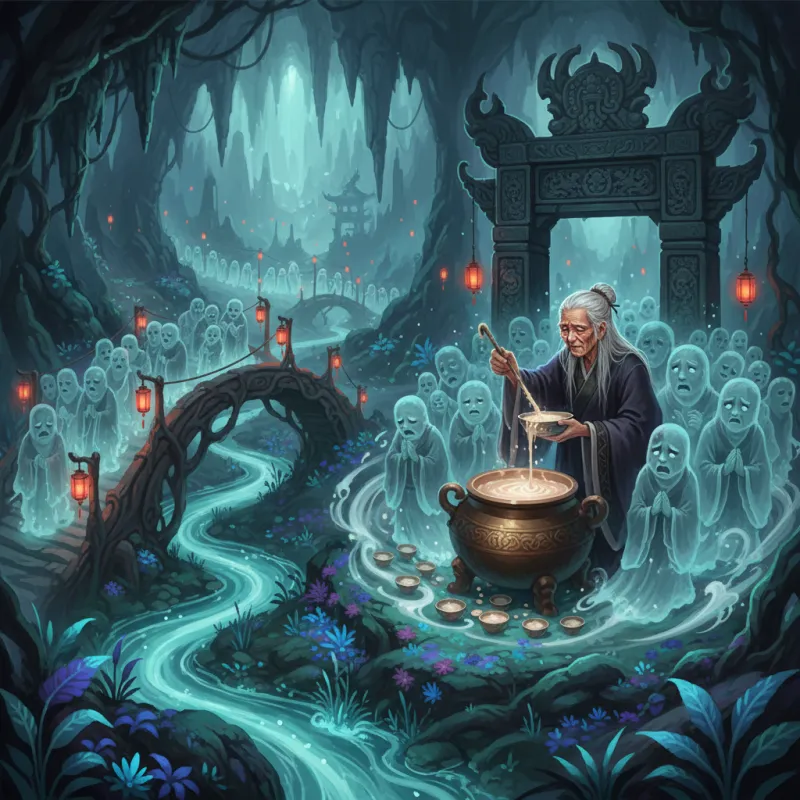
You've lived a full life. You've loved, lost, learned hard lessons, made mistakes you swore you'd never repeat. You've accumulated wisdom, memories, relationships that shaped who you are. And then you die. You pass through the Ten Courts of Hell, endure your punishments, settle your karmic debts. You think the hard part is over. But there's one final station before rebirth: a bridge, an old woman, and a bowl of soup that will erase everything you ever were.
This is Mengpo (孟婆, Mèngpó), and her soup is the most quietly devastating element of Chinese underworld mythology.
The Woman Who Makes You Forget
Mengpo isn't a demon or a judge. She's something stranger — a functionary of forgetting, stationed at the very edge of the underworld where it meets the realm of the living. Her title, Mengpo Niangniang (孟婆娘娘, Mèngpó Niángniáng), marks her as a goddess of sorts, though her role is more bureaucratic than divine.
She sits by the Bridge of Helplessness (奈何桥, Nàihé Qiáo), which spans the River of Forgetfulness (忘川, Wàngchuān). Every soul that has completed their journey through the underworld courts must cross this bridge to reach the Wheel of Reincarnation (轮回, Lúnhuí). But before they cross, they must drink from Mengpo's bowl.
The soup itself — Mengpo Tang (孟婆汤, Mèngpó Tāng) — is described in various texts with unsettling specificity. It's made from five ingredients that correspond to the five flavors: sweet, sour, bitter, spicy, and salty. Some accounts say it's brewed from herbs gathered in the underworld. Others claim it contains tears shed in life — tears of joy, sorrow, regret, and longing. The Jade Record (玉历, Yù Lì), a Qing dynasty text detailing underworld bureaucracy, describes it as having eight distinct tears as ingredients: born, old, sick, dead, parting, resentful meeting, unfulfilled desire, and letting go.
One sip, and your entire existence dissolves. You forget your name, your family, your accomplishments, your failures. The person you spent decades becoming simply ceases to exist in your consciousness.
The Mechanics of Forgetting
What makes Mengpo's soup particularly cruel is its thoroughness. This isn't selective amnesia or a gentle fading of memory. It's complete erasure. The texts are clear on this point: you don't just forget events, you forget yourself. The personality you developed, the preferences you cultivated, the wisdom you earned through suffering — all of it vanishes.
Some souls try to refuse. They beg, they plead, they argue that they need their memories for the next life. Mengpo doesn't argue back. She simply waits. Because here's the thing: you cannot cross the bridge without drinking. The system is absolute. If you refuse, you're stuck in limbo, unable to move forward, unable to go back. Eventually, every soul drinks.
There are stories of souls who tried to outsmart the system. They'd drink the soup but hold some in their mouths, planning to spit it out after crossing. But the Bridge of Helplessness has its own mechanisms. Some versions describe it as narrow and treacherous, causing souls to stumble and swallow. Others say the bridge itself has a guardian who checks each soul, ensuring the forgetting is complete.
The most poignant detail? Some texts claim that if you look back while crossing the bridge, you can catch one final glimpse of your past life — your family, your home, the people you loved. But by then, you've already drunk the soup. You see them, but you don't recognize them. You feel a strange pull, an inexplicable sadness, but you don't know why. Then you cross, and even that fades.
Why Forgetting Matters More Than Punishment
The punishments of the Ten Courts are brutal and specific. Liars get their tongues pulled out. Adulterers are thrown into pools of blood. Corrupt officials are sawed in half. But these punishments are temporary and proportional. They're karmic corrections, not eternal damnation. You suffer, you pay your debt, you move on.
Mengpo's soup is different. It's not punishment — it's policy. And it raises uncomfortable questions about identity and continuity. If you're reborn with no memory of your previous life, in what sense are you the same person? The karma follows you, yes — your next life's circumstances are shaped by your previous actions. But you don't remember making those choices. You inherit consequences without context.
This is why some Buddhist and Daoist practitioners spend their lives trying to achieve enlightenment before death. If you can break free from the cycle of reincarnation entirely, you never have to drink Mengpo's soup. You never have to forget. Your consciousness continues, unbroken, into whatever comes next.
The soup represents the ultimate reset button, but it's a reset you didn't ask for and can't refuse. It's the universe's way of saying: you don't get to keep what you learned. Every life is a fresh start, whether you want one or not.
The Rare Exceptions
Like any good bureaucratic system, there are loopholes and exceptions, though they're vanishingly rare. Some texts mention souls who managed to retain fragments of memory despite drinking the soup. These are usually explained as karmic anomalies — souls with such strong attachments or unfinished business that even Mengpo's brew can't completely erase them.
This is the mythological explanation for child prodigies and people who claim to remember past lives. They're souls who somehow slipped through with their memories partially intact. The Tang dynasty Buddhist text "Records of Rebirth" (转生记, Zhuǎnshēng Jì) documents several cases of children who could describe previous lives in detail, naming family members and locations they couldn't possibly know.
There's also a folk belief that certain powerful cultivators or enlightened beings can refuse the soup entirely. They've achieved such spiritual advancement that they're no longer subject to the standard underworld procedures. They can choose to be reborn with full memory, though most choose not to — carrying the weight of multiple lifetimes of memory is considered a burden few can handle.
The most romantic exception involves the Sansheng Stone (三生石, Sānshēng Shí), or Three Lives Stone, which supposedly stands near Mengpo's station. Souls who are destined to meet again in future lives can have their connection recorded on this stone. They'll still forget everything when they drink the soup, but fate will draw them together again. They won't remember each other, but they'll feel an inexplicable recognition, a sense of having known each other before.
Mengpo in Popular Culture and Modern Interpretation
Modern Chinese fantasy novels and dramas have latched onto Mengpo as a tragic figure. She's often portrayed as someone who has witnessed countless souls pass through, each one forgetting everything, each one starting over. Some versions give her a backstory: she was once human herself, someone who loved so deeply that she volunteered to become the keeper of forgetting, ensuring that others wouldn't carry the pain of loss into their next lives.
The 2017 drama "Eternal Love" (三生三世十里桃花, Sānshēng Sānshì Shílǐ Táohuā) features a scene where the protagonist refuses Mengpo's soup, choosing to carry the pain of her memories rather than forget the person she loves. It's a powerful moment that resonates with modern audiences: the idea that our memories, even painful ones, are what make us who we are.
There's something deeply human about our resistance to Mengpo's soup. We want to believe that what we learn matters, that who we become persists. The idea that it all gets wiped away feels like a cosmic injustice. But maybe that's the point. Maybe the soup is merciful. Maybe carrying the accumulated trauma and regret of multiple lifetimes would be unbearable. Maybe forgetting is the only way to truly start fresh.
The Philosophy of the Blank Slate
Mengpo's soup forces us to confront questions about identity and continuity that Western philosophy has grappled with for centuries. If your memories are erased, are you still you? Is there a core self that persists beyond memory, or are we nothing more than the sum of our experiences?
Chinese philosophy, particularly Buddhism, would argue that the self is an illusion anyway. What we think of as "I" is just a temporary collection of aggregates — form, sensation, perception, mental formations, and consciousness. These aggregates dissolve at death and recombine in new configurations at rebirth. Mengpo's soup just ensures that the illusion of continuity is broken cleanly.
But folk religion tells a different story. The popularity of ancestor worship and the emphasis on filial piety suggest a belief that identity does persist somehow. Your ancestors are still your ancestors, even if they've been reborn. The connections matter, even across the barrier of forgetting.
This tension — between the Buddhist teaching of no-self and the folk belief in persistent identity — is embodied in Mengpo herself. She's the enforcer of forgetting, but she's also a compassionate figure who eases the transition. She doesn't punish; she simply serves the soup and lets you go.
Living With the Knowledge of Forgetting
Here's what makes Mengpo's soup truly haunting: we know about it. We know that everything we're accumulating — every memory, every relationship, every hard-won piece of wisdom — will be erased. We're living with the knowledge of our own future forgetting.
How should that change how we live? Some might say it makes everything meaningless. If we're going to forget anyway, why bother? But the traditional Chinese view is the opposite: it makes this life more precious. These relationships, these experiences, these moments — they're all we have. We won't get to keep them, so we'd better pay attention while they're here.
There's also a practical element. If you believe in karma, your actions in this life shape your next one, even if you won't remember making those choices. You're essentially leaving a gift for your future self — a self who won't know you left it, but will benefit from it nonetheless. It's the ultimate act of faith in continuity despite discontinuity.
The soup also explains why spiritual cultivation matters so much in Chinese religious practice. If you can achieve enlightenment, you escape the cycle entirely. You never have to drink the soup. You never have to forget. Your consciousness continues, unbroken. That's the real prize — not heaven, not paradise, but simply the right to remember who you are.
Mengpo sits at her station, brewing her soup from tears and herbs, waiting for the next soul to arrive. She's been there for eons, and she'll be there for eons more. Every soul that passes through will drink, forget, and cross the bridge. And somewhere on the other side, a baby will be born with no memory of the person they used to be, ready to start the whole process over again.
The bowl is always full. The bridge is always waiting. And Mengpo never runs out of soup.
Related Reading
- How to Avoid Punishment in Chinese Hell: Loopholes, Bribes, and Good Behavior
- The Ten Kings of Hell: A Complete Guide to Chinese Underworld Justice
- The Underworld Courts: How Chinese Hell Judges the Dead
- Ox-Head and Horse-Face: The Messengers of Hell
- Exploring the Depths of Chinese Supernatural Folklore: Ghosts, Spirits, and Afterlife Beliefs
- Chinese Urban Legends: The Ghost Stories Your Taxi Driver Tells
- The Wheel of Reincarnation: How the Chinese Afterlife Recycles Souls
Explore Chinese Culture
- Explore ancient mythical creatures
- Explore Daoist exorcism traditions
- Explore Chinese folk beliefs and superstitions