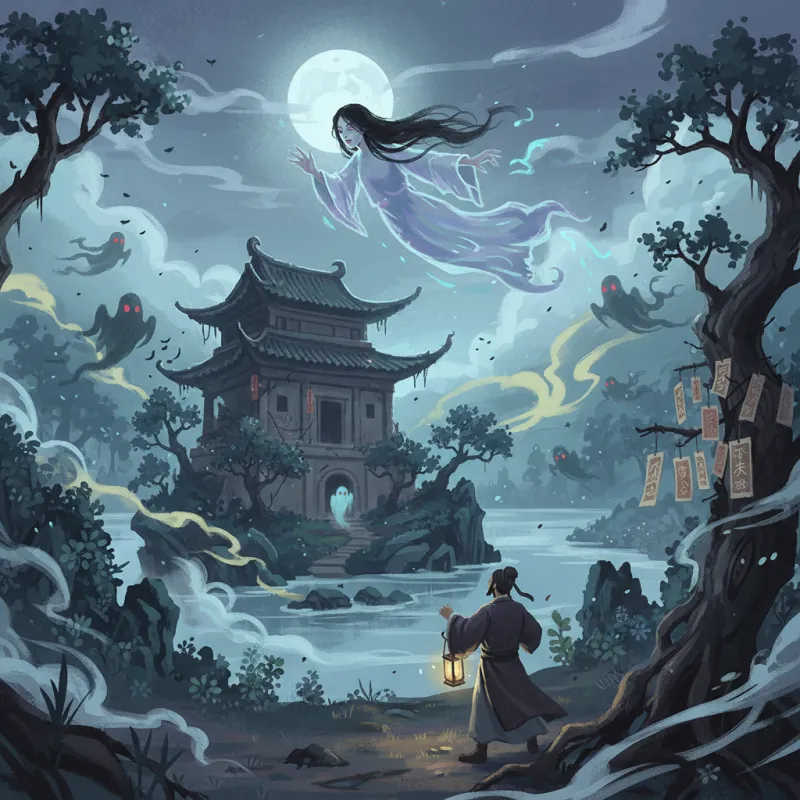
The first time you encounter a Chinese internet ghost story at 2 AM, you'll notice something different from Western creepypasta. There's no Slenderman lurking in pixelated forests, no Jeff the Killer grinning from your screen. Instead, you'll find a woman in a red qipao standing at a crossroads, or a child's voice calling from an empty elevator, or a pale hand reaching from beneath your bed — stories that feel ancient even when they're typed on smartphones. Chinese netizens didn't invent online horror; they digitized a supernatural tradition that's been terrifying people for over two thousand years.
From 聊斋 (Liáozhāi) to Tieba: The Evolution of Chinese Horror
Pu Songling never imagined his 17th-century ghost story collection would inspire millions of forum posts, but here we are. The 聊斋志异 (Liáozhāi Zhìyì, "Strange Tales from a Chinese Studio") established templates that Chinese internet horror still follows: the vengeful female ghost, the fox spirit seductress, the scholar who encounters the supernatural. When Baidu Tieba forums exploded in the mid-2000s, users didn't create new monsters — they remixed the old ones for the digital age.
The transition happened fast. By 2008, Tieba's 鬼故事吧 (Guǐgùshì Ba, "Ghost Story Forum") had millions of members sharing tales that blended traditional Chinese supernatural elements with modern urban settings. A 狐狸精 (húlijīng, fox spirit) might now seduce men through dating apps instead of moonlit gardens. A 僵尸 (jiāngshī, hopping vampire) could be trapped in a subway tunnel rather than a Qing Dynasty tomb. The monsters evolved, but their essential nature — and their ability to terrify — remained intact.
The Big Three: Platforms That Shaped Chinese Digital Horror
Chinese internet ghost stories don't live on a single creepypasta wiki. They're scattered across an ecosystem of platforms, each with its own flavor of fear. Tieba forums remain the old guard, where lengthy serialized stories unfold over hundreds of posts. Writers like "天下霸唱" (Tiānxià Bàchàng) built massive followings by posting chapters of supernatural adventures that would eventually become published novels and hit TV series.
Then came the short-form revolution. Weibo's 140-character limit (later expanded) forced horror writers to distill terror into bite-sized pieces. The "两句话鬼故事" (liǎng jù huà guǐgùshì, "two-sentence horror story") format became wildly popular: "I woke up to see my reflection smiling at me. I wasn't smiling." Simple, effective, shareable. These micro-horrors spread faster than any traditional ghost story ever could.
Douyin and Kuaishou brought video to the mix. Horror narrators with millions of followers read stories over eerie background music and unsettling visuals. Some channels specialize in "真实灵异事件" (zhēnshí língyì shìjiàn, "real supernatural incidents"), blurring the line between fiction and supposed fact. The comment sections become their own horror shows, with users sharing their own encounters and debating whether the stories are real. This participatory element — the collective belief or disbelief — adds a layer of authenticity that Western creepypasta rarely achieves.
The Recurring Nightmares: Common Tropes and Themes
Chinese internet horror has its own vocabulary of fear. The 红衣女鬼 (hóngyī nǚguǐ, red-dressed female ghost) appears constantly, a figure so ubiquitous she's become the Chinese equivalent of the woman in white. Red in Chinese culture signals both celebration and danger — wedding dresses and blood — making it the perfect color for a ghost caught between worlds. These spirits typically died violently, often by suicide or murder, and they're not interested in peaceful resolution. They want revenge, and they're patient.
Elevators feature prominently in modern Chinese horror, which makes sense in a country where hundreds of millions live in high-rise apartments. The "电梯游戏" (diàntī yóuxì, elevator game) — a ritual supposedly allowing access to another dimension — became so popular that apartment buildings posted warnings against attempting it. The game involves pressing buttons in a specific sequence while alone in an elevator at night. If done correctly, you'll arrive at a floor that doesn't exist. If done incorrectly, well, the stories vary on what happens, but none of the outcomes are good.
Mirrors and reflections obsess Chinese internet horror writers, drawing on the traditional belief that mirrors can trap souls or reveal hidden truths. The "镜子游戏" (jìngzi yóuxì, mirror game) involves staring at your reflection in a dark room at midnight. According to the stories, you'll eventually see your true self — or something pretending to be you. This taps into the Chinese concept of 魂魄 (húnpò), the idea that humans have multiple souls that can separate from the body. What if one of those souls is looking back at you from the other side of the glass?
The Blurred Line: "Real" Stories and Collective Belief
Western creepypasta typically acknowledges its fictional nature. Chinese internet ghost stories often don't. The most popular posts begin with phrases like "这是我亲身经历的" (zhè shì wǒ qīnshēn jīnglì de, "this happened to me personally") or "我朋友的朋友遇到的" (wǒ péngyou de péngyou yù dào de, "this happened to a friend of a friend"). This framing isn't necessarily deceptive — it's part of the genre's DNA, inherited from centuries of oral ghost story tradition where the teller always claimed the story was true or happened to someone they knew.
The comment sections reveal the real magic. Thousands of users share similar experiences, building a collective mythology around certain phenomena. A story about a 笔仙 (bǐxiān, "pen spirit" — similar to a Ouija board) will generate hundreds of comments from people claiming they've played the game and encountered something unexplainable. Whether these experiences are genuine, misremembered, or fabricated doesn't matter as much as the shared cultural experience they create. The stories become real through repetition and belief, much like traditional folklore.
This collective participation distinguishes Chinese internet horror from its Western counterpart. Creepypasta tends toward individual authorship and creative fiction. Chinese digital ghost stories function more like living folklore, constantly evolving through community input. A story posted on Tieba might be retold on Weibo with new details, then adapted into a Douyin video with additional elements, each iteration adding layers until the "original" version becomes impossible to identify. This is how folklore has always worked — the internet just accelerated the process.
The Commercial Ghost: When Horror Becomes Industry
Chinese internet ghost stories aren't just entertainment; they're big business. Successful Tieba writers like 南派三叔 (Nánpài Sānshū, "Third Uncle of the Southern Sect") turned their online supernatural serials into the 盗墓笔记 (Dàomù Bǐjì, "Grave Robbers' Chronicles") franchise, spawning novels, films, TV series, and video games worth hundreds of millions of yuan. The line between amateur internet horror and professional supernatural fiction has become nearly invisible.
Dedicated apps like "恐怖故事" (Kǒngbù Gùshì, "Horror Stories") and "午夜凶铃" (Wǔyè Xiōnglíng, "Midnight Ring") aggregate user-generated content alongside professional writers' work. Some apps use AI narration to read stories aloud, creating an endless stream of horror content. Premium subscriptions unlock "exclusive" stories, though the definition of exclusive is loose when users can screenshot and share content across platforms within minutes.
The commercialization hasn't killed the amateur spirit. If anything, it's encouraged more people to write and share stories, hoping to be the next internet horror success story. Thousands of new ghost stories appear daily across Chinese platforms, most receiving little attention, but a few catching fire and spreading across the internet like the vengeful spirits they describe. The democratization of horror storytelling means Chinese internet users have access to more supernatural content than any previous generation — and they're consuming it voraciously.
Why Chinese Internet Horror Hits Different
Chinese digital ghost stories carry cultural weight that Western creepypasta can't replicate. When a Chinese story mentions 头七 (tóuqī, the seventh day after death when the spirit returns home), readers understand the funeral tradition and its emotional significance. When a ghost appears at a 十字路口 (shízì lùkǒu, crossroads), they know crossroads are spiritually dangerous places where the boundaries between worlds thin. This shared cultural knowledge creates a deeper resonance than stories built on invented mythology.
The stories also reflect contemporary Chinese anxieties in ways that feel immediate and relevant. Ghost stories set in 城中村 (chéngzhōngcūn, urban villages) — the liminal spaces between old and new China — tap into fears about rapid modernization and displacement. Stories about 加班 (jiābān, overtime work) culture feature office workers who die at their desks and continue working as ghosts, unable to escape even in death. These aren't just scary stories; they're social commentary wrapped in supernatural packaging.
Perhaps most importantly, Chinese internet horror maintains a connection to traditional beliefs that many Chinese people, even young urbanites, haven't entirely abandoned. A 2019 survey found that over 40% of Chinese millennials believe in ghosts or supernatural phenomena to some degree. When they read internet ghost stories, there's a part of them — however small — that wonders if it might be true. That uncertainty, that possibility of belief, makes the stories more effective than fiction that's clearly fiction. The ghosts feel closer because, culturally, they've never really left.
The Future of Digital 鬼 (Guǐ)
Chinese internet ghost stories aren't going anywhere. If anything, they're evolving faster than ever. Virtual reality horror experiences are becoming popular in Chinese cities, allowing users to "enter" famous ghost stories. AI-generated horror content is emerging, with algorithms learning to write stories that follow traditional Chinese supernatural patterns. The technology changes, but the fundamental human need to tell and hear scary stories remains constant.
The next generation of Chinese internet horror will likely blend traditional elements with new technologies in ways we can't yet predict. Maybe AR apps will overlay ghost stories onto real locations, letting users experience supernatural tales in the actual places they're set. Maybe AI will create personalized horror stories based on users' fears and cultural backgrounds. Whatever form it takes, Chinese digital horror will continue doing what it's always done: taking ancient fears and making them feel immediate, relevant, and terrifying.
The 鬼 (guǐ) went digital decades ago, and they're not logging off anytime soon. They've found a new home in the endless scroll of Chinese social media, in the comment sections and group chats, in the videos that autoplay at midnight when you should be sleeping but can't stop watching just one more story. The ghosts have always been here, waiting in the shadows of Chinese culture. The internet just gave them a bigger audience — and more ways to reach you.
For more on Chinese supernatural traditions, explore The Hungry Ghost Festival and Fox Spirits in Chinese Folklore. If you're interested in how traditional beliefs manifest in modern contexts, check out Chinese Funeral Superstitions.
Related Reading
- Jiangshi: The Hopping Vampire Genre That Conquered Hong Kong Cinema
- The Best Chinese Horror Films: A Genre Guide — Cnspirit Perspective
- Chinese Horror Literature: From Liaozhai to Modern Thrillers
- Chinese Horror Novels and Web Fiction: A Reading Guide
- Unveiling the Secrets of Chinese Supernatural Folklore and Afterlife Beliefs
- The Tongji: Spirit Mediums of Southeast Asia's Chinese Communities
- Fox Spirits: China's Most Famous Shapeshifters
Explore Chinese Culture
- Explore ancient mythical creatures
- Explore Daoist exorcism traditions
- Explore Chinese folk beliefs and superstitions