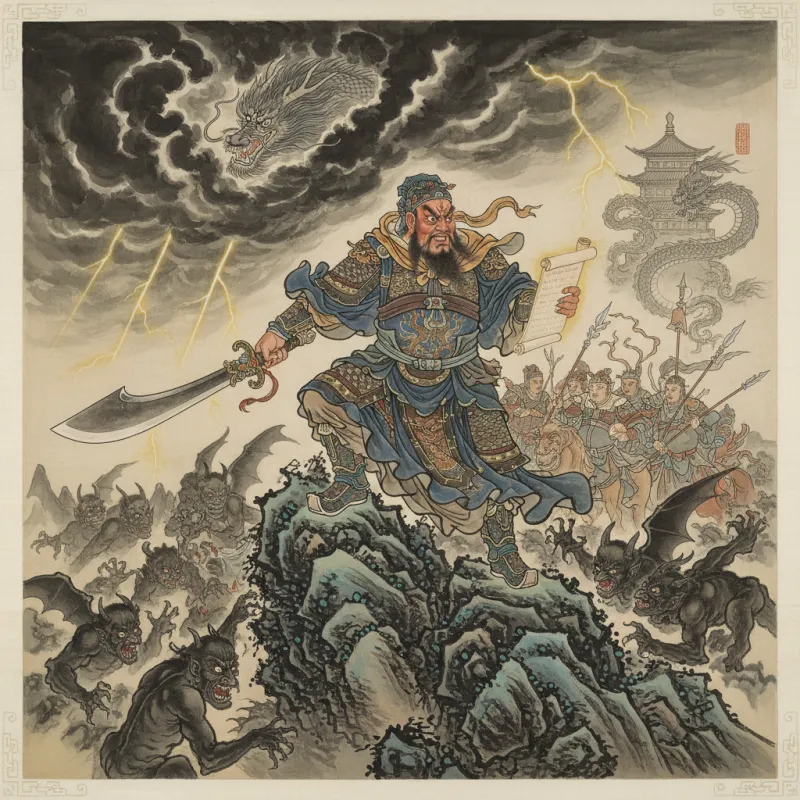
Picture this: You're the smartest person in the entire Tang Dynasty. You've just aced the imperial examinations — the most grueling intellectual gauntlet in human history. The emperor himself is about to name you the top scholar in the land. Then he looks at your face, recoils in disgust, and strips away your honor because you're too ugly to represent the court. What would you do?
Zhong Kui (钟馗, Zhōng Kuí) smashed his own head against the palace steps and died on the spot.
That suicide — born of humiliation, rage, and betrayed merit — transformed an obscure failed scholar into China's most powerful demon hunter. For over a millennium, his fierce, bearded face has glared from doorways during Chinese New Year, his sword raised against evil spirits. He's the patron saint of the wronged, the ugly, and anyone who ever got screwed over by a system that should have rewarded them. And unlike most exorcists and demon hunters who spend years training in temples, Zhong Kui earned his power through pure, concentrated injustice.
The Exam That Killed Him
The story begins during the reign of Emperor Xuanzong of Tang (712-756 CE), though some versions push it back to the Sui Dynasty. Zhong Kui came from Zhongnan Mountain in Shaanxi Province — already a significant detail, since Zhongnan was famous for Daoist hermits and spiritual cultivation. He wasn't some random peasant who got lucky. He was brilliant, dedicated, and had spent years preparing for the imperial examinations (科举, kējǔ).
When the results came in, Zhong Kui had scored first place. The zhuangyuan (状元, zhuàngyuán) — the top scholar — was supposed to be presented to the emperor in a grand ceremony. But when Emperor Xuanzong saw Zhong Kui's face — accounts describe him as having a dark complexion, wild hair, a scraggly beard, and features that were considered frightening or demonic — he was repulsed. Some versions say the emperor thought Zhong Kui looked like a demon himself. Others say court officials pressured the emperor, arguing that such an ugly man would embarrass the dynasty in official portraits.
The emperor stripped Zhong Kui of his title and gave it to the second-place scholar instead.
Zhong Kui didn't argue. He didn't petition. He didn't go home to try again next year. He walked to the palace steps, raised his head, and smashed it down onto the stone with enough force to kill himself instantly. The message was clear: if merit means nothing, if appearance trumps ability, then the system itself is demonic.
The Emperor's Fever Dream
Here's where it gets supernatural. Years later, Emperor Xuanzong fell seriously ill with a fever that wouldn't break. Palace physicians tried everything. Daoist priests performed rituals. Nothing worked. The emperor was dying.
Then, in a fever dream, Xuanzong saw a small demon stealing his jade flute and one of Consort Yang's embroidered pouches — precious items that represented imperial power and personal intimacy. The little demon was dancing around, mocking him, and the emperor was too weak to stop it.
Suddenly, a massive figure appeared — a fierce man in tattered scholar's robes, with a wild beard and bulging eyes. He grabbed the little demon, ripped out its eyeball, and ate it. Then he tore the demon apart and consumed it entirely. The emperor, terrified and fascinated, asked who this savage protector was.
"I am Zhong Kui," the figure said. "I failed to serve you in life because of my appearance. But Your Majesty gave me a proper burial and a posthumous title. In gratitude, I have sworn to rid the world of demons and evil spirits. I will protect you and your empire from all supernatural threats."
The emperor woke up. His fever was gone. He immediately summoned the court painter Wu Daozi (吴道子, Wú Dàozǐ) — one of the greatest artists in Chinese history — and described the vision in detail. Wu Daozi painted Zhong Kui exactly as the emperor described: fierce, ugly, powerful, dressed in scholar's robes, holding a sword, with a demon crushed beneath his foot.
That painting became the template for every Zhong Kui image that followed.
Why Ugliness Became Power
There's something deeply subversive about Zhong Kui's story. In Chinese culture, physical appearance was often seen as reflecting inner virtue — the idea that a noble soul would manifest in a handsome face. Confucian texts emphasized proper appearance and bearing. Imperial portraits showed emperors as dignified and beautiful. The whole system was built on the assumption that outer beauty and inner worth aligned.
Zhong Kui shattered that assumption. His ugliness became his strength. The very features that disqualified him from human society made him perfect for dealing with demons. He looked like a demon, so demons couldn't intimidate him. He'd already been treated as monstrous by the people who should have honored him, so he had nothing left to lose and no reason to play by their rules.
This is why Zhong Kui resonated so powerfully with common people. Everyone who'd been passed over for a job because of their looks, everyone who'd been judged unfairly, everyone who'd done everything right and still got screwed — they saw themselves in Zhong Kui. He was proof that the system was broken, and that sometimes the broken ones are the only ones who can fix things.
Compare this to other demon hunters in Chinese tradition. Daoist exorcists spent decades learning rituals and cultivating spiritual power. Buddhist monks achieved demon-fighting abilities through meditation and merit. But Zhong Kui? He got his power from suicide and imperial guilt. It's almost punk rock.
The Iconography of Righteous Rage
Walk through any traditional Chinese neighborhood during Spring Festival, and you'll see Zhong Kui's face on doors, walls, and gates. The standard image shows him in several variations:
Zhong Kui Traveling (钟馗出行, Zhōng Kuí Chūxíng): He's shown walking with a retinue of small demons who now serve him. Some carry his belongings, some hold umbrellas, some play musical instruments. The message is clear — even demons submit to his authority.
Zhong Kui Marrying Off His Sister (钟馗嫁妹, Zhōng Kuí Jià Mèi): A popular theme in paintings and opera. Despite his ugliness and supernatural status, Zhong Kui is shown as a caring brother who arranges a proper marriage for his sister. This humanizes him and emphasizes that he's not a demon himself — he's a righteous man who fights demons.
Zhong Kui Hunting Demons (钟馗捉鬼, Zhōng Kuí Zhuō Guǐ): The most common version. He's shown with his sword raised, stepping on or grabbing a demon, his face twisted in righteous fury. Sometimes he's accompanied by a bat (蝠, fú), which sounds like "fortune" (福, fú) in Chinese — a visual pun suggesting he brings good luck by removing evil.
The sword he carries isn't just any weapon. It's described as a demon-slaying sword (斩妖剑, zhǎn yāo jiàn) that can cut through supernatural flesh. Some versions say it was given to him by the emperor posthumously. Others say he forged it himself in the underworld. Either way, it's become as iconic as Zhong Kui himself.
From Tang Dynasty to Modern Media
Zhong Kui's influence spread far beyond door paintings. He became a major figure in Chinese opera, particularly in plays performed during the Ghost Festival (中元节, Zhōngyuán Jié). Actors playing Zhong Kui would wear elaborate makeup emphasizing his fierce features — bulging eyes, wild beard, dark complexion. The role required both martial skill and dramatic presence.
In literature, Zhong Kui appears in countless stories and novels. The Ming Dynasty collection "Stories to Caution the World" (警世通言, Jǐngshì Tōngyán) includes tales of Zhong Kui intervening to save people from supernatural threats. Qing Dynasty scholars wrote poems about him, often using him as a symbol of unrecognized merit and righteous anger.
Modern adaptations have taken Zhong Kui in fascinating directions. Hong Kong films in the 1980s and 90s featured him as a supernatural detective. Video games like "Onmyoji" and "Honor of Kings" include him as a playable character. Taiwanese puppet theater (布袋戏, bùdàixì) has elaborate Zhong Kui storylines. Japanese culture adopted him as Shōki, with similar demon-quelling functions.
What's remarkable is how consistent his core characterization remains: ugly, brilliant, wronged by the system, and absolutely merciless toward evil. Whether he's in a Tang Dynasty painting or a 21st-century mobile game, Zhong Kui is always recognizable.
The Demon Who Hunts Demons
There's a philosophical tension at the heart of Zhong Kui's story that's never quite resolved. He looks like a demon. He acts with demonic violence — ripping out eyes, tearing apart spirits, consuming supernatural flesh. He exists in a liminal space between the human world and the spirit realm. So what makes him different from the demons he hunts?
The answer, according to Chinese tradition, is intent and authorization. Zhong Kui serves the emperor and protects humanity. His violence is directed outward, against threats to social order. He's not acting out of personal malice or hunger — he's fulfilling a duty. The emperor's posthumous title and proper burial gave him legitimacy. His suicide, while tragic, was an act of protest against injustice, not a selfish escape.
But there's always been an undercurrent of ambiguity. Some folk tales suggest Zhong Kui is a bit too enthusiastic about his demon-hunting. He enjoys it. He's not just protecting people — he's getting revenge on a world that rejected him. This makes him more interesting than a simple hero. He's complicated, angry, and possibly dangerous even to those he protects.
This ambiguity is why Zhong Kui works so well as a protective figure. He's not a gentle guardian. He's not going to comfort you or offer wisdom. He's going to absolutely destroy anything that threatens you, and he's going to enjoy doing it. Sometimes that's exactly what you need.
Why We Still Need Him
In an age of smartphones and skyscrapers, why do Chinese families still hang Zhong Kui's image on their doors? Why does his story still resonate?
Because the injustice he represents never went away. People still get passed over for promotions because of their appearance. Brilliant students still get rejected from opportunities because they don't fit the image. The system still rewards presentation over substance. Zhong Kui's rage is as relevant now as it was in the Tang Dynasty.
But there's also something deeper. Zhong Kui represents the idea that your worst qualities — the things that make you unacceptable to polite society — might actually be your greatest strengths. His ugliness made him powerful. His outsider status made him effective. His death made him immortal.
In a culture that often emphasizes conformity and proper behavior, Zhong Kui is a reminder that sometimes the misfits are the ones who get things done. Sometimes the people who don't fit in are the only ones who can see clearly enough to fight the real demons.
And in a world full of demons — both supernatural and metaphorical — we could all use a protector who's too angry to quit and too ugly to care what anyone thinks.
Related Reading
- Modern Exorcism in Chinese Communities: When Ancient Rituals Meet the 21st Century
- Daoist Exorcism Rituals Explained: How to Kick Out a Demon the Chinese Way
- Exorcism in Chinese Culture: How to Get Rid of Ghosts (According to Tradition)
- Talismans and Fu: The Ancient Art of Paper Magic
- Unveiling the Mysteries of Chinese Supernatural Folklore: Ghosts, Spirits, and Afterlife Beliefs
- Chinese Urban Legends: The Ghost Stories Your Taxi Driver Tells
- Spirit Writing: Fuji Divination and Messages from the Gods
Explore Chinese Culture
- Explore ancient mythical creatures
- Explore Daoist exorcism traditions
- Explore Chinese folk beliefs and superstitions