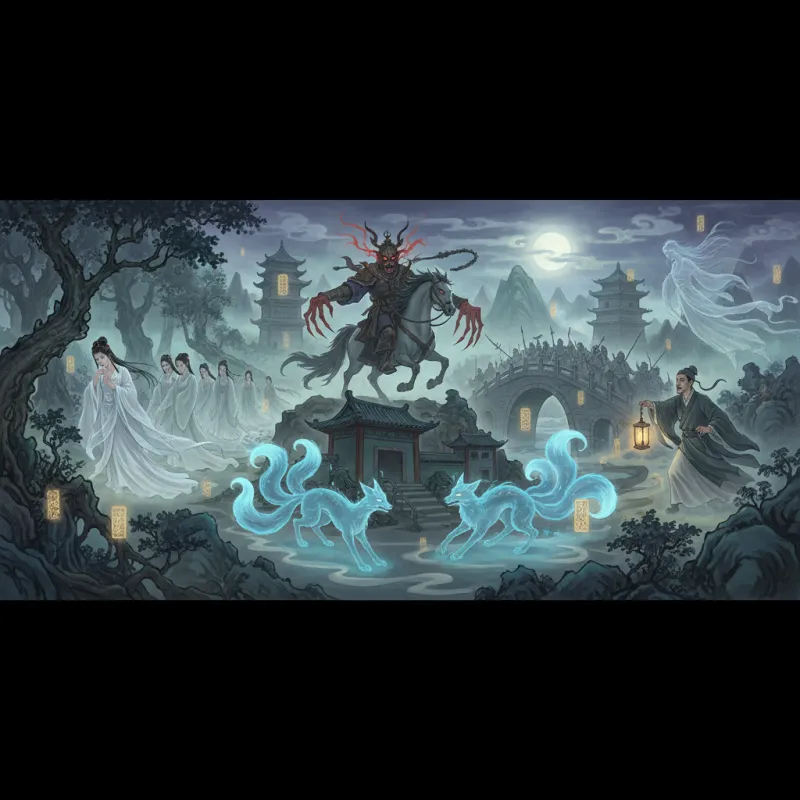
Picture this: A scholar walks home through a moonlit bamboo grove. A beautiful woman appears, asking for directions. He helps her. They talk. She's charming, educated, cultured. They meet again the next night. And the next. Within a week, they're lovers. Within a month, he's wasting away, his skin pale as rice paper, his eyes sunken. His family calls a Taoist priest, who takes one look and says: "That's not a woman. That's a fox spirit draining your life force." The scholar doesn't believe it — until the priest throws a handful of millet at his beloved and she transforms mid-sentence into a white fox and bolts into the forest.
This is how Chinese ghost stories work. They don't just want to scare you. They want to seduce you, confuse you, make you question what's real and what matters. Chinese supernatural tales are morally slippery in ways that Western ghost stories rarely attempt. The ghost might be the hero. The living human might be the villain. The demon might teach you Buddhism. The exorcist might be a fraud. Nothing is simple, and that's the point.
The Painted Skin: When Beauty Hides Horror
The most viscerally terrifying story in Chinese literature might be "The Painted Skin" (画皮, Huàpí) from Pu Songling's Strange Tales from a Chinese Studio. A scholar named Wang meets a beautiful young woman fleeing an abusive household. Naturally, he takes her home and hides her in his study. His wife is suspicious. A wandering Taoist priest is horrified: "That's a demon wearing a human skin like a coat."
Wang doesn't listen — until one day he peeks through a crack in the door and sees the "woman" sitting at a table, painting a human face on a piece of skin stretched across her lap. She hangs the skin on the wall like a dress, then reveals her true form: a hideous green-faced demon with jagged teeth. She puts on the painted skin like a mask, and instantly becomes beautiful again.
The demon kills Wang, rips out his heart, and eats it. The Taoist priest eventually defeats her, but only after Wang's devoted wife humiliates herself by begging a mad beggar for help — who makes her swallow a ball of phlegm that he coughs up, which somehow contains Wang's heart and brings him back to life.
The story works because it's not really about demons. It's about vanity, lust, and the willingness of men to ignore obvious warning signs when a beautiful woman is involved. The demon is almost beside the point. The real horror is Wang's stupidity.
Nie Xiaoqian: The Ghost Who Didn't Want to Kill You
If "The Painted Skin" is about deception, "Nie Xiaoqian" (聂小倩, Niè Xiǎoqiàn) is about redemption. Also from Strange Tales, this story gave us one of Chinese culture's most enduring ghost characters — a young woman forced by a tree demon to seduce and kill travelers.
Ning Caichen (宁采臣, Níng Cǎichén), a poor scholar, stays at an abandoned temple. Xiaoqian appears, tries to seduce him, but finds him genuinely kind and morally upright. She can't go through with the murder. Instead, she warns him: "I'm a ghost. I'm supposed to kill you. Please leave." He refuses to abandon her. She falls in love with him for real.
The tree demon who controls her is furious and sends other ghosts to kill Ning. He's saved by a wandering swordsman named Yan Chixia (燕赤霞, Yàn Chìxiá), a gruff Buddhist warrior who fights demons with sword techniques and sutra recitations. Together, they destroy the tree demon and free Xiaoqian, who becomes Ning's wife — a ghost married to a living man, which is apparently fine in Chinese supernatural logic.
This story has been adapted into countless films, TV shows, and operas. The 1987 Hong Kong film "A Chinese Ghost Story" turned it into a wire-fu fantasy romance that defined a generation of Asian cinema. But the original tale is quieter and stranger: a ghost who retains her humanity despite being dead, and a man who sees past the supernatural to the person underneath.
The Peony Pavilion: Dying for Love, Then Coming Back
Tang Xianzu's (汤显祖, Tāng Xiǎnzǔ) 1598 opera "The Peony Pavilion" (牡丹亭, Mǔdān Tíng) takes the ghost-romance concept to its logical extreme: What if the ghost is the protagonist, and death is just an inconvenient plot point?
Du Liniang (杜丽娘, Dù Lìniáng), a sheltered 16-year-old girl, dreams of a beautiful garden and a handsome scholar. She wakes up, realizes her real life will never match the dream, and literally dies of lovesickness. Three years later, the scholar from her dream — Liu Mengmei (柳梦梅, Liǔ Mèngméi) — actually shows up, finds her portrait, and falls in love with it. Her ghost appears, they have an affair, and she loves him so intensely that she comes back to life.
Her father, a rigid Confucian official, refuses to believe his daughter could resurrect herself for love. He has Liu arrested for grave robbery and necrophilia. It takes an imperial decree to sort out the mess.
"The Peony Pavilion" is a 55-scene, 20-hour opera that's still performed today. It's about the conflict between passion and propriety, between individual desire and social duty. The ghost element isn't horror — it's a metaphor for how love transcends death, social class, and even reality itself. Chinese ghost stories do this constantly: use the supernatural as a lens to examine very human problems.
Madame White Snake: The Demon Who Became a Saint
The legend of the White Snake (白蛇传, Báishé Zhuàn) is probably the most famous Chinese supernatural tale that isn't primarily a ghost story — it's about a snake demon who transforms into a woman. But it belongs in any discussion of Chinese supernatural fiction because it's the ultimate example of moral ambiguity.
Bai Suzhen (白素贞, Bái Sùzhēn), a white snake who has cultivated herself for a thousand years, takes human form and marries Xu Xian (许仙, Xǔ Xiān), a gentle pharmacist. They're happy. She uses her powers to help people. She's a better person than most humans.
Enter Fahai (法海, Fǎhǎi), a Buddhist monk who sees a demon and decides she must be destroyed, regardless of her actions. He tricks Xu Xian into giving his wife realgar wine during the Dragon Boat Festival, which forces her to reveal her true snake form. Xu Xian dies of fright. Bai Suzhen travels to the heavens, steals an immortality herb, and brings him back to life.
Fahai imprisons her under Leifeng Pagoda (雷峰塔, Léifēng Tǎ) for the crime of being a demon who dared to love a human. She stays there for 20 years until her son, now a successful scholar, passes the imperial examinations and earns the right to free her.
Modern retellings increasingly portray Fahai as the villain — a rigid fundamentalist who can't accept that a demon might be more compassionate than a monk. The story asks: What makes someone good? Their nature or their actions? If a demon acts with love and a monk acts with cruelty, who's the real monster?
The Butterfly Lovers: Romeo and Juliet, But They Turn Into Butterflies
"The Butterfly Lovers" (梁山伯与祝英台, Liáng Shānbó yǔ Zhù Yīngtái) is China's most famous tragic romance, and while it's not exactly a ghost story, it ends with supernatural transformation, which is close enough.
Zhu Yingtai disguises herself as a man to attend school (women couldn't get formal education in ancient China). She becomes best friends with Liang Shanbo, a sweet, oblivious scholar who doesn't realize she's a woman for three years. When he finally figures it out and proposes, her family has already arranged her marriage to a wealthy man.
Liang dies of heartbreak. On the way to her forced wedding, Zhu stops at his grave to pay respects. The tomb splits open. She jumps in. They emerge as a pair of butterflies and fly away together.
The story has been retold in every Chinese art form: opera, film, ballet, pop songs. It's a protest against arranged marriage, against the Confucian system that valued family duty over individual happiness. The supernatural ending isn't just romantic — it's a middle finger to the social order. You can force people to obey in life, but you can't control what they become after death.
Why Chinese Ghost Stories Hit Different
Western ghost stories, especially in the Gothic tradition, tend to be about fear, guilt, and the past refusing to stay buried. Chinese ghost stories are about desire, justice, and the porousness of the boundary between life and death. Ghosts in Chinese literature aren't always scary. They're often sympathetic, sometimes more moral than the living characters, and frequently get happy endings.
This reflects deeper cultural differences. Chinese cosmology doesn't have a hard line between the natural and supernatural. The spirit world and the human world overlap constantly. Ghosts aren't aberrations — they're just people in a different state of being. They can be reasoned with, fall in love, hold grudges, seek revenge, or help the living. They're subject to bureaucracy (the underworld has courts and officials). They can be bribed, tricked, or defeated with the right rituals.
The best Chinese ghost stories use the supernatural to critique social problems: corrupt officials, arranged marriages, rigid moral codes, the oppression of women. Pu Songling's Strange Tales is full of fox spirits who are more loyal than human wives, and ghosts who are more honest than living scholars. The message is clear: being human doesn't make you good, and being a ghost doesn't make you evil.
The Legacy: From Classical Tales to Modern Horror
These stories aren't museum pieces. They're still being adapted, reinterpreted, and reimagined. "A Chinese Ghost Story" spawned multiple sequels and a 2011 remake. "The Painted Skin" became a big-budget 2008 film and a 2012 sequel. "Madame White Snake" has been adapted into TV series, animated films, and even a 2019 Chinese-American animated feature.
Modern Chinese horror films like "The Eye" (2002) and "Rigor Mortis" (2013) draw on the same tradition: ghosts with complex motivations, supernatural events with moral dimensions, and the sense that the spirit world is always just one thin veil away from our own. The ghost stories from the Three Kingdoms period established many of these tropes, and they've remained remarkably consistent across centuries.
What makes these stories endure isn't just that they're scary or romantic or morally complex — though they're all of those things. It's that they take the supernatural seriously as a way to explore what it means to be human. They ask: If a ghost can love more deeply than a living person, what does that say about love? If a demon can be more compassionate than a monk, what does that say about morality? If death is just another state of being, what does that say about how we should live?
These aren't just ghost stories. They're arguments about justice, desire, duty, and the price of being human in a world where the supernatural is always watching, judging, and occasionally falling in love with you.
Related Reading
- Campus Ghost Stories in China: The Haunted Dormitories and Cursed Libraries
- Ghost Month: Surviving the Seventh Month
- Ghost Stories from Chinese Folklore: Tales That Will Keep You Awake
- Daoist Exorcism Rituals Explained: How to Kick Out a Demon the Chinese Way
- River Gods and Water Deities in Chinese Mythology
- Exploring Chinese Supernatural Folklore: Ghosts, Spirits, and Afterlife Beliefs
Explore Chinese Culture
- Explore ancient mythical creatures
- Explore Daoist exorcism traditions
- Explore Chinese folk beliefs and superstitions